If you’ve ever looked at your cat and realised they’re essentially a furry landlord who doesn’t pay rent, you’re not far off the mark.

They don’t see themselves as pets in the way dogs do; to a cat, the house is their territory, and you’re just the slightly clumsy, oversized roommate who’s remarkably good at opening tins. It’s not just that they’re smug, either. It’s hardwired into their DNA to treat their environment like a kingdom they need to patrol, which is why they get so offended if you dare to close a bedroom door or move their favourite chair. They’re not purposely being furry little balls of trouble; they honestly believe that since they’ve marked the place with their scent, they’re the ones in charge of the floor plan.
Cats were never fully domesticated the way dogs were.

Dogs have been selectively bred over thousands of years to work with humans, follow instructions, and treat people as the leader of the group. Cats took a much more independent route into domestic life, essentially choosing to hang around human settlements because it suited them, and that fundamental difference in how the relationship started still shows up in how they behave today. Your cat isn’t being awkward, it’s just never been hardwired to see you as the one in charge.
They control access to resources, which is a classic power move.

In animal behaviour terms, whoever controls resources tends to hold the power, and cats are surprisingly good at flipping this around in a domestic setting. They demand food on their schedule, decide when they want attention and when they don’t, and will often ignore you completely until they need something, at which point they become extremely insistent. From their perspective, they trained you to respond to their signals rather than the other way around, and they’re not entirely wrong.
They mark everything as theirs, including you.
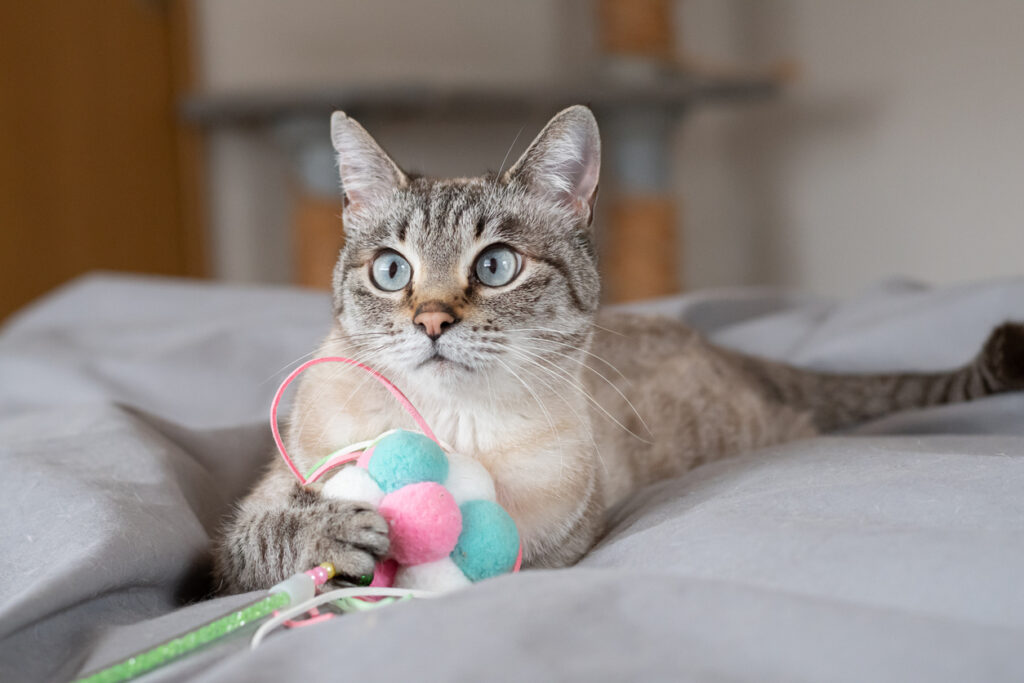
When a cat rubs its face against your leg, your furniture, or your laptop while you’re trying to work, it’s depositing scent from glands on its cheeks and marking those things as part of its territory. Your cat isn’t being affectionate in the way you might assume, it’s claiming ownership, and the whole house is included in that claim. The fact that you’ve paid the mortgage on the building is not information your cat has or would particularly care about.
They choose where everyone sleeps.

The cat decides which part of the bed is theirs, and that decision tends to expand gradually over time until you’re clinging to a six-inch strip of mattress trying not to disturb them. Moving a sleeping cat is theoretically possible but comes with consequences, either a reproachful stare or they just come straight back, and most people eventually give up and rearrange themselves around the cat instead. That’s not a coincidence, it’s a negotiation the cat has been winning for years.
They don’t respond to their name the way dogs do.

Research has confirmed that cats do actually recognise their own names, they just frequently choose not to respond, which is quite different from not knowing. A dog hearing its name will typically look up and come over because it’s been shaped to associate the sound with positive interaction and instruction. A cat hearing its name will often do a slow blink, twitch an ear, and carry on with whatever it was doing because responding is optional, and it knows it.
They maintain eye contact as a dominance signal.

In cat communication, a direct unbroken stare is not a friendly look, it’s a challenge, and cats use it deliberately with other cats to establish who holds the higher ground. When your cat stares at you across a room without blinking, it’s not a loving gaze, it’s a fairly confident display of social status. The slow blink, on the other hand, is genuinely a sign of trust and relaxation, so if your cat does that at you, you’re at least on good terms even if you’re still not in charge.
They decide when interaction starts and when it ends.

You can try to pick up a cat that doesn’t want to be picked up and you’ll quickly find out how that goes. Cats initiate contact on their own terms, approach when they feel like it, and leave the moment they’re done, often mid-stroke, with absolutely no negotiation. Attempting to extend an interaction past the point a cat has decided it’s finished is one of the fastest ways to get scratched, and the cat will feel entirely justified about it.
They use vocalisation to manage your behaviour.

Adult cats don’t meow at each other, they developed that particular communication specifically for interacting with humans, which means every meow your cat produces is essentially aimed at getting you to do something. Different cats develop different vocal strategies for different outcomes, a short chirp for food, a drawn-out yowl for a door to be opened, a persistent trill for attention, and most owners learn to respond to each one without really noticing they’ve been trained to do so.
They patrol the house on a schedule you weren’t consulted about.

Cats are territorial animals and most of them conduct regular inspections of their domain, checking rooms, looking out of windows, and monitoring for any changes or intrusions. This patrol happens regardless of what you’re doing or whether it’s the middle of the night because the schedule is the cat’s and the house is the cat’s, and your presence is part of the landscape rather than a factor in the decision-making. You’ll know when the patrol is happening because it typically involves walking across you.
They punish unwanted behaviour quite effectively.

Cats are remarkably good at expressing displeasure in ways that get results, whether that’s knocking things off surfaces, scratching furniture, ignoring you pointedly, or placing a dead mouse somewhere significant. Most owners modify their behaviour to avoid these responses without really registering that they’re doing it, which means the cat has successfully shaped how you act in your own home. That’s a fairly sophisticated level of household management from an animal that weighs four kilograms.
They sleep in the best spots as a matter of principle.

Whichever chair gets the most sun, whichever cushion is the softest, whichever surface is the most inconveniently placed for whatever you’re trying to do, that’s where the cat will be. This isn’t random, cats in multi-cat households often sort themselves into a hierarchy partly based on who gets the best resting spots, and your cat is applying that same logic to the shared space it occupies with you. It has assessed the premium locations and claimed them, and you were not part of that conversation.
They ignore rules selectively and consistently.

Most cat owners have attempted to keep a cat off a particular surface, out of a particular room, or away from a particular piece of furniture, and most cat owners have failed. Cats learn quickly what you don’t want them to do and will often do it anyway, particularly when they think you’re not watching, which suggests they understand the rule perfectly well and have decided it doesn’t apply to them. A cat that jumps off the counter the moment you walk in and jumps straight back up when you leave isn’t confused, it’s negotiating.
They use physical proximity to assert presence.

A cat that sits directly on your keyboard, plants itself between you and the television, or positions itself squarely in the middle of whatever you’re trying to read is not doing this by accident. Inserting themselves into your focus is a way of redirecting attention toward themselves and away from whatever held it, and it works essentially every time. The cat has figured out that your attention is a resource, and it would prefer that resource to be pointed at them.
They have no concept of your authority.

You can’t discipline a cat the way you might train a dog, because cats don’t have the same social framework that makes hierarchy and correction meaningful. Telling a cat off doesn’t register as authority, it registers as an interesting noise or a mild inconvenience, and they’ll usually resume the behaviour within minutes. Their social world doesn’t include a concept of submitting to a higher-ranking human, so any dominance you think you’re asserting is largely invisible to them.
They outlast you in any stand-off.

Cats are extraordinarily patient when they want something and will sit and stare at a cupboard, a closed door, or your face at 5am for longer than any reasonable person can hold out. Most humans eventually cave, open the door, get up, or give the treat, and the cat notes this as a successful outcome and applies the same strategy next time. The cat isn’t being stubborn, it’s just operating on a longer timeline than you are, and it knows from experience that persistence works.
Honestly, most owners wouldn’t have it any other way.

Despite all of this, cat ownership remains enormously popular, and most people who live with cats are quietly charmed by the dynamic rather than genuinely bothered by it. There’s something genuinely enjoyable about an animal that has strong opinions, clear preferences, and absolutely no interest in pretending otherwise, and the moments when a cat chooses to show affection feel more meaningful precisely because they weren’t demanded. The cat knows it’s the boss, you know it’s the boss, and the whole arrangement works surprisingly well on that basis.