Every autumn, when flocks of geese sweep across the sky, their V-shaped formation is hard to miss.

It looks deliberate, almost mathematical, and it turns out, it is. That graceful pattern isn’t just for show; it’s one of nature’s most efficient team strategies. Flying in a V helps geese conserve energy, communicate more easily, and stay organised over enormous distances.
Each bird benefits from the air currents created by the one in front, taking turns leading to share the workload. Scientists have spent years studying this phenomenon, and the more they learn, the more it reveals about cooperation, endurance, and instinct in the animal world.
The bird in front creates an updraft for the ones behind.

When a goose flaps its wings, it pushes air down and back, which creates an upward air current just behind and to the side of it. The geese flying in those spots get a free lift from this updraft, meaning they don’t have to work as hard to stay airborne. It’s like cycling behind someone else to use their slipstream. Each bird benefits from the one in front, making the whole journey less exhausting for everyone except the leader.
Flying in formation saves massive amounts of energy.

Scientists have calculated that geese flying in a V formation can travel about 70% further than a lone goose using the same amount of energy. That’s a huge advantage when you’re migrating thousands of miles. By positioning themselves to catch the updraft from the bird ahead, each goose reduces the amount of effort needed to fly. Over long distances, this energy saving is the difference between making it to their destination or not.
The lead position rotates so no single bird gets exhausted.

Being at the front of the V is the hardest job because that goose doesn’t get any help from updrafts. They’re breaking through the air resistance for everyone else. So geese take turns leading. When the front bird gets tired, it drops back into the formation and another goose moves up to take over. This rotation system means the workload is shared fairly, and no single bird gets completely knackered.
They can see each other clearly in this formation.

The V shape means every goose has a clear view of the birds ahead and to the side. If they were bunched together in a blob, half of them wouldn’t be able to see where they’re going or keep track of the flock. The V formation gives them maximum visibility, which is crucial for coordination. They can spot predators more easily and keep track of which direction the flock is heading without losing sight of each other.
The honking is constant communication.
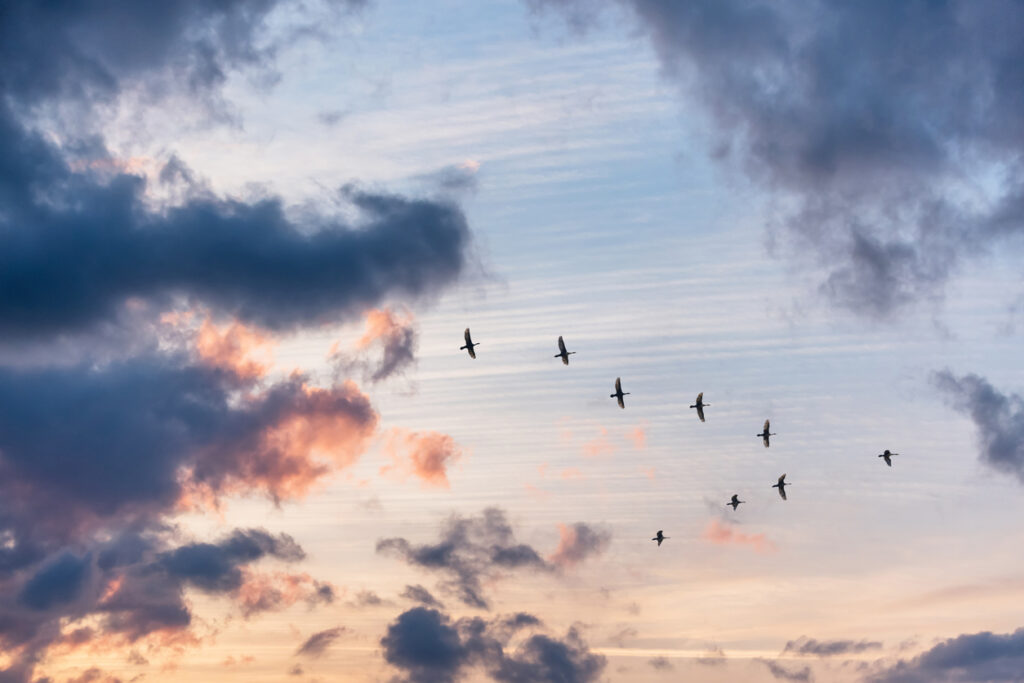
If you’ve ever heard geese flying overhead, you’ll know they’re noisy. That constant honking isn’t random, it’s communication. The geese at the back honk to encourage the ones at the front and let them know they’re still there. It’s basically them saying “keep going, we’re right behind you” to the birds working hardest. This vocal coordination helps keep the flock together and motivated during long flights.
The formation helps them navigate more accurately.

When geese fly in a V, they’re all following the same lead bird who’s navigating. If they were scattered randomly, different birds might head in slightly different directions and the flock would drift apart. The V formation keeps everyone on the same flight path, following the experienced navigators at the front. This is especially important during migration, when they need to reach specific destinations hundreds or thousands of miles away.
Younger geese learn migration routes from their elders.

Geese don’t instinctively know where to migrate, they have to be taught. Young geese fly in the V formation with older, experienced birds who know the route. By maintaining this formation, the youngsters can follow along and learn the way for future migrations. It’s like a flying classroom where the older generation passes down knowledge about where to stop for food and rest, and which landmarks to follow.
The slipstream effect compounds through the whole formation.

It’s not just the bird directly behind the leader that benefits. Each goose creates an updraft for the birds behind them, so the energy-saving effect multiplies down the entire V. The birds at the very back of long formations get the accumulated benefit of all the updrafts created by every goose ahead of them. This is why larger flocks form longer V shapes rather than staying bunched up.
They can adjust the formation based on wind conditions.

Geese aren’t rigidly stuck in a perfect V at all times. They adjust the angle and tightness of the formation depending on wind speed and direction. In strong headwinds, they’ll tighten up the V to maximise the drafting effect. With tailwinds, they might spread out more. This flexibility shows the formation isn’t just instinct, it’s an intelligent response to changing conditions that helps them fly more efficiently.
It reduces the risk of midair collisions.

When you’ve got a large group of big birds flying at speed, there’s serious potential for crashes if they’re not organised. The V formation naturally spaces geese out so they’re not flying directly behind each other where they could collide. Each bird has its own clear flight path with space around it. This spacing is especially important when the flock needs to change altitude or direction quickly to avoid obstacles or predators.