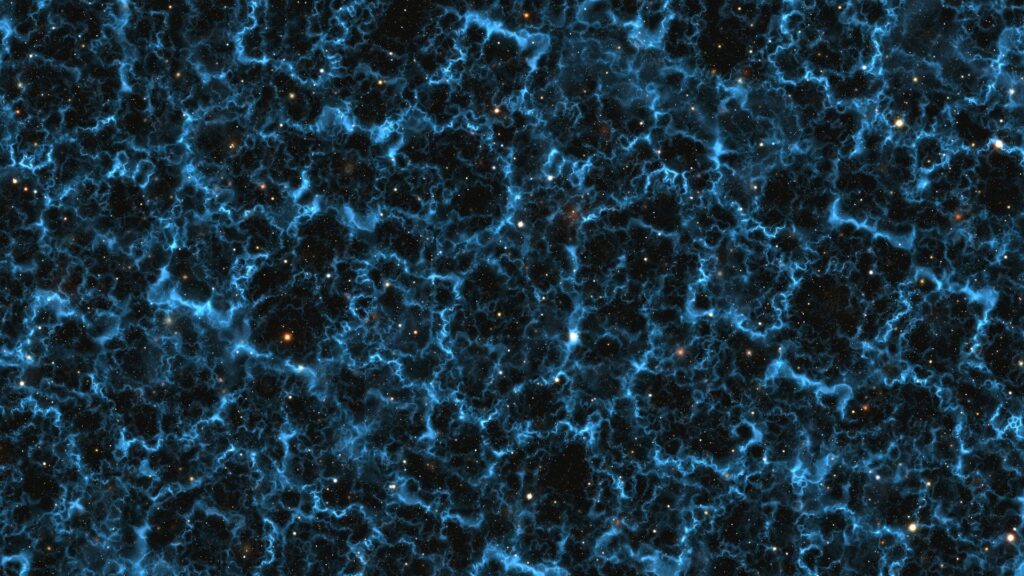
Dark matter makes up most of the universe, yet no one really knows what it is. It doesn’t emit light, can’t be seen directly, and doesn’t behave like anything we fully understand. Scientists know it’s there because of the way it pulls on galaxies and bends light, but the substance itself remains one of the biggest puzzles in physics.
For decades, researchers have been trying to pin down what dark matter is made of and why it behaves the way it does. Every time they get close to an answer, new questions appear. It’s the kind of mystery that keeps even the most brilliant minds awake at night because solving it could change everything we know about the universe.
1. We still don’t know what it’s made of.
Dark matter makes up about eighty-five percent of all matter in the universe, yet we’ve never touched it or even seen it. Every element, particle, and atom we understand makes up only a tiny fraction of everything that exists. Scientists have tried to find particles that could explain it, but none have been confirmed. It’s like knowing there’s a huge hidden world around us, but not knowing what’s inside it.
2. It bends light without giving off any
One of the few ways we can detect dark matter is by how it affects light. It bends the light of distant galaxies as it passes by, creating distorted images we can measure. That bending, called gravitational lensing, proves something invisible is shaping what we see. It’s one of the clearest signs that dark matter is real, even if we still don’t know what it looks like.
3. It holds galaxies together.
Galaxies spin so fast that, by normal physics, they should fall apart. However, they don’t, and dark matter is why. Its invisible gravity acts like glue, keeping stars in place as galaxies rotate. Without it, most galaxies, including our own Milky Way, wouldn’t exist in their current form. It’s one of the reasons scientists believe dark matter makes up the unseen skeleton of the universe.
4. It doesn’t seem to interact with anything.

Dark matter doesn’t collide, absorb, or react with normal matter the way everything else does. It passes through planets, stars, and people as if they aren’t there. That’s why it’s so hard to detect. It might make up most of the universe, but it could drift right through the Earth without leaving a trace.
5. Some think it could be made of unknown particles.
Physicists have proposed new particles that could explain dark matter, such as WIMPs (weakly interacting massive particles) or axions. Both would be invisible and incredibly hard to detect. So far, though, every experiment has come up empty. Either dark matter is something completely different, or we’re just not looking for it the right way yet.
6. It might not even be “matter” at all.
Some scientists believe dark matter might not be a substance, but a sign that our understanding of gravity is wrong. Maybe the rules of physics change at cosmic scales. If that’s true, we’d have to rethink how the universe works entirely. It’s a wild idea, but in science, even the impossible has to be considered.
7. It could be hiding in black holes.
Another theory suggests that dark matter might come from tiny, ancient black holes that formed right after the Big Bang. These “primordial” black holes would be scattered across the universe. If enough of them exist, their gravity could explain the missing mass, but detecting something that small and invisible is a challenge scientists are still trying to solve.
8. It shaped the universe’s structure.
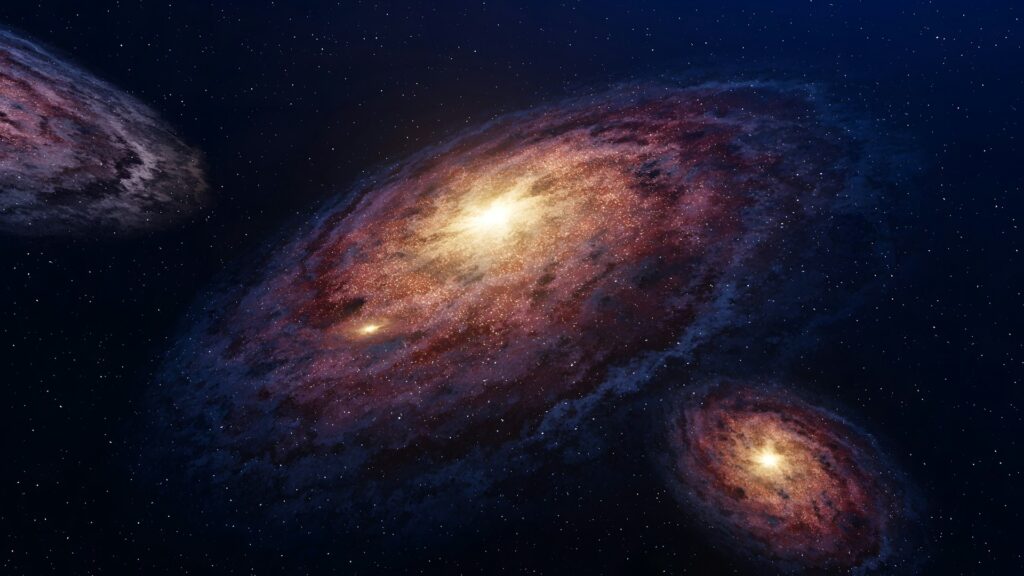
Without dark matter, galaxies wouldn’t have formed the way they did. It pulled normal matter together early in the universe, creating clusters and webs of galaxies across billions of light years. In a way, dark matter built the cosmic landscape we see today. Everything from stars to planets owes its place to something we still can’t identify.
9. It could be constantly passing through us.
Right now, trillions of dark matter particles might be moving through your body without you feeling a thing. They don’t interact with atoms, so we’d never know. Some underground labs are trying to detect these particles using ultra-sensitive detectors. So far, no one’s caught a single one, but the search continues around the clock.
10. It might explain strange galactic movements.
In some galaxies, stars move in ways that can’t be explained by normal physics. They orbit too fast or behave as if something massive is pulling on them from unseen corners. Dark matter could be behind this hidden force. Without it, many of these galaxies would tear apart under their own motion.
11. There might be several types of it.
Scientists used to think dark matter was made of one kind of particle, but new research suggests it could be a mix of several. Some types might clump together, while others drift freely through space. This idea would explain why dark matter behaves differently in various parts of the universe, but proving it will take decades of research.
12. It might not be evenly spread.
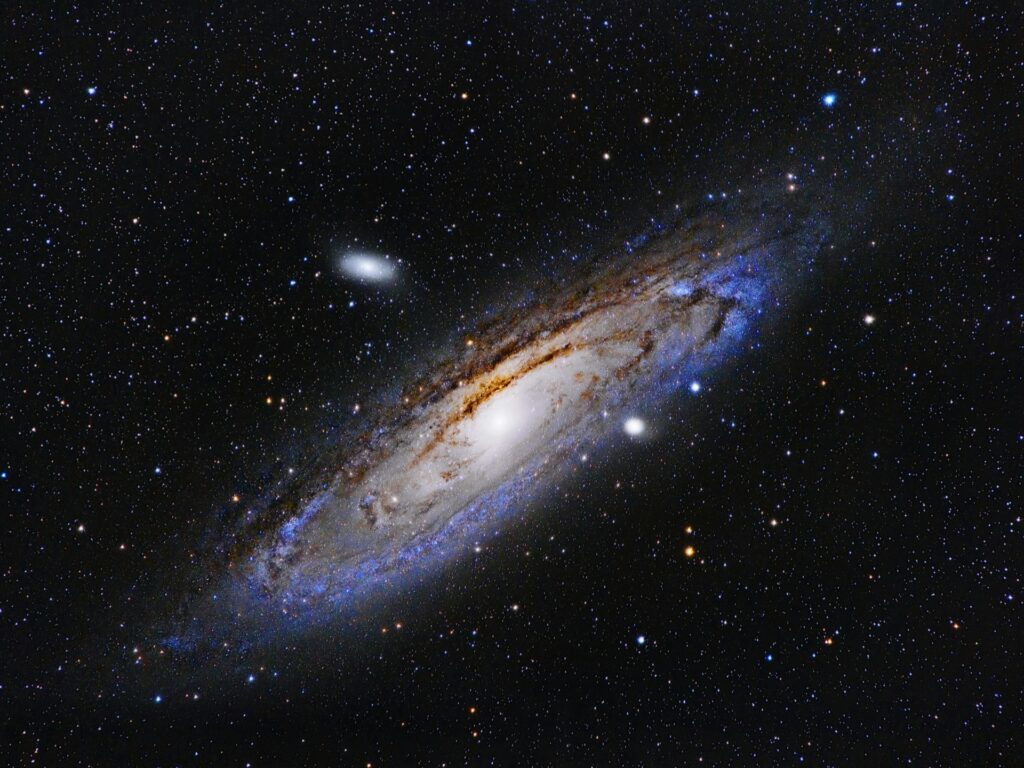
Dark matter isn’t everywhere in equal amounts. Some areas of the universe are packed with it, while others have almost none. It collects in “halos” around galaxies and clusters. Scientists are mapping where it hides using gravitational lensing. These maps are helping us understand how the invisible universe is structured, piece by piece.
It could be slowly disappearing.
Some physicists think dark matter might decay over time, slowly breaking down into even smaller particles. If that’s happening, the universe could be changing in ways we can’t yet detect. This decay would happen over billions of years, so it’s not something we’d notice now, but it could shape the universe’s far future.
14. It might connect to dark energy
Dark matter isn’t the only mystery out there. There’s also dark energy, a force pushing the universe to expand faster and faster. Some scientists think the two might be linked. If they are, understanding one could help explain the other. But right now, we don’t know if they’re distant cousins or completely separate forces working together to shape the cosmos.
15. It could change how we see everything.
Cracking the mystery of dark matter would change science forever. It could reveal new laws of physics, hidden dimensions, or even unseen parts of reality we’ve never imagined. Until then, scientists will keep searching, testing, and staying up late wondering what makes up most of the universe. The answer is out there somewhere. We just haven’t found the light to see it yet.