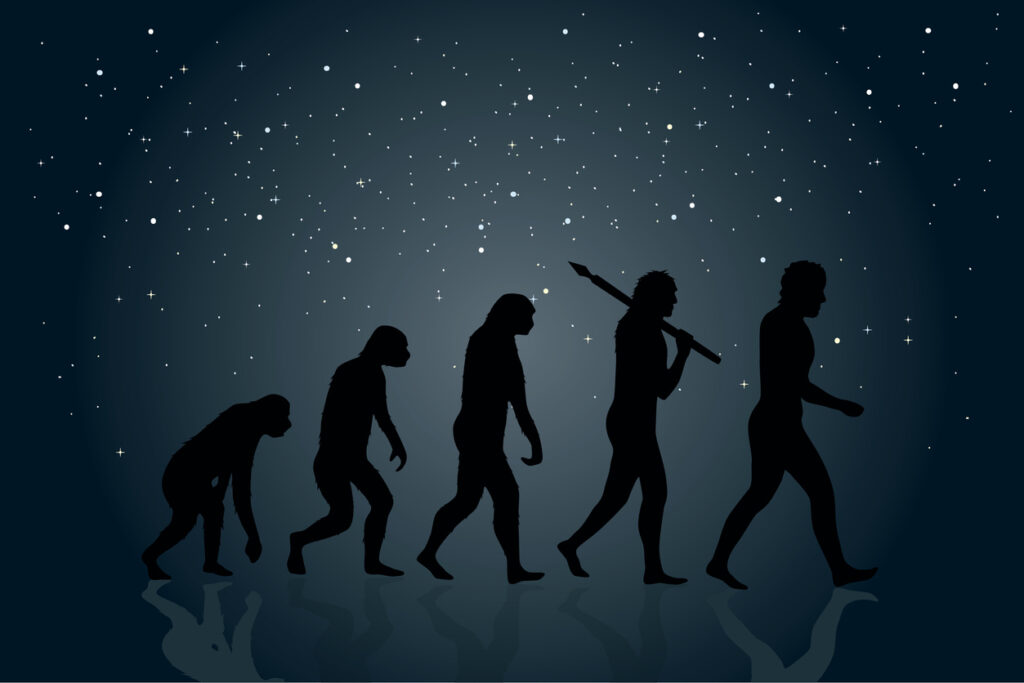
It’s a common mistake to think we came directly from the monkeys or chimps you see at the zoo today, but the actual story of our origins is more about a complex family tree than a straight line. We share a massive amount of our DNA with primates because we both branched off from a shared ancestor millions of years ago, with each group moving down its own separate path ever since.
Scientists have spent decades piecing together the fossil record and genetic links to figure out exactly how we transitioned from tree-dwellers to the upright humans we are now. Understanding where we really fit into the natural world means looking past the myths and seeing the evidence for how we actually evolved alongside our distant primate cousins.
Humans didn’t evolve from modern primates like chimpanzees or gorillas.
This is the biggest misunderstanding people have about human evolution because we didn’t descend from any species alive today. Humans and chimpanzees share a common ancestor that lived about 6-7 million years ago, but that ancestor wasn’t a chimp or a human. Think of it as cousins sharing grandparents rather than one cousin being the parent of the other, and that extinct common ancestor gave rise to separate lineages that eventually became humans and modern apes.
@dw.science Did humans come from monkeys? Let’s look at human evolution: The human genome is very similar to that of our closest living evolutionary cousins – other primates. We share distant ancestors but don’t come from modern apes. #explained #evolution #evolutionarybiology #humanevolution #chimpanzee #monkeys #humans #dwscience #learnontiktok #sciencetok ♬ Whistle Song – Pinknoize
Humans are primates, not descended from them.
We’re classified as primates because we share all the defining characteristics of the primate order, including forward-facing eyes, grasping hands, and relatively large brains. Saying humans evolved from primates is like saying you descended from your own family, when actually you’re part of it. The primate family tree includes lemurs, monkeys, apes, and humans, and we’re simply one branch on that tree rather than something separate that came from it.
DNA evidence shows humans share about 98.8% of our DNA with chimpanzees.
Genetic sequencing has confirmed that chimps are our closest living relatives, with bonobos equally close in genetic terms. The similarity isn’t coincidental but reflects our recent shared ancestry in evolutionary terms. We share progressively less DNA with more distant primate relatives like gorillas (98.4%), orangutans (97%), and monkeys (93%), which matches perfectly with what the fossil record suggests about when these lineages split.
The fossil record shows a clear progression of hominin species.
We’ve discovered numerous extinct human relatives that show transitional features between earlier apes and modern humans. Species like Australopithecus, Homo habilis, Homo erectus, and Homo neanderthalensis show a gradual change in brain size, tool use, and body structure. These aren’t perfectly linear stepping stones but rather a bushy family tree where multiple hominin species often existed simultaneously before going extinct.
Our hands and feet show evolutionary history from tree-dwelling ancestors.
Human hands maintain the grasping ability that evolved for life in trees, with opposable thumbs that let us grip branches or manipulate tools. Our feet have changed more dramatically for walking upright, but babies are born with a grasping reflex in their feet that serves no purpose now but reflects our arboreal past. The bones in our hands match the pattern found in all primates, showing shared ancestry rather than separate creation.
Walking upright happened before our brains got larger.
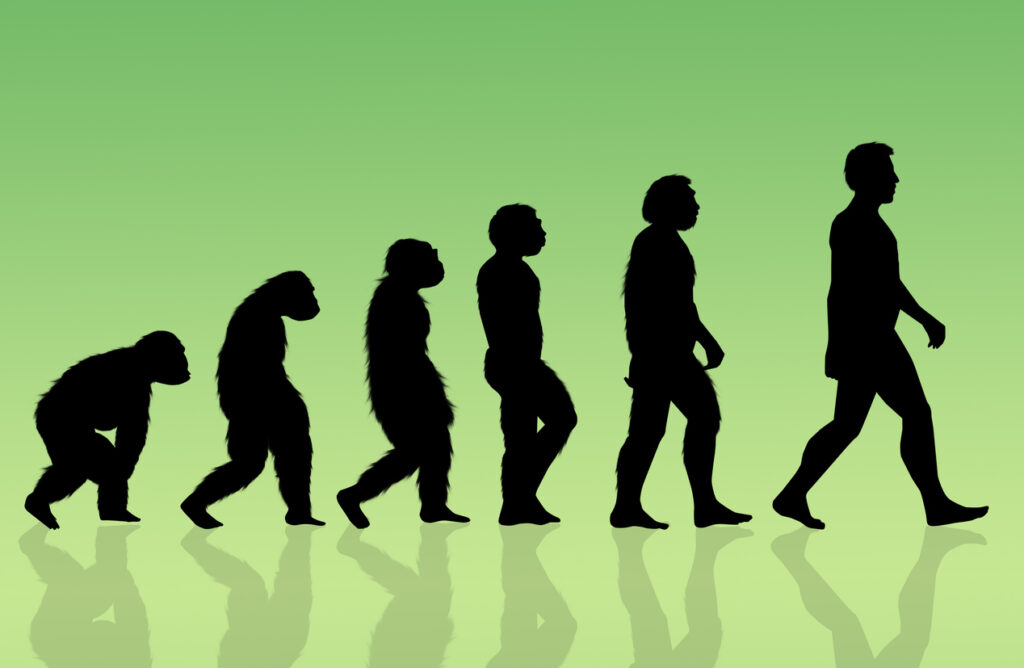
Fossil evidence shows that bipedalism evolved millions of years before the dramatic brain expansion that characterises modern humans. Australopithecus walked upright about 4 million years ago but had brains only slightly larger than chimpanzees. This tells us that walking on two legs provided some advantage that was selected for before intelligence became the defining human trait, possibly freeing hands for carrying food or tools.
We have physical features that only make sense as evolutionary leftovers.
Humans have a tailbone with no function, wisdom teeth that often don’t fit in our jaws, an appendix that does very little, and muscles for moving our ears that most people can’t control. These vestigial features make perfect sense as remnants from ancestors who needed them but are difficult to explain if humans were separately created. Our bodies are basically modified ape bodies with updates rather than completely new designs.
Human embryos develop similarly to other primate embryos.
Early human embryos have gill-like structures and tails that are later absorbed or modified during development, showing that our developmental program contains ancient instructions from distant ancestors. Human embryos look remarkably similar to other primate embryos at early stages, only diverging into species-specific features later. This pattern of development reflects evolutionary relationships and wouldn’t be necessary if each species was independently created.
@dr.peter81 Humans evolution. #documentary #human #science #universe #monkey ♬ original sound – UniverseUnfolded
Chromosome 2 in humans resulted from two ancestral chromosomes fusing.
All great apes have 24 pairs of chromosomes while humans have 23 pairs, and genetic evidence shows that human chromosome 2 formed when two ancestral chromosomes fused together. We can see the remnants of the original chromosome structures within chromosome 2, including two sets of centromeres and telomeres in the middle where they shouldn’t be. That’s exactly what you’d expect if humans shared ancestors with other apes but not what you’d predict if we were separately created.
Tool use and culture exist in other primates too.
Chimpanzees make and use tools, teach these skills to their young, and have different cultural practices in different populations. Gorillas use sticks to test water depth, and orangutans use leaves as gloves or umbrellas. These behaviours show that the cognitive foundations for human culture and technology existed in our common ancestors and weren’t completely new inventions that appeared in humans.
The geographic distribution of primates matches what evolution predicts.
Primate species are distributed globally in patterns that make sense if they descended from common ancestors and spread out over time. The fossil record shows early primates in Africa, then later species spreading to other continents as they evolved. If species were separately created, there’s no reason to expect this geographic pattern, but it matches perfectly with evolutionary descent and migration.
Multiple independent lines of evidence all point to the same evolutionary tree.
Evidence from DNA, fossils, anatomy, embryology, and geographic distribution all independently support the same family tree of primate relationships. The fact that completely different types of evidence converge on the same answer is powerful support for evolution. If any of these evidence sources contradicted the others, it would suggest problems with the theory, but instead they reinforce each other consistently.