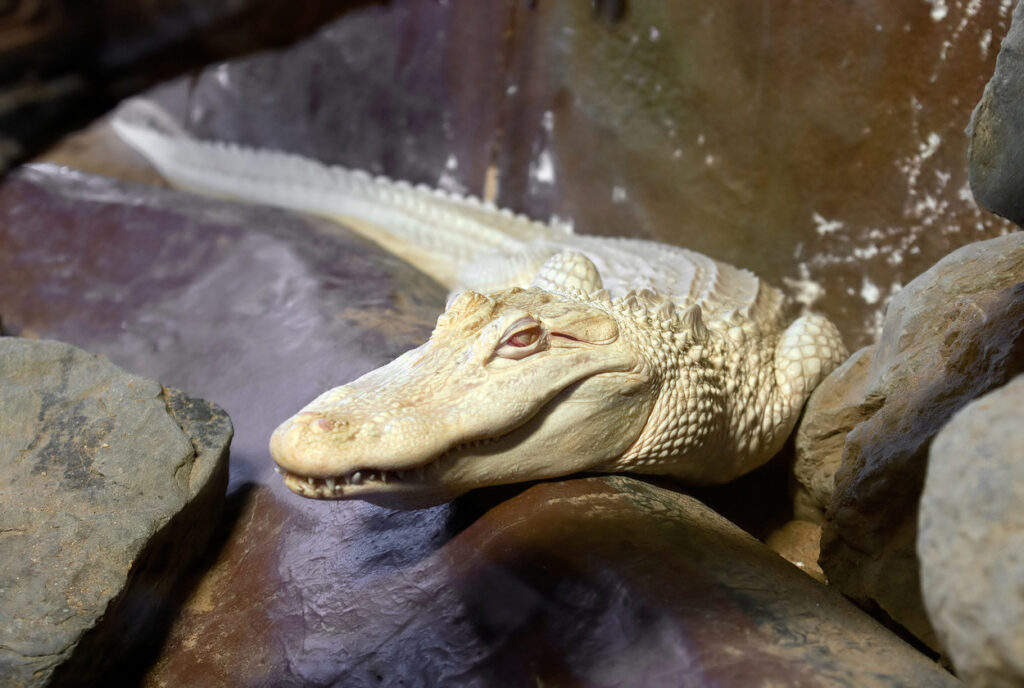
Nature has a funny way of making even the most terrifying predators look like something out of a fever dream, and an albino alligator is exactly that. Seeing one of these in the flesh is a bit of a shock to the system because your brain struggles to square the familiar, prehistoric shape with a skin tone that looks like it’s been carved out of white marble.
They’re incredibly rare, mostly because a bright white reptile in a murky green swamp has about as much chance of hiding from a predator as a neon sign in a blackout. Because they lack any protective pigment, they’re basically the ghosts of the bayou—creatures that shouldn’t really survive in the wild but manage to look absolutely haunting in the safety of a sanctuary.
They’re white because they produce no melanin at all.
Albinism is a genetic condition that prevents the body from producing melanin, which is the pigment responsible for colour in skin, scales, eyes, and hair. In alligators, the result is a creature that would normally be dark grey or olive green coming out almost completely white, with pale yellow tinges across the scales and eyes that appear pink or red because the blood vessels behind them are visible through the unpigmented iris. It’s the same condition that produces white tigers or albino rabbits, just in an animal that already looks fairly prehistoric, which makes the effect considerably more dramatic.
They almost never survive in the wild.
In the wild, a normal alligator’s dark colouring does a lot of work. It helps them blend into murky water, dark banks, and shadowy vegetation, making them effective ambush predators and keeping younger alligators hidden from things that would eat them. An albino alligator has none of that. It’s immediately visible in almost any environment, which makes it far easier for predators to spot when it’s young and far less effective as a hunter as it gets older. The lack of melanin also means no UV protection, so extended sun exposure causes serious skin damage. Most albino alligators in the wild wouldn’t make it past the first few weeks of life.
There are estimated to be fewer than a hundred in existence.
Exact numbers are difficult to pin down, but estimates suggest there are fewer than a hundred albino alligators in the world, and the vast majority of those are in captivity. They’re rare partly because the genetic combination required to produce albinism needs to come from both parents, and partly because so few survive long enough in the wild to reproduce. The ones that do exist in captivity tend to live in aquariums and wildlife facilities, where they’ve become significant draws — people will travel considerable distances specifically to see one.
@pubity This alligator loves a scrub 🧼 🐊 #aligator #comedу #funny #animals #cute #pubity ♬ original sound – Pubity
They were almost unknown until a group was discovered in Louisiana in the 1980s.
In 1987, 18 albino alligators were found in a single nest in the Louisiana bayou, which was a remarkable discovery. Finding even one would have been unusual, but finding 18 together suggested both parents were carriers of the recessive gene, which is vanishingly unlikely in a wild population. Those original eighteen animals became the foundation of most of the albino alligators currently in captivity around the world, and many of the individuals you’ll see in aquariums today can be traced back to that one nest. The bayou region of Louisiana remains the most likely place in the world to encounter one, even if the chances are still extremely slim.
Their eyes are pink or red, which adds to the otherworldly appearance.
The eye colour in albino animals often gets described as red, though in alligators it tends to be more of a pale pink or amber depending on the light. It’s caused by the same absence of pigment — without melanin in the iris, light reflects off the blood vessels at the back of the eye rather than being absorbed, which produces that distinctive colour. Combined with the white scales, it gives albino alligators a look that’s genuinely unsettling in a way that’s hard to explain. Alligators already look like something from a different era, and the albino colouring pushes that quality further, like something dredged up from much deeper in prehistory than their relatives.
They can still grow to full size.
Albinism affects pigmentation but doesn’t prevent normal growth, so albino alligators in captivity reach sizes comparable to their normally coloured relatives. American alligators typically grow to between two and four metres, with males being considerably larger than females. In captivity, where food is reliable and conditions are controlled, albino alligators can live for decades and reach impressive sizes. The largest captive examples are genuinely enormous animals, and the contrast between that size and the ghostly pale colouring is part of what makes them so striking to see in person.
Some people confuse them with leucistic alligators, which are different.
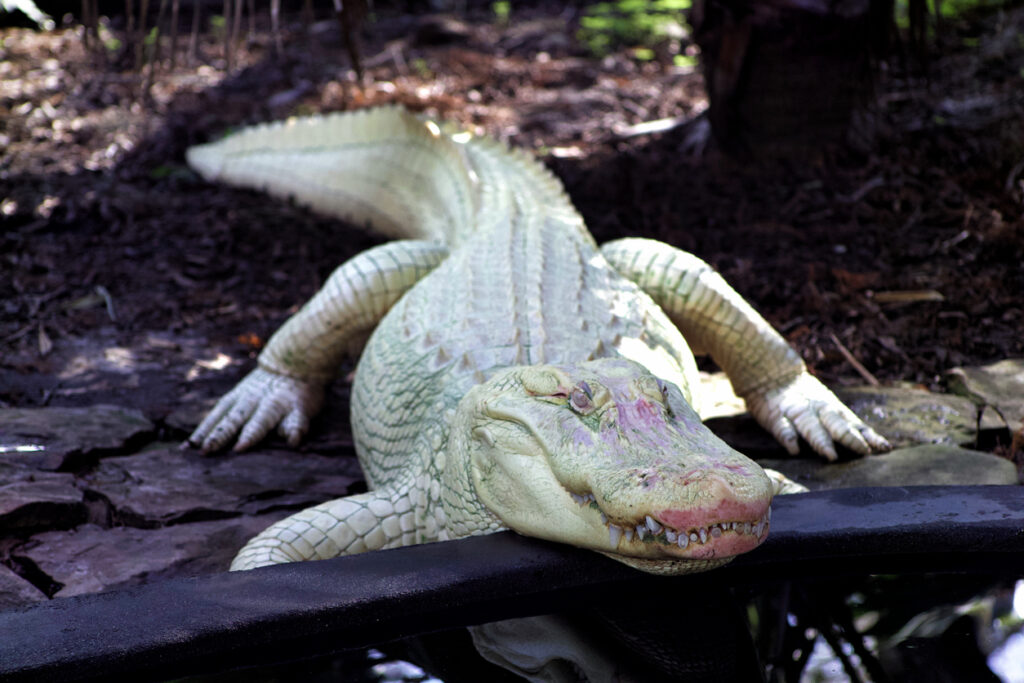
Leucism is a separate condition that also produces pale or white colouring but works differently. Leucistic alligators still produce some melanin, which means they can have patches of normal colour on their bodies, and their eyes are typically blue rather than pink. True albino alligators have a complete absence of pigment and always have the characteristic pink or red eyes. Both conditions are extremely rare, and the two types are sometimes housed together in captivity, which causes some confusion. The distinction matters biologically, even if both animals look striking — the underlying genetics and the specific challenges they face are different.
They’re surprisingly calm in captivity.
Alligators in general are not the constantly aggressive animals that their reputation might suggest. They’re ambush hunters that conserve energy and tend to stay still for long periods, and captive alligators, particularly those raised in controlled environments from a young age, often seem notably unbothered by human presence. Albino alligators in aquariums are frequently described by keepers as calm and easy to manage relative to their size. Whether that’s a result of captive conditioning or just the natural temperament of alligators is hard to say, but many visitors are surprised to find that the animal drifting motionlessly in the enclosure seems entirely indifferent to the crowd pressed against the glass.
They feature in some Native American folklore.
White alligators appear in the mythology of some indigenous cultures in the American South, where they were seen as sacred or spiritually significant animals. An all-white alligator in a landscape where every other gator is dark and camouflaged would have been an extraordinary thing to encounter, and it’s not hard to see how such a sighting would carry meaning. Some traditions associated white animals generally with spiritual power or the presence of the supernatural, and an animal as imposing as a full-grown alligator in an unexpected colour would have made a strong impression on anyone who came across one.
Seeing one in person is a genuinely unusual experience.
People who work with albino alligators regularly still tend to describe them as animals that take some getting used to. There’s something about the combination of a familiar animal shape in an entirely wrong colour that the brain struggles to process quickly. Alligators look ancient because they essentially are — they’ve existed in roughly their current form for a very long time, and that quality is already present in their appearance before you add the albinism. The white colouring seems to intensify it somehow, stripping away the camouflage and leaving something that looks less like a living animal and more like a remnant, a thing that shouldn’t quite still be here.