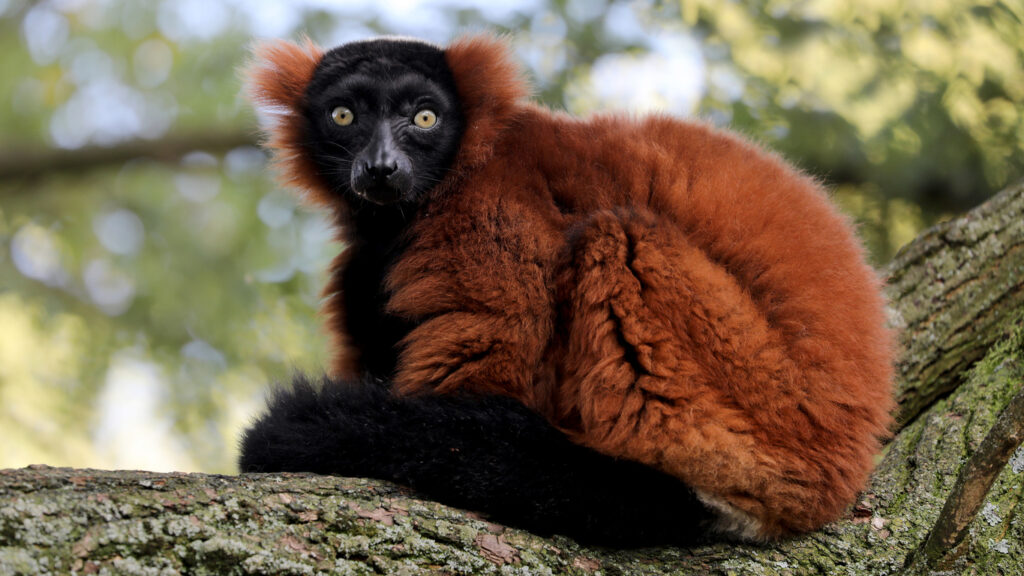
If you’ve ever been deep in the forests of Madagascar and heard what sounds like a police car chasing a fire engine, you haven’t stumbled onto a secret road; you’ve probably just annoyed a red-ruffed lemur. These primates are some of the loudest animals on the planet, and they don’t just make a bit of noise to mark their territory. They let out a series of deafening, metallic shrieks that can be heard over a mile away, designed to tell every living thing in the vicinity to keep its distance.
It’s a bit of a shock to find that such a fluffy, rust-coloured creature is capable of a sound that’s more mechanical than animal. While they look like something you’d want to give a quick pat, their vocal cords are basically built-in security systems that make the average car alarm sound like a whisper.
It produces one of the most startling sounds in the animal kingdom.
The call of a red-ruffed lemur is hard to describe until you’ve actually heard it. It starts as a bark and builds into something between a shriek and a wail, loud and frantic in a way that sounds far more like a car alarm than anything you’d expect from a primate. Groups of them will often call together, which makes the whole thing even more intense.
The sound travels a long way through dense rainforest, which is the whole point — these calls carry real information about predators, territory, and where other group members are. It’s not random noise. It’s a communication system that works remarkably well for an animal living in thick jungle where you often can’t see more than a few metres ahead.
@frankbuckzoo Red ruffed lemur call. #redruffedlemur #lemursoftiktok #lemur #foryoupage #fyp #primate #call #animal #frankbuckzoo ♬ original sound – Frank Buck Zoo
It’s one of the largest living lemurs.
Red-ruffed lemurs are big by lemur standards, reaching around three and a half to four kilograms when fully grown. They’re found only in the rainforests of the Masoala Peninsula in northeastern Madagascar, a stretch of dense, humid forest that very few people ever visit.
Because they’re so tied to this one specific habitat, they don’t really have anywhere else to go if things go wrong there. Most animals have at least some flexibility in where they can survive, but the red-ruffed lemur is about as specialist as it gets, which makes its situation more precarious than it might otherwise be.
The colouring is immediately recognisable.
Their fur is a deep rusty red across most of the body, with black on the face, hands, feet, and tail. The ruff, which is the thick collar of fur around the neck, is pale and stands out clearly when they move through the canopy. It’s striking enough that you’d think it would make them easy targets for predators, but the way light and shadow breaks up in a rainforest canopy actually makes that bold pattern harder to track from a distance than you’d expect. Up in the trees, surrounded by dappled light and moving leaves, they’re less conspicuous than they look in photos.
They spend almost all of their time in the treetops.
Red-ruffed lemurs are highly arboreal, meaning they live in the upper layers of the forest and rarely come down to the ground. They move through the canopy by leaping and climbing, and they do all their foraging up there too, eating mainly fruit, nectar, and some leaves.
Since they eat so much fruit, they swallow seeds and deposit them elsewhere as they move around, which makes them important for spreading certain tree species across the forest. Some large-fruited trees in the Masoala appear to depend heavily on red-ruffed lemurs for seed dispersal, so removing them from the ecosystem has knock-on effects that go well beyond the lemur population itself.
@brutamerica Red Ruffed Lemurs are known for their unique morning sunbathing ritual. These primates are native to the rainforests of Madagascar, which often have cool, damp mornings. Red Ruffed Lemurs are often spotted lying on their backs or stretching their arms out wide to the sky, adjusting their posture to efficiently absorb solar heat in a process known as thermoregulation. Exposing their bellies to the sun helps kickstart their metabolism before they climb to the treetops for foraging. Red Ruffed Lemurs are herbivores whose diets primarily consist of fruit, as well as some leaves, seeds, and nectar. #RedRuffedLemur #Lemur #Animal #Sunbathing #Madagascar ♬ original sound – Brut.
They’re also important pollinators.
This is one of the more surprising things about them. When red-ruffed lemurs feed on the nectar of the traveller’s palm—a tree that’s become something of a symbol of Madagascar—they pick up pollen on their faces and carry it to the next flower they visit.
It’s a relationship that seems to have developed over a very long time, with the tree and the lemur becoming genuinely dependent on each other. It’s unusual for a primate to play this kind of role, and it means the red-ruffed lemur isn’t just a resident of its forest but an active part of how that forest reproduces and sustains itself.
Their social life is more flexible than most lemurs.
They live in what’s called a fission-fusion society, which basically means the group doesn’t stay together as one fixed unit all the time. They split into smaller subgroups depending on the season and food availability, then come back together again.
The social structure tends to be centred around females, who hold the dominant position, which is typical of lemurs generally, where female dominance is the norm. Males have a less fixed role and will often move between groups, while females tend to maintain the more stable core bonds within the group.
They have an unusually high reproductive rate for a primate.
Most primates of a similar size have one baby at a time and spend years raising it. Red-ruffed lemurs can have litters of up to six, though two to four is more common. The young are born in a relatively undeveloped state and spend their first weeks in a nest rather than clinging to the mother, which is different from how most primates handle early life.
While the mother forages, the infants are left in the nest or tucked into a branch, with other group members keeping a loose eye on them. It’s a very different approach to parenting, and it means the species can theoretically recover faster from population losses than a primate that raises a single offspring over several years.
@artisamsterdam Did you know that red lemurs are sun-worshippers? 🌞🦊 Due to the habit of spreading their legs to sunbathe, the Red ruffed lemurs were considered by early native people of the area as sacred animals, worshipping the sun. Therefore these animals weren’t hunted for centuries thanks to this mistaken belief. #artis #zoo #amsterdam #lemur #animal #animaltok #lerenoptiktok #sunbathing ♬ Summermode – Official Sound Studio
They’re critically endangered
The IUCN lists red-ruffed lemurs as critically endangered, the category just before extinct in the wild. The Masoala Peninsula still holds some of Madagascar’s largest areas of intact rainforest, but it’s under constant pressure from logging, slash-and-burn farming, and hunting.
Because the red-ruffed lemur exists nowhere else, there’s no backup population somewhere else in the world to fall back on. What happens to the Masoala forest is what happens to the species, full stop, and the forest has been shrinking steadily for decades.
They’re hunted directly as well as losing their habitat.
Bushmeat hunting adds to the pressure on top of habitat loss. Red-ruffed lemurs are large enough to be worth hunting, and their loud calls and bright colouring make them relatively easy to find compared to smaller, quieter animals. Enforcement of wildlife protections in remote areas is difficult, and illegal hunting inside the national park that covers part of the peninsula does still happen. Conservation work in the Masoala has had some positive results, but the challenges are significant and ongoing.
Very few people will ever see one in the wild.
The Masoala Peninsula is remote and not straightforward to reach, which has helped protect its forest but also means red-ruffed lemurs stay largely unknown outside Madagascar and the researchers who study them. Some exist in captive breeding programmes, which offers a degree of protection but isn’t a real substitute for a healthy wild population. For an animal that makes this much noise, it’s quietly slipping towards the edge, and most of the world hasn’t noticed.