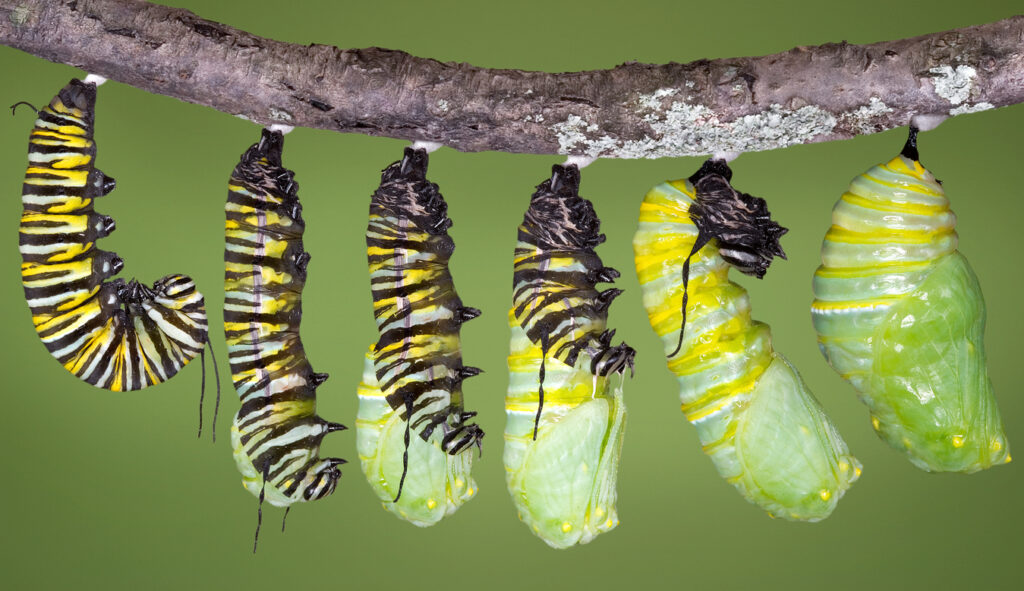
Most of us grew up with the lovely idea that a caterpillar simply goes to sleep in its cocoon and wakes up with a pair of wings, but the reality is a lot more gruesome and fascinating than that. It’s not just a bit of a nap and a change of clothes; inside that protective shell, the caterpillar’s entire body literally dissolves into a soup of enzymes and cells.
It has to completely deconstruct everything it used to be—every leg, every segment, and even its digestive system—before it can start the massive job of rebuilding itself from scratch. It’s one of the most extreme transformations in the natural world, and what is going on inside that casing is a brilliant, messy bit of biological engineering that’s far from peaceful.
The caterpillar essentially dissolves itself from the inside.
Once the caterpillar seals itself in, it releases enzymes that break down most of its own body tissue. Not just a restructuring, but a near-total liquefaction of everything it was. Muscle, organs, and structure all break down into a thick cellular soup that has very little resemblance to either the caterpillar it came from or the butterfly it’s becoming. It’s one of the more extraordinary things happening in any back garden on a Tuesday afternoon.
Not absolutely everything gets dissolved.
A small number of structures survive the breakdown intact, and these become the anchor points for everything that gets rebuilt. Clusters of cells called imaginal discs are present in the caterpillar from the very beginning, sitting dormant and waiting. There are discs for the wings, the legs, the eyes, the antennae, each one already carrying the blueprint for the specific structure it will eventually become. The dissolving of everything else is in some ways just clearing the way for these to take over.
@talknerdytomecaliforniaWhen a caterpillar is ready to transform, it seals itself inside a chrysalis and… completely dissolves. Scientists literally call it “butterfly soup.” 🦋🥣 Enzymes break the body down into goo, but hidden inside the caterpillar all along are imaginal discs—tiny blueprints waiting for this exact moment. From that soup, the discs build wings, eyes, legs, antennae… everything. In just about 10 days, an entirely new creature emerges—rebuilt from scratch. And if you look closely before it hatches, you can actually see the wings through the clear chrysalis. Nature is wild!♬ original sound – Gabrielle- Talk Nerdy to Me 😘
The brain partially survives and carries memories across the transformation.
Research has shown that moths can remember things they learned as caterpillars, which implies that something of the original nervous system makes it through the process. Given how completely everything else breaks down, this is a remarkable finding. A caterpillar trained to avoid a particular smell will show the same aversion as a moth after completing metamorphosis, which means the transformation isn’t a complete reset. Some version of what the caterpillar experienced is still in there on the other side.
The imaginal discs build the butterfly’s body from the cellular soup around them.
Once the breakdown is largely complete, the imaginal discs activate and begin pulling from the nutrient-rich liquid surrounding them to construct entirely new structures. They essentially use the dissolved caterpillar as raw material and build something completely different from it. The wings, which were tiny folded structures in the disc, expand and take shape during this phase. What was a crawling, leaf-eating larva is being rebuilt from its own components into something with compound eyes and the ability to fly.
The heart is one of the few organs that keeps working throughout.
While almost everything else shuts down or dissolves, the caterpillar’s simple tube-like heart keeps beating through the entire process. It pumps the cellular fluid around the developing structures and keeps the whole system viable during the rebuild. Without it, the transformation couldn’t sustain itself. It’s a small detail, but it changes the picture slightly because this isn’t a dead thing waiting to become alive again, it’s a living system continuously in process throughout.
It all happens remarkably quickly.
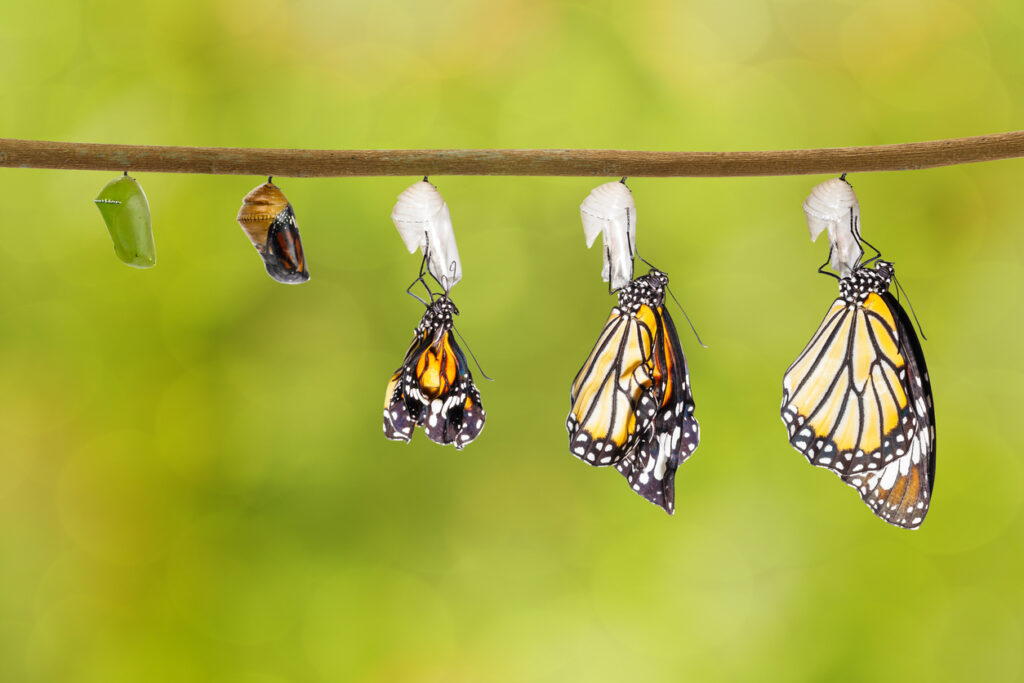
Depending on the species, the entire transformation from sealed caterpillar to fully formed butterfly or moth can take as little as ten days. Given the scale of what’s happening, that speed is extraordinary. The breakdown and rebuild of an entire body plan, the construction of a completely new set of structures, and the reorganisation of an organism’s fundamental biology all happen in roughly the time it takes to read a moderately long book. Some species take longer over winter, but the core process is faster than almost anyone expects.
The cocoon itself is doing an active job, not just sitting there.
The silk casing isn’t simply a protective shell. It regulates temperature and moisture inside in ways that support the transformation. Some species incorporate leaves, debris, or camouflage into the outer layer to avoid predators during the vulnerable period. The structure is also designed to let the butterfly exit when the time comes, with specific weak points built in. It’s engineered rather than simply spun, which becomes obvious when you look at how precisely it serves its purpose.
A butterfly and a caterpillar have almost no physical structure in common.
The caterpillar has a chewing mouthpart designed for leaves. The butterfly has a long coiled proboscis for reaching into flowers. The caterpillar has simple eyes that can barely distinguish light from dark. The butterfly has large compound eyes with a wide field of vision. The legs are different, the digestive system is different, the entire body plan is different. These aren’t the same animal with modifications, they’re the same genetic material rebuilt into something with an almost entirely different relationship with the world.
@sabrinas.other.vibe.86 Nature fascinates me! #MonarchButterfly #Metamorphosis #Change #Nature ♬ Little Sparrow – Paul Alan Morris
The process goes wrong more often than people realise.
Metamorphosis is physiologically demanding and a significant number of chrysalises don’t produce a viable adult. Temperature fluctuations, disease, parasites that lay eggs inside the caterpillar before it pupates, and developmental errors all take a toll. Some parasitic wasps specifically target pupae because the immobile, nutrient-rich environment inside is ideal for their larvae. The transformation looks serene from the outside but the success rate is far from guaranteed and the threats from other species are constant.
The butterfly that emerges still needs time before it can actually fly.
When a butterfly first breaks out of the chrysalis, its wings are small, wet, and crumpled. It has to hang and pump fluid from its body into the wing veins to expand them to their full size, and then wait for them to dry and harden before flight is possible. This takes anywhere from a few minutes to a couple of hours depending on the species and conditions. During that window, it’s completely vulnerable. The whole process ends not with a dramatic takeoff, but with a slow, patient wait for something delicate to become strong enough to work.