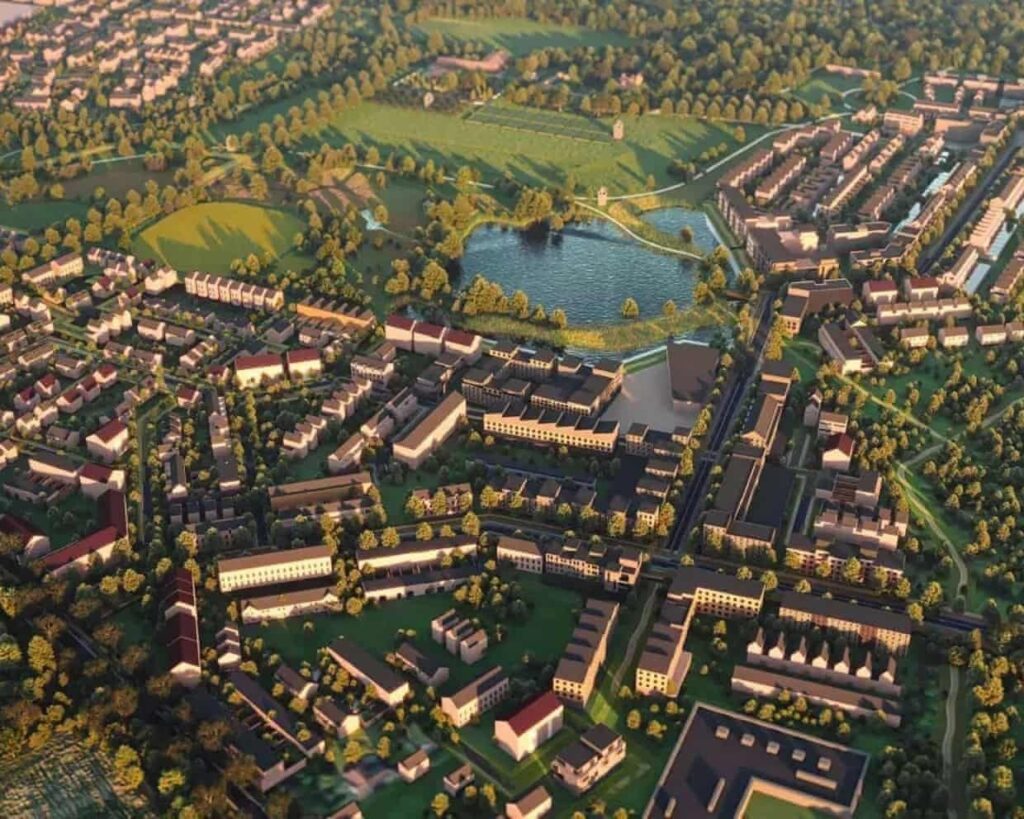
A few miles outside Folkestone, a new town is being built with an ambition that goes well beyond bricks and mortar. Otterpool Park will run entirely on electricity—no gas boilers, no petrol cars—and, when the national grid is under strain, it will be able to send power back rather than simply taking it. The deal behind it was set out in The Guardian, which reported that from 2027, all 8,500 homes will be connected through a smart local network designed and run by energy company SNRG, turning the community into a kind of virtual power plant.
How will the town power itself?
The setup is simple in principle but clever in execution. Every home will have rooftop solar panels, heat pumps instead of gas boilers, electric hobs, and an EV charger on the drive. For every 300 or so houses, there’ll be a communal battery to store surplus solar energy, ready to feed it back when the sun goes in or demand rises. Alongside this, the development will have its own solar farm on nearby council-owned land, expected to meet around half of its electricity needs once the town is fully built.
The key is that all of this will be linked by SNRG’s control system, which can make tiny, temporary adjustments to balance supply and demand. For example, if the national grid is under pressure, the system can briefly pause EV charging across hundreds of homes. No one household notices a delay of a few seconds, but the cumulative effect is enough to help prevent outages or the need to fire up costly fossil fuel plants. As SNRG’s chief product officer Dan Nicholls told the Guardian, “that’s the kind of invisible teamwork the grid needs more of” as Britain moves towards electrifying heat and transport.
The dedicated solar farm is a notable part of the plan. Because the land is already owned by Folkestone & Hythe District Council, it can be leased to the developer without extra cost to taxpayers. The council says the project will go through a full planning process so that local residents have the opportunity to raise questions or concerns before work begins.
The move will cut bills and ease grid pressure.
New housing developments often run into delays because the local electricity network can’t handle the extra demand without costly upgrades. By generating and storing so much of its own energy, Otterpool Park should be able to avoid that problem. It’s a model that could save time, reduce infrastructure costs, and keep energy bills lower for residents.
On sunny days, rooftop panels and the solar farm will cover much of the town’s demand and charge the batteries. In the evenings, stored energy will take the strain before any top-up is drawn from the national grid. When the grid has excess, for example, during a windy night when offshore turbines are producing more than the country can use, those same batteries can soak up the surplus, ready to release it later. When supply is tight, Otterpool can switch from being a consumer to a supplier.
Jim Martin, leader of Folkestone & Hythe District Council, described the project as a local example of how renewable energy can lower carbon emissions and benefit residents without adding to the public purse. The Guardian also reported that the solar farm’s expected 34 megawatts of capacity is enough to cover a sizeable share of the town’s needs while helping to keep the wider system stable.
It’s a blueprint for other developments.
Otterpool Park isn’t just about cleaner energy for its own residents; it’s a potential template for other new communities. As more homes are built and more cars and heating systems run on electricity, the demands on Britain’s power network will grow. The old approach, which was to plug every new estate into the grid and hope it copes, is running up against capacity limits in many parts of the country.
By integrating generation, storage, and smart controls from the start, developments like this can lighten the load on the national system instead of adding to it. That doesn’t mean cutting the cord, of course. Otterpool will still draw from the grid, especially in the winter, but it does mean less strain during the peaks and the ability to help when the country needs it.
It’s not hard to imagine the ripple effects. If housebuilders follow this model, grid constraints become less of a bottleneck, planning objections over energy use may ease, and residents get the reassurance of lower, more predictable bills. Crucially, the technology is already here. It’s the planning and integration that make the difference.
For Kent, it’s another chapter in the county’s growing renewable energy story, which already includes large solar parks and offshore wind projects. For Britain as a whole, it’s a test case in building the kind of resilient, decentralised power system the country will need to meet its net zero goals.
And for the people who will eventually live there? They’ll get the benefits without having to think too much about the mechanics. The system will run quietly in the background, adjusting a few seconds of charging here, shifting a dishwasher cycle there, all to keep the lights on, not just in Otterpool Park, but for homes miles away.