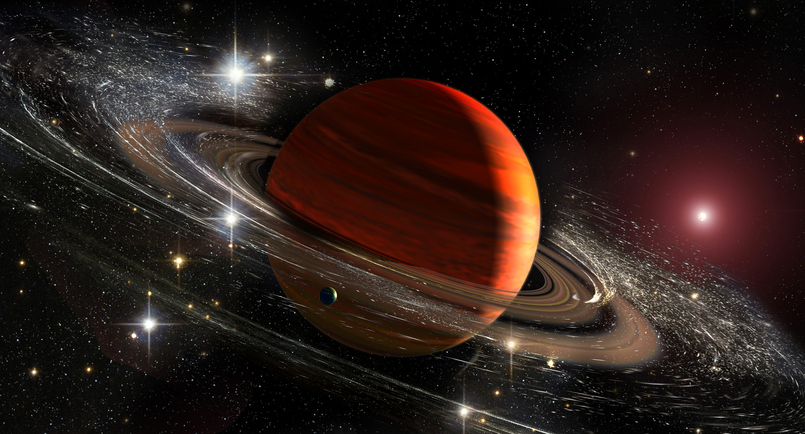
Planetary rings are one of the most striking sights in the solar system, yet not every planet has them. Saturn’s rings are the most famous, but other gas giants also have smaller and less visible systems. The mystery lies in why some planets develop rings while others appear bare. These are just some of the reasons that help explain why only certain planets have rings.
Rings come from broken material.
Rings often form when moons or comets are torn apart by a planet’s gravity. The debris gets trapped in orbit instead of escaping into space, creating the thin, shimmering bands we see. Not every planet has the right conditions to break apart passing bodies, which is why some end up without rings at all. The presence of debris is the starting point for any ring system.
Gravity strength plays a part.
Gas giants like Saturn and Jupiter have much stronger gravity than rocky planets like Earth or Mars. That means they are more capable of capturing and holding onto the material that forms rings. Smaller planets often cannot generate the pull needed to keep debris in orbit. Instead, it either falls to the surface or drifts away into space.
Distance from the Sun plays a role, too.
Planets closer to the Sun face more solar radiation and stronger gravitational influence, which can scatter or clear away ring material quickly. This is one reason rocky inner planets lack visible rings. Gas giants further out sit in calmer environments where delicate ring systems can survive. Their distance gives them a better chance of keeping debris in place for billions of years.
Saturn had the right ingredients.

Saturn’s rings are so dramatic because of a fortunate mix of factors: strong gravity, plenty of icy material, and a calm orbit far from the Sun. The ice reflects sunlight, making the rings bright and spectacular. Other planets may also have debris, but without icy particles to scatter light, their rings appear faint and dusty. Saturn simply had the perfect recipe for visibility.
Collisions shaped them.
Many ring systems probably started with a violent event, such as a moon colliding with another object and shattering. The fragments spread out and flattened into a ring under the planet’s gravity. If a planet has not experienced these kinds of collisions, it is less likely to end up with rings. The history of impacts plays a big part in whether a planet is ringed or not.
The Roche limit is key.
The Roche limit is the distance within which a planet’s gravity can tear apart a moon. If debris falls inside that boundary, it is shredded and spread out into rings. Saturn and other gas giants have Roche limits that trap material effectively. Planets without moons passing close enough to the boundary will never generate rings in the same way.
Some rings fade over time.
Not every planet keeps its rings forever. Dust and ice can fall into the planet or be blown away by radiation, slowly thinning out the system. Jupiter, Neptune, and Uranus all have faint rings that are likely remnants of larger systems. Their fading shows that rings are temporary features in cosmic timescales.
Planet size helps stabilise rings.
Larger planets create more stable environments for rings to exist. Their stronger gravitational fields prevent debris from scattering too easily. Smaller planets cannot create this balance, so any potential rings would be short-lived. The difference explains why giant planets dominate when it comes to ring systems.
Moons can both make and break rings.

Moons are often responsible for rings forming, since collisions or breakups supply the material. But moons also help shape and stabilise rings by acting as shepherds, keeping particles in place. Without moons, ring particles might spread too far or fall apart quickly. Planets without these helpful neighbours are less likely to sustain rings over long periods.
Composition changes visibility.
Saturn’s rings are bright because they are mostly made of ice, while Jupiter’s and Neptune’s rings are darker and dustier, making them harder to see. What the rings are made of directly affects how visible they appear from Earth. That means some planets may look bare to us, even though they technically have rings. The difference is not their existence but how clearly we can spot them.
Earth once may have had rings.

Some theories suggest Earth could have briefly had rings in the past, possibly after a massive impact. The debris from such collisions might have formed temporary rings before coalescing into the Moon. If true, it shows rings are not exclusive to gas giants but simply don’t last as long around smaller planets. Earth’s rings, if they ever existed, were short-lived compared to Saturn’s lasting display.
Rings highlight planetary diversity.
In the end, rings depend on a mix of gravity, history, material, and chance. Saturn shows what happens when everything aligns, while other planets reveal how fragile these systems can be. The fact that some planets have them and others don’t is part of what makes the solar system so fascinating. Rings remind us that even worlds orbiting the same star can turn out very differently.