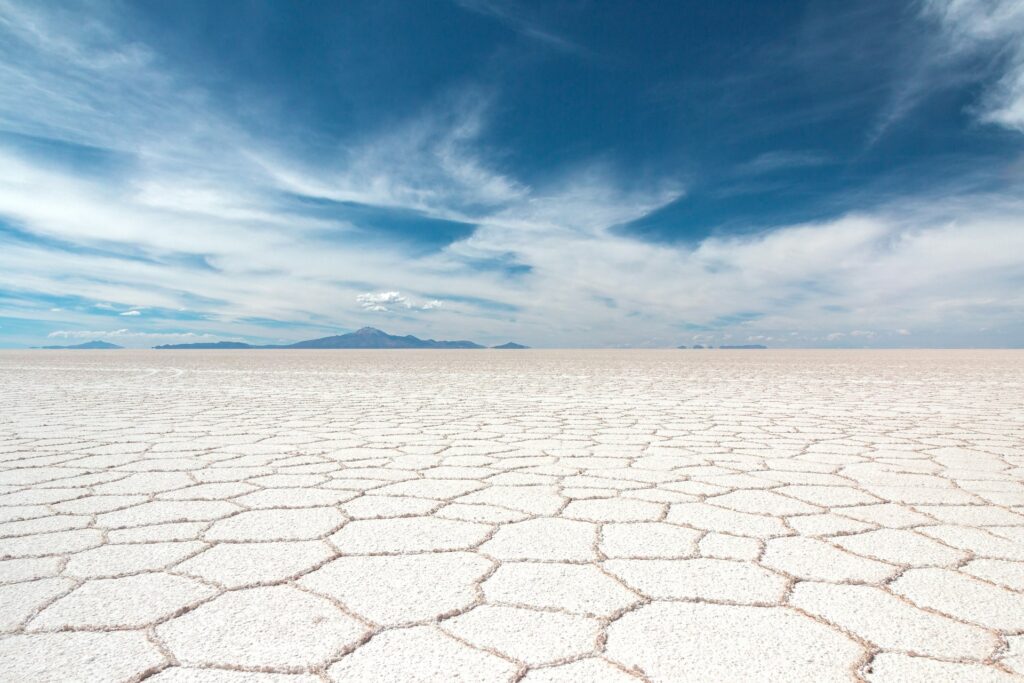
Bolivia’s Salar de Uyuni is the largest salt flat on earth and one of the most visually disorienting places a person can stand. At over 10,000 square kilometres of blinding white crust sitting at nearly 3,700 metres above sea level, it doesn’t look or feel like anywhere else on the planet for some pretty major reasons.
The scale is genuinely incomprehensible in person.
Photographs don’t prepare you for the reality of standing somewhere with no visible boundary in any direction. The salt flat stretches so far that the curvature of the earth becomes apparent, and the absence of any reference point for distance or scale creates a disorientation that’s difficult to describe to someone who hasn’t experienced it. Your brain keeps trying to find the edge and there isn’t one, which produces a sensation that’s somewhere between awe and mild existential unease.
The surface looks like it was tiled by something enormous.
The hexagonal patterns that form across the salt crust are one of the flat’s most striking features, created by the expansion and contraction of the salt as moisture evaporates. From above, they look like an infinite mosaic. From ground level, they stretch in every direction with an eerie geometric precision that feels less like a natural landscape and more like something that was deliberately constructed. Nothing in ordinary experience prepares you for a natural surface that looks this designed.
@zenifie.com Ever seen the sky on the ground? Welcome to Salar de Uyuni, Bolivia — the world’s largest natural mirror! So smooth it looks like Earth just got a full-body wax! Mirror illusions, surreal beauty, and hidden treasures below the surface… This isn’t just a place, it’s nature’s wildest flex. #SalarDeUyuni #Bolivia #TravelTok #MirrorWorld #HiddenGem #NatureLovers #Illusion #Wanderlust #naturalwonder #foryou #fyp ♬ original sound – Zenifie
The reflections create a perfect mirror world.
During the wet season, a thin layer of water covers the salt and creates one of the most extraordinary optical effects on earth. The sky reflects so completely and clearly in the water that the horizon disappears entirely, and it becomes impossible to tell where the ground ends and the sky begins. Clouds appear beneath your feet, the sun sets in both directions simultaneously, and the experience of walking across it produces a genuine and disorienting sense of floating in something infinite.
The light behaves differently here.
At high altitude, with white salt in every direction, the light is reflected and intensified in ways that feel entirely wrong to eyes calibrated for ordinary landscapes. Shadows fall differently, distances are impossible to judge accurately, and the brightness on a clear day is so extreme that sunglasses alone are often insufficient. Photographers who visit for the first time consistently report that their instincts about exposure and framing don’t work here in the way they do everywhere else.
The silence has a physical quality to it.
Away from the edges of the flat and any other visitors, the silence at Salar de Uyuni is the kind that most people in the modern world simply never encounter. No traffic, no wind on most days, no wildlife, no ambient noise of any kind. The absence of sound becomes its own presence, and many visitors report that it creates a sensation of pressure or unreality that takes some adjustment. It’s the kind of quiet that makes you aware of sounds in your own body that are usually completely inaudible.
The horizon is perfectly, unnaturally flat.
Most landscapes have something on the horizon: a hill, a building, a treeline, a variation of some kind. Salar de Uyuni has nothing. The horizon is a clean, unbroken line in every direction, and the visual effect of standing inside what amounts to a perfect circle with a flat white floor and a dome of sky overhead produces a sense of being on a stage set rather than a planet. It triggers a low-level wrongness in the brain that’s hard to attribute to any single element.
The altitude adds a layer of unreality to everything.

At nearly 3,700 metres, the reduced oxygen affects perception in subtle ways that compound the visual strangeness. Colours can appear slightly more vivid, physical effort produces an unusual awareness of the body, and many visitors report a mild dreamlike quality to their experience that persists throughout their time on the flat. Whether this is purely physiological or a combination of altitude and environment is hard to separate, but the effect is real and consistent across accounts.
The islands of cacti look like they’ve been placed there deliberately.
Rising from the flat are several rocky outcrops covered almost entirely in giant cacti, some reaching several metres in height. Isla Incahuasi is the most visited, and the effect of a dense cactus forest emerging from an otherwise featureless white plain is profoundly surreal. The cacti grow slowly, some estimated at over a thousand years old, and the combination of their age, their scale, and the complete absence of any other vegetation creates something that looks very much like production design for a science fiction film.
The colours change in ways that feel impossible.
The flat isn’t always white. Depending on the time of day, the season, and the weather, it moves through shades of blue, grey, gold, pink, and deep orange in ways that feel more like a digital rendering than a physical landscape. Sunrise and sunset in particular produce colour combinations that most visitors struggle to believe they’re seeing with unedited eyes, and the fact that the colour is coming from both the sky and its reflection doubles the intensity in a way that becomes genuinely overwhelming.
@adrienrazaThe sunset of my life! ✨ Just a few simple slides at Salar De Uyuni make the whole trip worth it!
There are active geothermal features at the edges.
The surrounding region includes geysers, hot springs, and bubbling mud pools that add a primordial quality to the landscape. The Sol de Mañana geyser field releases jets of steam from cracked earth at temperatures that make the ground feel hostile and alive, and the sulphurous smell and constant activity create an environment that feels less like somewhere habitable and more like a planet still in the process of forming. Standing there in the early morning with steam rising around you in the pre-dawn cold is as close as most people will ever get to feeling like they’re witnessing geology in real time.
The flamingos make the strangeness complete.
The shallow lakes at the edges of the region, tinted pink and red by algae, are home to large populations of flamingos that seem almost hallucinatory against the white and red landscape. The visual combination of birds that already seem improbable standing in candy-coloured water surrounded by salt desert and distant volcanoes produces an image so unlikely that most first-time visitors instinctively question whether what they’re seeing is real. It’s one of those places where the actual wildlife looks more like special effects than actual wildlife.
It changes the way you think about what a planet is.
Most people carry an unconscious assumption that earth looks a certain way, and Salar de Uyuni doesn’t fit that assumption at any point during a visit. Standing on the flat on a clear day with nothing in any direction, with the curvature of the earth visible and the sky indistinguishable from the ground beneath your feet, the cognitive categories that usually organise experience simply stop working. It doesn’t feel like a dramatic version of somewhere familiar. It feels like somewhere else entirely, and the strangeness of that sensation tends to stay with people considerably longer than most travel experiences do.