
The gyrfalcon unfortunately doesn’t get the same hype as polar bears or wolves, but up in the Arctic it sits right at the top of the food chain. This bird is power, patience, and precision wrapped in feathers. Here are twelve wild facts about the Arctic’s top hunter that most people never hear about.
It’s the largest falcon on Earth.
The gyrfalcon isn’t just big for the Arctic. It’s the biggest falcon anywhere in the world. Females can weigh more than twice as much as males, which is common in birds of prey, but still impressive when you see one up close. Needless to say, its size gives it serious hunting muscle. A bigger body means more strength in the wings and more force in a strike. When this bird dives, it doesn’t mess about. It hits hard and fast, often knocking prey out of the air in one blow.
It lives in some of the harshest places on the planet.
You will find gyrfalcons across the far north, including parts of Greenland, Iceland and northern Canada, all within the wider Arctic region. Winters there are long, dark and brutally cold. Most birds migrate to escape that kind of weather. The gyrfalcon often stays put. It has adapted to freezing winds and snowstorms in a way few birds can. Surviving up there means it’s built tough, from beak to talons.
@exploreorg Gyrfalcons are the only falcon you’ll ever see with white feathers #birdweek #falcon #birds #nature ♬ original sound – Sarah Cothran
It hunts other birds in midair.
While some birds of prey swoop down on rodents or fish, the gyrfalcon specialises in taking down other birds. Ptarmigan are a favourite, but it will also go after ducks and seabirds. It often chases its prey low over the ground in long, powerful flights, rather than just diving from great height. That pursuit can stretch over surprising distances. Imagine a high speed aerial chase across snow and ice, and that’s a normal day for this hunter.
It comes in different colour forms.
One of the most striking things about the gyrfalcon is how much its appearance can vary. Some are dark grey, others almost white. The white ones blend beautifully into snowy landscapes, and that colour variation isn’t random. In areas with more snow cover, lighter birds are more common because they are better camouflaged. It’s nature’s way of matching predator to environment.
It doesn’t build its own nest.
Unlike many birds, the gyrfalcon usually doesn’t bother constructing a fresh nest. Instead, it takes over old nests built by ravens or other large birds. Sometimes it nests on cliff ledges or rocky outcrops without much structure at all. The location matters more than the decoration. High, remote and hard to reach is the goal.
It has been prized for centuries in falconry.
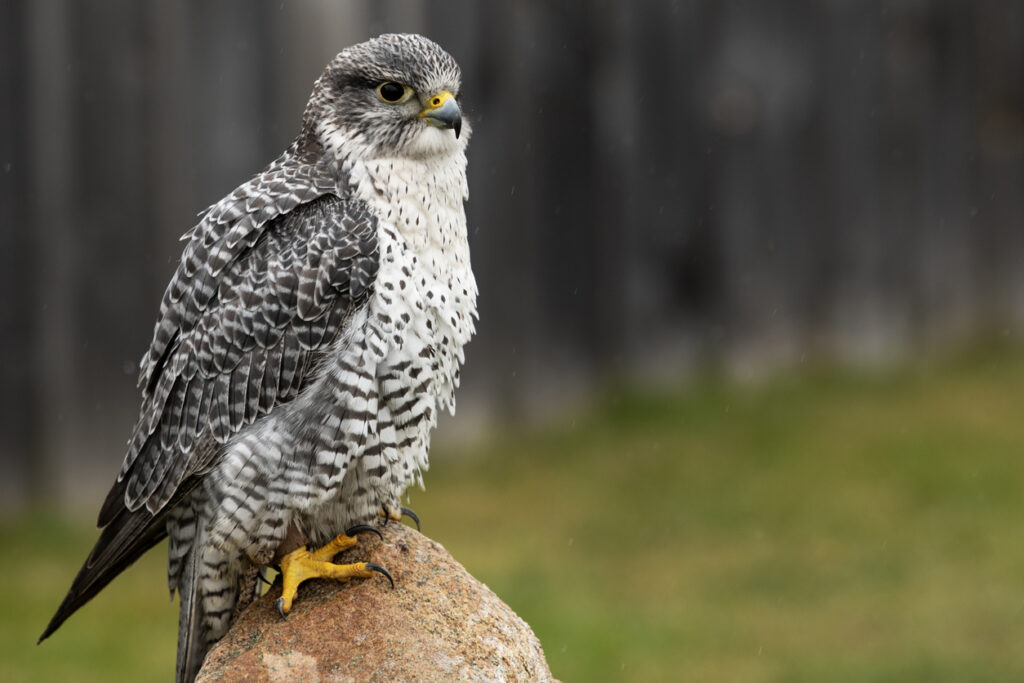
For hundreds of years, gyrfalcons were considered the ultimate falconry bird. In medieval Europe, they were so highly valued that they were often reserved for royalty. Their strength and hunting skill made them a status symbol as much as a working bird. Owning one wasn’t just about sport. It was about power and prestige.
It can survive on a single main prey species.
In some Arctic regions, the gyrfalcon relies heavily on one bird, the ptarmigan. When ptarmigan numbers rise and fall, gyrfalcon breeding success often follows. This tight link shows how connected Arctic ecosystems are. If prey numbers drop sharply, the falcons may lay fewer eggs or skip breeding altogether. Life at the top still depends on what is happening lower down.
Its eyesight is razor sharp.
Like other falcons, the gyrfalcon has extraordinary vision. It can spot prey from long distances across open tundra, where there’s almost nowhere to hide. That wide, open landscape works in its favour. With little cover for prey and very little obstruction to its view, the gyrfalcon can scan huge areas in a single glide.
@smjfalconry 5 Gyr Falcon Facts! this beautiful falcon species has always been admired as the king of falcons due to its size and beauty. #kingsbird #gyrfalcon #whitefalcon #birdsofprey #smjfalconry ♬ original sound – SMJ Falconry
It’s built for power rather than pure speed.
When people think of falcons, they often think of the peregrine falcon, famous for its record-breaking dives. The gyrfalcon isn’t quite as fast in a straight vertical stoop, but it makes up for that in stamina and strength. Its long wings and strong body allow it to chase prey over distance and in tough winds. In the Arctic, endurance can matter just as much as raw speed.
It defends its territory fiercely.
Breeding pairs can be extremely protective of their nesting sites. If another bird of prey drifts too close, it may be met with loud calls and aggressive flights. That boldness makes sense when you think about how limited good nesting spots are in rocky Arctic landscapes. A strong pair will return to the same territory year after year if conditions allow.
It sometimes hunts on the ground.
Although it’s a master of the sky, the gyrfalcon isn’t afraid to finish a hunt on the ground. After knocking prey down, it will land quickly to secure it before it can escape. On snow-covered tundra, that white or pale plumage can make it surprisingly hard to spot. For the prey, what looked like an empty stretch of snow can suddenly turn into a lethal ambush.
It sits at the very top of the Arctic food web.
In much of its range, the gyrfalcon has few natural predators. It’s one of the dominant avian hunters of the far north. That top position also makes it important for scientists. Changes in its numbers can hint at wider shifts in Arctic ecosystems. When the Arctic changes, the gyrfalcon feels it, and so its story is closely tied to the health of the region itself.