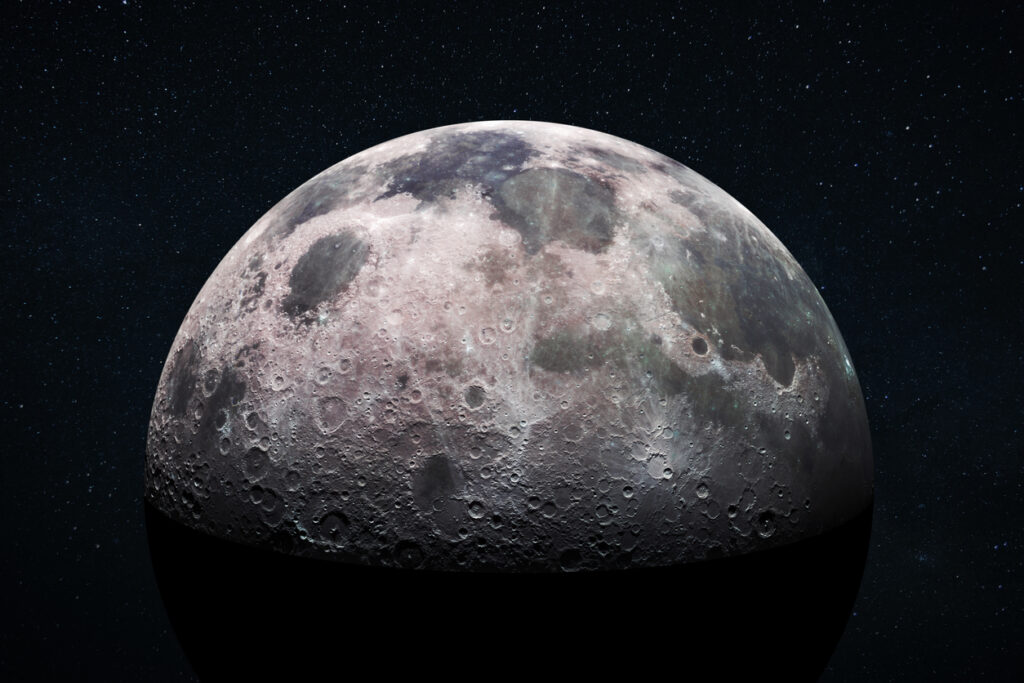
You’ve seen it countless times, that enormous moon rising over the horizon looking impossibly large, then hours later it’s high in the sky appearing significantly smaller. The difference feels so obvious that you assume it must be some atmospheric effect or the moon actually being closer, but here’s the unsettling truth: the moon hasn’t changed size at all, and your brain is lying to you about what you’re seeing.
The moon is actually the same size regardless of position.
You’re absolutely convinced the horizon moon is bigger because the difference feels so dramatic, but measuring it with your thumb at arm’s length or photographing it proves the angular size is identical whether it’s rising or overhead. Your perception is wrong, consistently and predictably wrong, but wrong nonetheless. The moon doesn’t get closer to Earth based on where it appears in the sky.
It’s called the moon illusion rather than the moon effect. It’s not a physical phenomenon, it’s a perceptual trick your brain plays on you, and knowing it’s an illusion doesn’t stop you experiencing it because the effect operates below conscious awareness.
Your brain uses surrounding objects as size references.
When the moon sits near the horizon, your brain compares it to trees, buildings, and mountains, objects with known sizes that make the moon appear enormous by contrast. Overhead, the moon floats in empty space with no reference points, giving your brain nothing to compare it against, so it defaults to perceiving it as smaller even though the actual size hasn’t changed.
The illusion is stronger in urban or forested areas than open plains. More contextual objects mean stronger comparative cues, amplifying the effect and making the horizon moon seem even more dramatically oversized.
Perspective compression tricks your depth perception.
Your brain interprets the horizon as farther away than the overhead sky, applying perspective rules that suggest distant objects appearing this large must be genuinely massive. Overhead, the moon seems closer in your mental model of space, so the same angular size registers as a smaller actual object. Your visual system is applying depth cues that don’t actually apply to objects 384,000 kilometres away.
Flat Earthers sometimes cite the moon illusion as evidence. They’re experiencing a genuine perceptual phenomenon but misinterpreting it as physical proof of their claims rather than recognising it as their brain’s depth perception system malfunctioning.
The sky isn’t actually a dome, but your brain thinks it is.

You perceive the sky as a flattened dome rather than a true hemisphere, with the horizon seeming farther away than directly overhead. This “celestial dome” model makes your brain assume anything at the horizon must be more distant, and therefore if it appears this large whilst being farther away, it must be genuinely huge. The geometry is wrong, but your visual processing system doesn’t know that.
That’s why the moon looks bigger at the horizon, but stars don’t show the same dramatic effect. Your brain doesn’t have the same distance miscalculation for tiny points of light that it has for large objects with defined edges.
Eye movement affects how your brain processes size.
Looking at the horizon requires different eye and head positions than looking overhead, and these physical differences influence how your brain interprets size. Gazing upward with your head tilted back involves different muscular feedback than looking straight ahead, and your visual system factors in these proprioceptive cues when judging object size, creating inconsistent size estimates for identical stimuli.
Lying down and looking at the overhead moon can sometimes reduce the illusion slightly. You’ve changed the physical relationship between your body position and viewing angle, disrupting some of the cues that contribute to the size misperception.
Atmospheric refraction is real but makes the moon smaller, not larger.
You’ve probably heard atmospheric distortion explains the large horizon moon, and whilst the atmosphere does affect the moon’s appearance, it actually compresses it vertically by about one percent, making it slightly smaller and oval-shaped rather than larger. The refraction explanation sounds scientific but actually works opposite to what people claim, debunking rather than confirming the size difference.
Careful observation shows the horizon moon is slightly flattened. The atmosphere is doing something, just not what people think, and that actual effect contradicts the perceived enlargement rather than explaining it.
The Ponzo illusion explains part of the effect.
This classic optical illusion shows two identical lines appearing different sizes when surrounded by converging lines, suggesting perspective depth. The horizon moon sits in a visual context full of these perspective cues, trees, and buildings appearing to recede into the distance, creating a natural Ponzo illusion that makes the moon appear larger just as those identical lines appear different sizes in the classic demonstration.
The illusion is strongest when interesting foreground objects are present. Telegraph poles, buildings, or tree lines create strong linear perspective cues that enhance the Ponzo effect and amplify the moon’s apparent size.
Colour changes reinforce the illusion.

The horizon moon often appears orange or reddish due to atmospheric scattering, whilst the overhead moon is typically pale white or yellow. This colour difference makes them feel like different objects entirely, reinforcing your perception that they’re different sizes even though colour and size are unrelated attributes. Your brain links the colour change with a size change, creating a more convincing illusion.
The illusion can feel weaker on extremely clear nights when colour difference is minimal. Without that additional perceptual distinction, the size illusion loses some of its psychological reinforcement.
Expectation influences what you perceive.
You’ve been told since childhood that the horizon moon looks bigger, you’ve experienced it repeatedly, and now you expect it every time, creating a self-fulfilling perceptual prophecy. Expectation is a powerful force in perception, priming your visual system to see what you anticipate seeing rather than what’s objectively there. You’re experiencing what you expect to experience.
That’s why telling people it’s an illusion before they observe often reduces, but doesn’t eliminate the effect. Knowledge fights expectation, but expectation usually wins because the perceptual processing happens before conscious reasoning kicks in.
Angular size constancy is failing.
Your brain normally maintains size constancy, perceiving objects as staying the same size despite changing distance. A person walking away doesn’t seem to shrink even though their image on your retina does because your brain compensates using depth cues. With the moon, this system malfunctions, applying size constancy when it shouldn’t, trying to maintain a constant perceived size for an object whose distance your brain is misjudging.
The illusion is uniquely strong for celestial objects. Your size constancy system evolved for earthly distances and fails catastrophically when applied to objects hundreds of thousands of kilometres away, where normal depth cues are meaningless.
Memory makes the effect seem stronger than it is.
When comparing the horizon moon to your memory of the overhead moon hours earlier, you’re not comparing two accurate visual records, you’re comparing current perception to a distorted memory. Memory exaggerates differences, making the horizon moon seem even larger in recollection than it did in the moment, and making the overhead moon seem smaller in retrospect than it appeared when you actually saw it.
People are often shocked when shown photographs proving the sizes are identical. Their memory insisted the difference was enormous, but objective evidence reveals the illusion is entirely perceptual, existing only in the moment of observation and in the unreliable memory afterward.
There’s still no complete scientific consensus.
Despite centuries of study and numerous competing theories, psychologists and vision scientists don’t fully agree on which combination of factors creates the moon illusion or which theory best explains the effect. Multiple mechanisms probably contribute, but their relative importance and how they interact remains debated, meaning the complete explanation for why your brain consistently lies about the moon’s size is still partially mysterious.
It explains why new papers about the moon illusion still appear regularly. It’s a deceptively simple phenomenon that turns out to be fiendishly complex to explain comprehensively, revealing how much we still don’t understand about how human visual perception actually works.