
When you think of the biggest dinosaurs—Brachiosaurus, Diplodocus, Argentinosaurus—they weren’t terrifying meat-eaters. They were leaf-lovers. So why were they so enormous? It’s not like trees were running away from them. But when you dig into the science, it becomes clear: size wasn’t just about looking impressive. These giants had to grow big just to survive in the world they lived in. Here’s what’s behind it.
Bigger bodies helped them digest tough plants.
Leaves, ferns, and conifers aren’t exactly soft on the stomach. They’re fibrous, low in calories, and hard to break down. A massive gut gave these dinosaurs the room to ferment and digest plant matter slowly and efficiently. The longer the food stayed in their system, the more nutrients they could squeeze out. Basically, their sheer size gave their stomachs time and space to do the hard work.
They had to eat an unbelievable amount.
When your food isn’t high in calories, you’ve got to eat a lot of it. Big bodies meant they could browse all day long without needing to run around hunting. They could just strip leaves from treetops and keep moving. Being tall helped too. The higher they could reach, the more food they had access to. Plus, they didn’t have to compete as much with smaller, ground-level grazers.
Size helped protect them from predators.
It’s hard to mess with something the size of a two-story house. Their sheer mass acted as a defence against meat-eating predators like Allosaurus or even T. rex (though they came later). Young or smaller dinosaurs were easy targets, but full-grown sauropods were so big that most predators wouldn’t even bother trying. Sometimes, just being huge is protection enough.
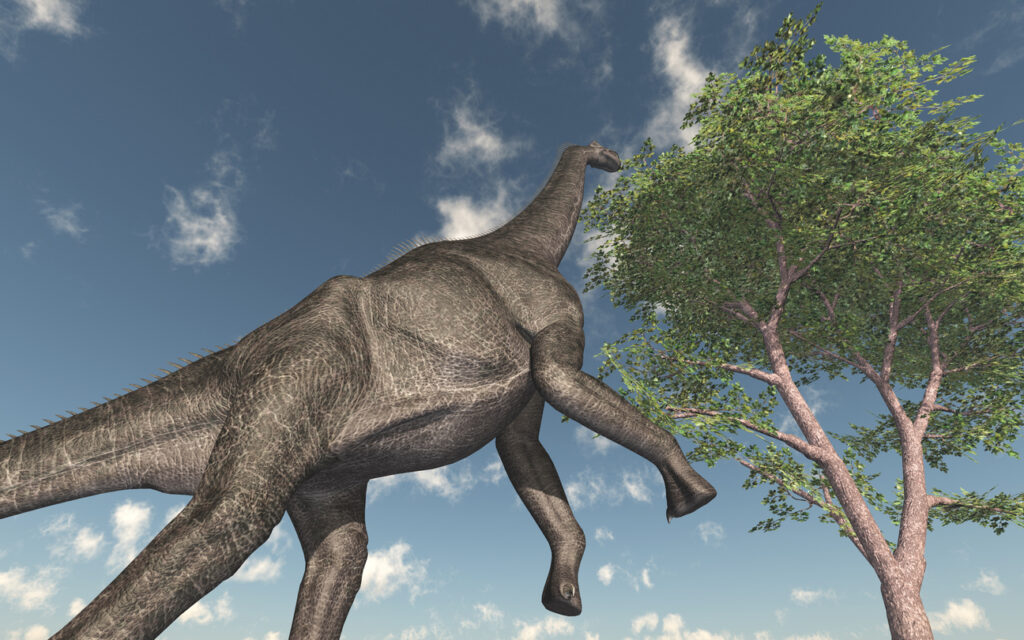
They didn’t chew; they swallowed food whole.
Unlike mammals, many herbivorous dinosaurs didn’t chew their food. They had peg-like teeth to strip leaves, but then it all went straight down. That meant they needed massive guts to handle big quantities of unchewed plant material. Imagine swallowing mouthfuls of raw salad without chewing, then imagine needing to do that all day, every day. Their bodies had to do what their teeth didn’t.
Their long necks let them feed efficiently.
Some sauropods had necks over 10 metres long, which let them reach a wide area without moving much. Their body size helped support that massive neck and the long digestive tract it fed. Instead of walking from tree to tree, they could stay in one spot and just sweep their neck side to side, saving energy while still hoovering up tons of foliage.
Their size helped regulate body temperature.
Large animals lose heat more slowly than small ones. In hot climates, a giant body with a low surface-area-to-volume ratio could help them stay cooler during the day and warmer at night. That sort of thermal stability is called “gigantothermy,” and it may have helped sauropods survive in environments that swung between scorching sun and cooler nights.
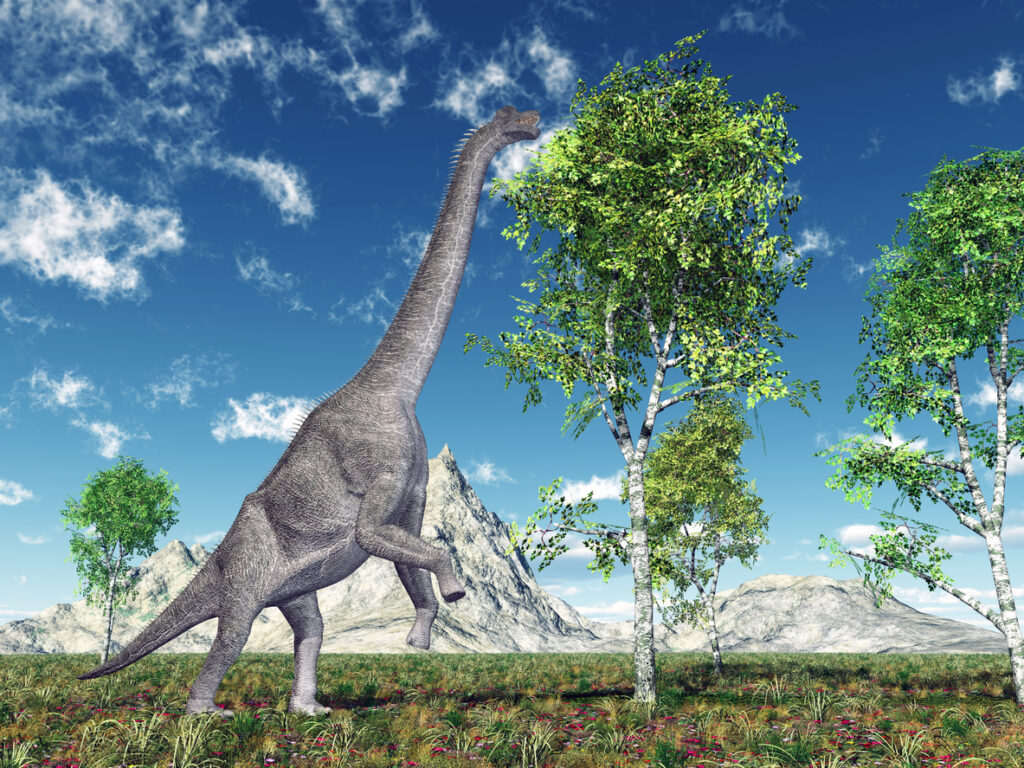
Their bigger size made them more mobile over long distances.
Despite their bulk, many large herbivores could walk long distances. Having huge strides meant they could cover ground efficiently when moving between feeding grounds or migrating to new areas. Big size doesn’t necessarily mean slow. Their long legs helped them move steadily across massive landscapes, which would’ve been essential during dry seasons when food was scarce in one spot.
They lived in a world full of massive plants.
Back then, many plants grew taller and faster than we see today—think tree ferns, giant horsetails, and massive conifers. To reach and eat those, dinosaurs had to keep up in size. It was a bonus to be big, obviously, but it was also kind of necessary to get to the good stuff. Their size matched the scale of the landscape around them.
Their growth helped them reach maturity faster.
Some studies suggest that growing big quickly helped herbivorous dinosaurs survive their most vulnerable years. The faster they got too large for predators to mess with, the better their odds. Getting huge was about survival as a whole, not just food. A young sauropod that could bulk up quickly had a much better shot at seeing adulthood.
It just worked, and evolution doubled down.
Once being huge proved effective, evolution ran with it. Over time, the biggest leaf-eaters survived, passed on their genes, and created even bigger offspring. The size wasn’t random; it was the result of millions of years of pressure to grow or be eaten, or starve. So in the end, these towering vegetarians didn’t just eat leaves. They turned eating leaves into a full-time survival strategy, and their bodies grew massive to make it work.