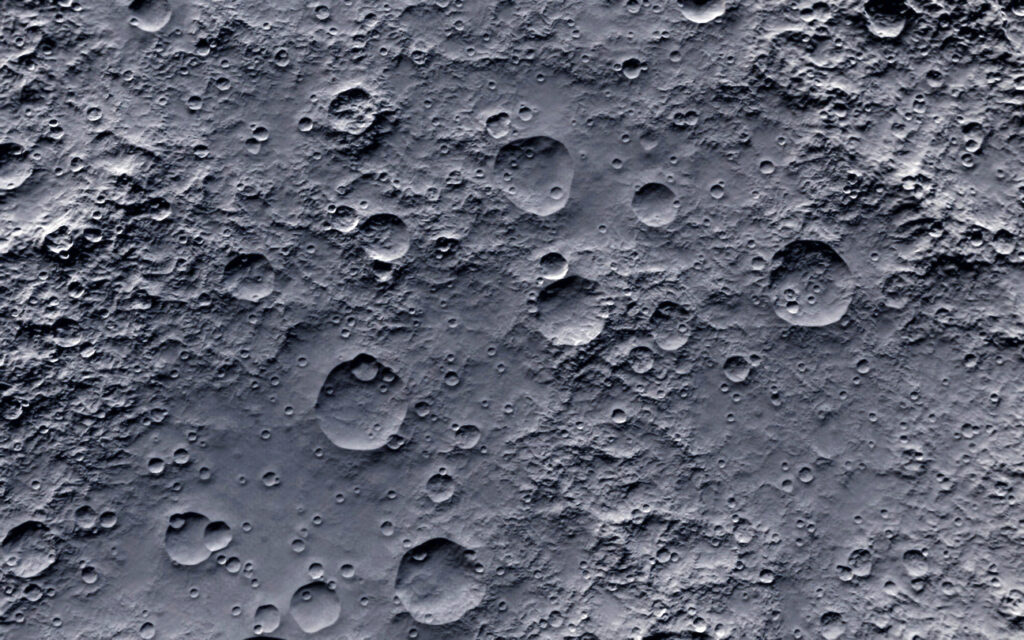
If you look at the Moon through binoculars or even a small telescope, the first thing you notice is the surface. It’s covered in round scars of all sizes. These are craters, and many of them formed billions of years ago, when the young solar system was a far messier and more violent place than it is today.
Space rocks smashing into the Moon at incredible speed contributed.
Most lunar craters were formed by impacts. Space is full of rocky debris called asteroids and meteoroids, and in the early days of the solar system these objects collided with planets and moons far more often than they do now. When one of these rocks slammed into the Moon, it released an enormous amount of energy.
Even a small rock hitting at tens of thousands of kilometres per hour behaves more like an explosion than a simple crash. The impact blasts material outward, digs a bowl-shaped hole, and throws debris across the surface. That violent process leaves behind the circular craters we see today.
The Moon has no atmosphere to burn up incoming objects.
On Earth, many small space rocks never reach the ground because our atmosphere burns them up first. Friction heats them until they break apart or vaporise, which is why we often see shooting stars streak across the night sky. The Moon has almost no atmosphere at all. That means even tiny meteoroids can hit the surface without slowing down much. Over billions of years, those constant impacts have peppered the Moon with craters of every size.
@georgturprr Why The Moon & Mars Are Covered in Craters ☄️ #moon #astrophysics #mindblowingfacts #briancox #foryoupage ♬ original sound – PhysicsInFocus
There’s no wind or rain to erase the damage.
Earth constantly reshapes its own surface. Rain, rivers, wind, plants, and shifting tectonic plates slowly wear down or bury impact craters. Many of the craters that formed on Earth long ago have disappeared because the landscape keeps changing.
The Moon doesn’t have weather or flowing water. There is no wind to smooth the ground and no rain to wash things away. Once a crater forms, it can remain almost unchanged for millions or even billions of years.
Giant impacts once struck during the solar system’s early chaos.
The largest lunar craters formed during a period scientists call the Late Heavy Bombardment. Roughly four billion years ago, huge numbers of asteroids and comets were flying around the inner solar system and frequently colliding with planets and moons.
Some of these impacts were enormous. They created massive basins hundreds of kilometres wide. Many of the dark patches you can see on the Moon with the naked eye are actually ancient impact basins that later filled with lava.
The round shape comes from explosive energy.
People sometimes wonder why lunar craters are almost always circular. Even if the incoming rock strikes at an angle, the resulting crater usually ends up round. This happens because the energy of the impact spreads outward equally in all directions when the surface explodes on contact. Instead of carving a long groove, the blast throws material out in a circle, leaving the familiar bowl-shaped crater behind.
Some craters were later flooded by ancient lava.
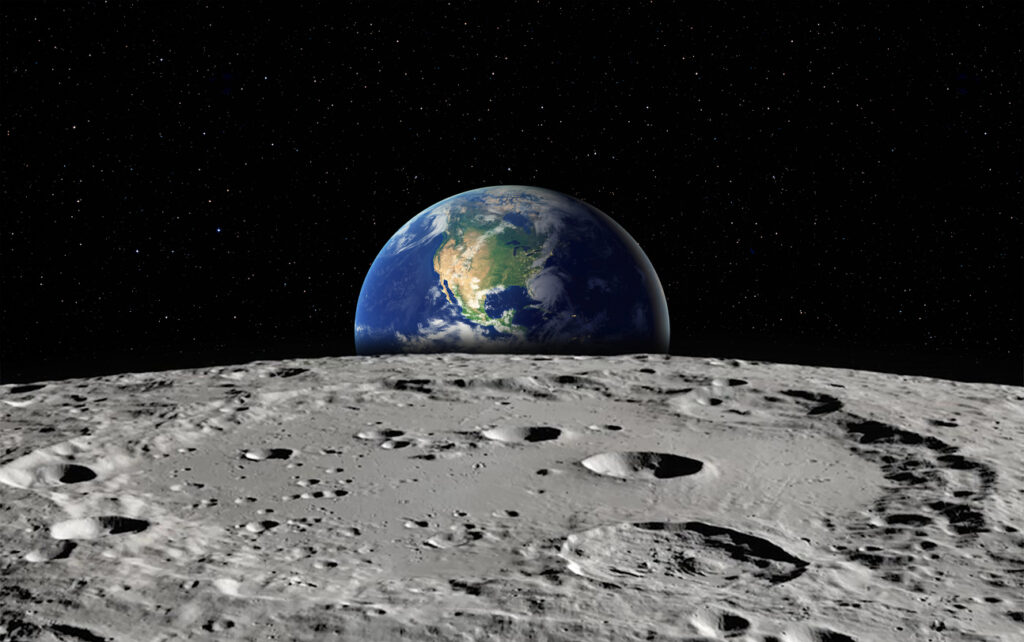
After certain giant impacts created deep basins, molten rock from inside the Moon slowly rose and filled them. When this lava cooled, it created the smooth, darker regions known as lunar maria, which means seas in Latin. These areas look flatter than the heavily cratered highlands around them. Even so, they still contain many smaller craters that formed after the lava hardened, showing that impacts continued for a long time afterward.
Small impacts still happen today.
Although the solar system is calmer now than it was billions of years ago, impacts haven’t stopped entirely. Tiny meteoroids still strike the Moon regularly. Scientists have even observed brief flashes of light on the lunar surface caused by these impacts. Each new strike adds another small crater to the Moon’s already scarred landscape.
Crater rays show where debris was blasted outward.
Some lunar craters have bright streaks radiating away from them. These lines are called crater rays, and they were formed by material blasted across the surface during the impact. When the rock struck the Moon, pieces of debris were thrown out in long arcs and landed far from the original hole. The lighter coloured dust and rock create visible streaks that can stretch for hundreds of kilometres.
@dailymoonofficial @StarTalk (Neil deGrasse Tyson) explaining the original thought of how the craters formed on the moon (Part 1) and how they actually formed (Part 2) in episode #919 of the “Joe Rogan Experience.” Just thought this was interesting information most people didn’t know. #moon #neildegrassetyson #crater #joerogan #astroid #joeroganpodcast #joeroganexperience ♬ som original – AV music
The size of the crater depends on the energy of the impact.
A small pebble-sized meteoroid may only create a tiny pit, while a large asteroid can carve out a crater dozens or even hundreds of kilometres wide. The final size depends on several things, such as the speed of the object and how massive it was. Because most space rocks travel extremely fast, even relatively small objects can create surprisingly large craters. The energy released in the collision is far greater than what we see in everyday impacts on Earth.
The Moon is basically a record book of ancient collisions.
Because the lunar surface changes very slowly, the craters act like a historical archive of the solar system’s past. Each one tells a story about a time when a piece of space debris struck the Moon long ago. By studying the size, depth, and distribution of these craters, scientists can estimate when different regions of the Moon formed. In a way, the Moon’s battered surface preserves a record of cosmic events that happened billions of years before humans ever looked up at the sky.