
The word dinosaur tends to conjure a single image, but dinosaurs existed across a time span so vast that the world they lived in changed almost beyond recognition multiple times over. From the first dinosaurs in the Triassic to the last in the Cretaceous, roughly 165 million years of history passed, which is long enough for continents to move, seas to rise and fall, and the entire character of the planet to transform several times. These ten points give a sense of what that world actually looked like.
The continents were arranged completely differently.
When dinosaurs first appeared around 230 million years ago, all of the world’s landmasses were joined together in a single supercontinent called Pangaea. There was one enormous ocean, known as Panthalassa, surrounding it, and a large shallow sea called the Tethys cutting into the eastern side. Over the course of the Mesozoic era, Pangaea gradually broke apart, first splitting into a northern landmass called Laurasia and a southern one called Gondwana, then fragmenting further into the shapes that would eventually become the continents we recognise today. By the time the dinosaurs disappeared, the world’s geography was beginning to look recognisable, though the details were still quite different from anything on a modern map.
The climate was a lot warmer than today.
For most of the Mesozoic era, the Earth had no permanent polar ice caps, and global temperatures were considerably higher than they are now. The poles were cool and forested rather than frozen, and tropical conditions extended much further toward high latitudes than they do today. There were no grasslands anywhere on the planet during most of the dinosaur era, which is a detail that reshapes the mental image considerably. The world was warmer, wetter in many regions, and covered in vegetation types that don’t exist in the same form anywhere today. Carbon dioxide levels in the atmosphere were substantially higher than current levels, which contributed to both the warmth and the lush plant growth that supported the enormous herbivores.
@media.thv A little perspective of the timespan that dinosaurs ruled the earth. #neildegrassetyson #dinosaur #factual #education ♬ original sound – The History Vault
The plant life was completely alien.
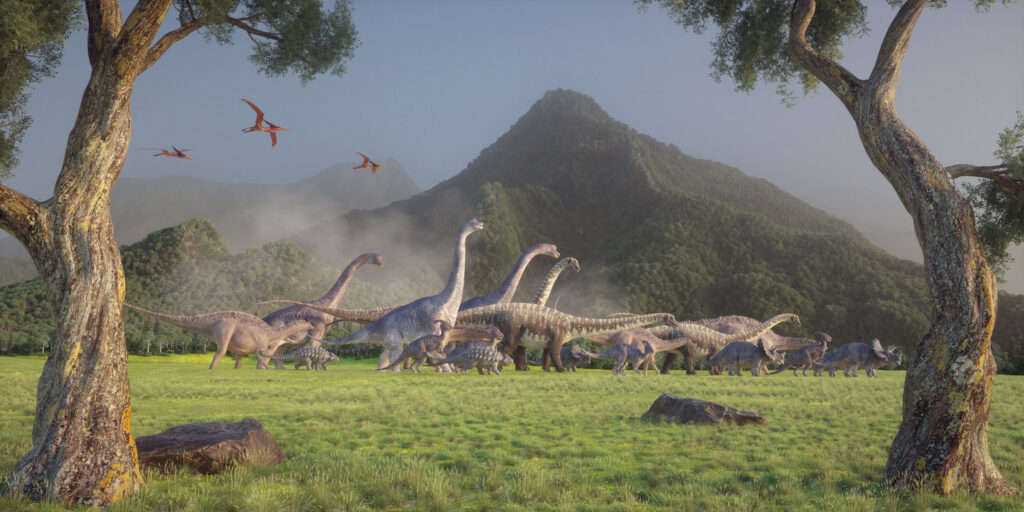
Flowering plants didn’t appear until the Cretaceous period, roughly 130 million years ago, and even then, they took tens of millions of years to become dominant. For most of the time dinosaurs existed, the landscape was covered in ferns, horsetails, cycads, ginkgos, and conifers, producing a world that looked fundamentally different from any modern environment. There was no grass, no wildflowers, no fruit-bearing trees in the familiar sense. The forests were dark-canopied and dense in humid regions, and the absence of the flowering plant diversity that defines modern ecosystems gives the Mesozoic landscape a genuinely alien quality that illustrations only partially capture.
The oceans were dramatically different.
The seas of the Mesozoic were warmer, shallower in many places, and considerably higher than today’s ocean levels, which means that large areas of what is now dry land were submerged under shallow inland seas. The Western Interior Seaway, for example, split North America in two during the Cretaceous, creating a warm, shallow sea running from the Gulf of Mexico to the Arctic. These seas were populated by large marine reptiles including plesiosaurs, mosasaurs, and ichthyosaurs rather than the whales and dolphins of today’s oceans, and the ecosystems within them were structured quite differently from anything in the modern marine world.
The atmosphere had more oxygen at certain points.
Oxygen levels fluctuated in a major way across the Mesozoic era, and at certain points were higher than the current 21% of the atmosphere. Higher oxygen levels support larger body sizes and more energetic metabolisms, which may have contributed to some of the extraordinary scale achieved by the largest dinosaurs. The air also contained higher concentrations of carbon dioxide than today, contributing to the greenhouse conditions that kept global temperatures elevated throughout most of the era. Breathing that air would have felt different from breathing modern air, though not in ways that would have been immediately dangerous to a time-travelling human visitor.
There were no flowers for most of dinosaur history.
This is one of the details that most dramatically reshapes the imagined dinosaur landscape. The riot of colour associated with flowering plants simply didn’t exist for the first hundred million years of dinosaur evolution. The world was green and brown, dominated by the muted tones of ferns and conifers, with none of the colour variation that insects and flowering plants created together. When angiosperms finally began to diversify in the Cretaceous, they transformed the visual landscape of the planet and created new ecological relationships that changed everything from insect populations to the diets of herbivorous dinosaurs. The dinosaur world of popular imagination is largely drawn from the Cretaceous, which is the most colourful period of their existence, but it’s still far less visually varied than anything familiar today.
The days were shorter than they are now.
The Earth rotated faster during the Mesozoic than it does today, which means individual days were shorter, somewhere in the region of 23 hours during the Cretaceous compared to today’s 24. The Moon was also slightly closer to the Earth and appeared larger in the sky, and its gravitational influence produced stronger tidal effects than those we experience now. These are small differences in isolation, but over the hundreds of millions of years of dinosaur existence they add up to a world running on a slightly different clock, with different tidal rhythms and slightly compressed daily cycles that would have influenced the behaviour and biology of every organism in the ecosystem.
@liminaldestinations POV: You slipped through the fabric of time and got stuck in the Jurassic Period 🦕 The Jurassic Period, spanning approximately 201 to 145 million years ago, was a significant era in Earth’s history, marked by the dominance of dinosaurs and the flourishing of diverse plant and animal life. It was the second period of the Mesozoic Era, following the Triassic, and witnessed a warm, humid climate that fostered lush vegetation, including vast forests of ferns, cycads, and conifers. Dinosaurs reached new levels of diversity and size during this time, with iconic species such as the long-necked sauropods and fearsome theropods like Allosaurus thriving across the planet. The oceans teemed with marine reptiles like ichthyosaurs and plesiosaurs, while the skies were increasingly populated by pterosaurs. The Jurassic also saw birds from small, feathered theropods, as demonstrated by Archaeopteryx. Tectonic activity during this period led to the breakup of the supercontinent Pangaea, shaping the early foundations of the modern continents. #jurassic #jurassicera #jurassicperiod #prehistoric #dinosaurs #history #aivideo ♬ original sound – OurUniverse08
The sky looked and sounded different.
Birds as we know them today were just beginning to emerge by the end of the Cretaceous, descended from theropod dinosaurs and coexisting with their relatives during the final tens of millions of years of the Mesozoic. Before that, the skies were dominated by pterosaurs, which ranged from sparrow-sized animals to the enormous Quetzalcoatlus with a wingspan of up to ten metres. The soundscape would have been similarly unfamiliar, with insects producing noise but nothing resembling the bird calls that define outdoor sound in the modern world. The combination of unfamiliar vegetation, different animal calls, and a sky populated by flying reptiles rather than birds would have made the sensory experience of the Mesozoic landscape completely unlike anything that exists today.
Volcanic activity was a lot higher.
The Mesozoic era was a period of intense geological activity, with higher rates of volcanic eruption than the present day contributing to elevated CO2 levels, periodic climate disruption, and the reshaping of landscapes on timescales that would have been perceptible over millions of years. The breakup of Pangaea involved enormous geological forces, and the rifting and collision of tectonic plates produced mountain ranges, opened ocean basins, and created the conditions for the shallow inland seas that characterised so much of the Mesozoic landscape. The end of the dinosaur era itself was accompanied by the Deccan Traps eruptions in what is now India, one of the largest volcanic events in Earth’s history, which contributed to the environmental stress that the Chicxulub asteroid impact finished off.
It was already ancient before the dinosaurs arrived.
One of the things that’s genuinely difficult to internalise about the dinosaur era is that the Earth was already enormously old when it began. By the time the first dinosaurs appeared in the Triassic, complex life had existed on Earth for hundreds of millions of years, entire ecosystems had risen and collapsed, and the planet had already survived multiple mass extinction events. The Permian extinction, which preceded the dinosaurs by a few million years, had wiped out around 96% of marine species and 70% of terrestrial vertebrate species, and the world the dinosaurs inherited was still recovering from that event. The Mesozoic wasn’t the beginning of life’s story on Earth. It was a chapter in the middle of a history that dwarfs even the 165 million years the dinosaurs themselves occupied.