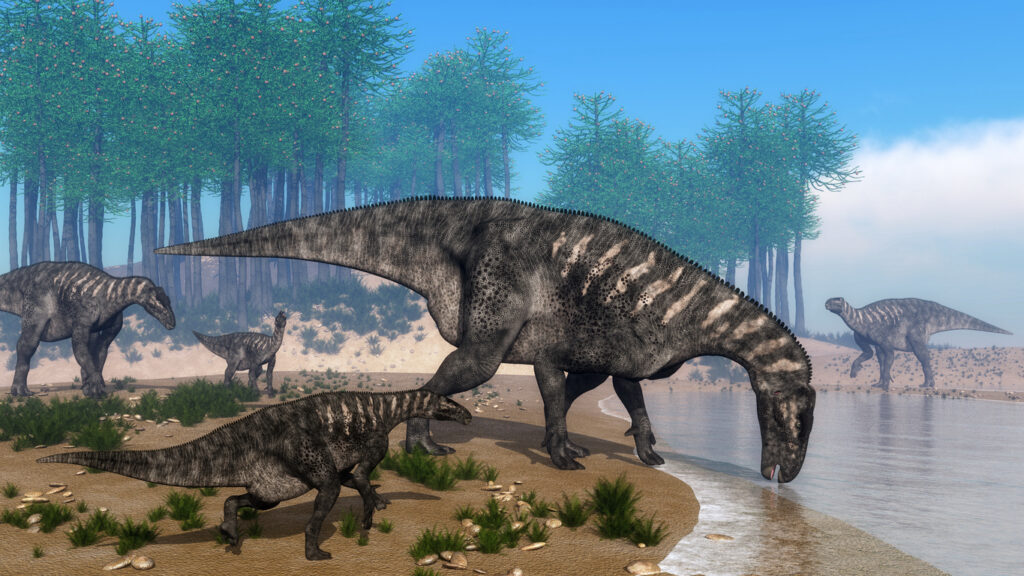
The Iguanodon has had more makeovers than a reality TV star, going from Victorian monster to modern scientific reconstruction as new fossils and techniques reveal what these dinosaurs actually looked like. Our understanding has changed dramatically from those early museum models that made them look like giant iguanas.
They weren’t the massive lizards Victorian scientists imagined.
When Iguanodon was first discovered in the 1820s, scientists literally thought they’d found a giant iguana and built reconstructions that looked like enormous lizards lounging around. The name even means “iguana tooth” because that’s exactly what the first fossil teeth resembled.
These early reconstructions were wildly wrong — they had Iguanodon crawling on four legs with a horn on its nose (which was actually a thumb spike), looking more like a dragon than what we now know these dinosaurs actually looked like. Victorian imagination filled in the gaps with familiar reptile shapes.
They were actually built more like massive, muscular kangaroo.
Modern reconstructions show Iguanodon as bipedal creatures that could also walk on all fours when needed, with powerful hind legs and smaller front limbs. They had deep, barrel-shaped bodies to house massive digestive systems needed for processing tough plant material.
Their posture was much more upright than early scientists thought, with long tails that balanced their bodies rather than dragging behind them. Think of a cross between a kangaroo and a really buff horse, and you’re getting closer to their actual build.
Those famous thumb spikes were actually defensive weapons.
The spike that Victorian scientists stuck on Iguanodon’s nose actually belonged on its hand: a massive, pointed thumb claw that could be used for defence, stripping vegetation, or possibly for social displays. Each spike was about 15 centimetres long and wickedly sharp.
These weren’t delicate little claws, but serious weapons that could do real damage to predators or rival Iguanodons. The rest of their fingers were more like hooves, perfect for supporting their weight when walking on all fours, but not much use for grasping.
They had sophisticated dental batteries for processing tough plants.
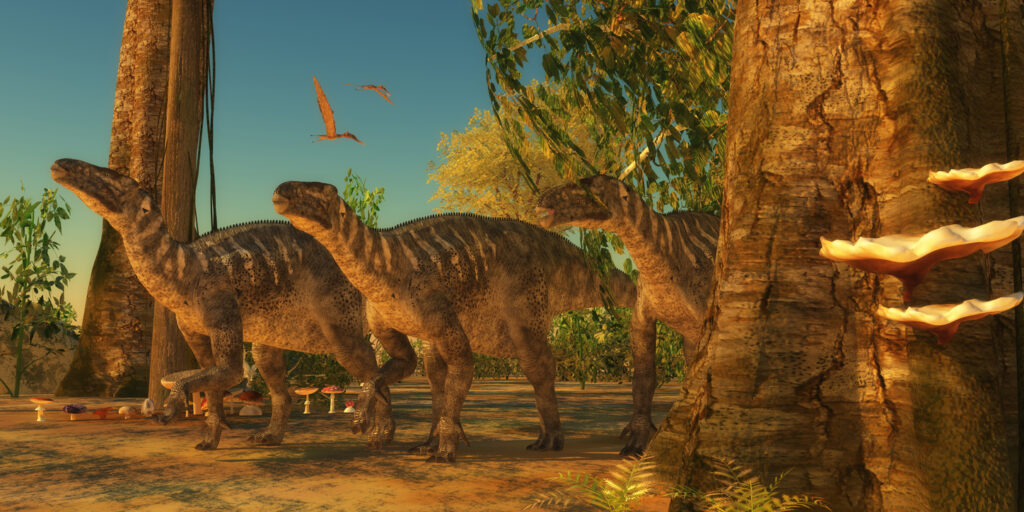
Iguanodon teeth weren’t just simple pegs like modern iguanas — they had complex grinding surfaces arranged in rows that worked like biological food processors. As teeth wore down, new ones grew up from below to replace them throughout their lives.
This dental system was incredibly advanced and allowed them to process tough, fibrous plant material that would be impossible for simpler teeth to handle. They were essentially walking mulching machines with mouths full of self-replacing grinders.
Their skin was likely more like a rhino’s than a lizard’s.
Rare skin impressions suggest Iguanodon had thick, pebbly hide similar to modern elephants or rhinos, rather than the smooth, scaly skin often shown in older reconstructions. The skin had a bumpy texture with different sized scales and tubercles across different parts of the body.
Their tough hide would have provided excellent protection from thorns, branches, and predator attacks while still allowing enough flexibility for the animal to move around effectively. It was functional armour that evolved for their plant-eating lifestyle.
They were probably more colourful than we usually imagine.
New research on dinosaur pigmentation suggests many were much more colourfully patterned than the drab greys and browns of old museum displays. Iguanodon might have had stripes, spots, or patches for camouflage, social signalling, or temperature regulation.
Without direct evidence of Iguanodon colouration, scientists look at modern large herbivores for clues. They might have been anything from zebra-striped to elephant-grey, possibly with different colours for different seasons or social situations.
Their heads were longer and more horse-like than reptilian.

Early reconstructions gave Iguanodon typical lizard heads, but fossil evidence shows they had elongated skulls more similar to modern horses or cows. Their faces were designed for reaching vegetation and housing those complex tooth systems.
The shape of their skulls suggests they had fairly sophisticated jaw muscles and probably quite mobile lips and cheeks for manipulating food. They would have looked much more mammalian around the face than the dragon-like creatures of Victorian imagination.
They lived in herds and had complex social behaviours.
Fossil trackways and bone beds show that Iguanodon travelled in groups, possibly with sophisticated social structures similar to modern large herbivores. They weren’t solitary monsters but social animals that likely communicated and cooperated.
Evidence suggests they may have had different roles within herds, with some individuals acting as lookouts while others fed. Their thumb spikes might have been used for social displays or establishing dominance within the group as much as for defence against predators.
They were surprisingly fast and agile for their size.
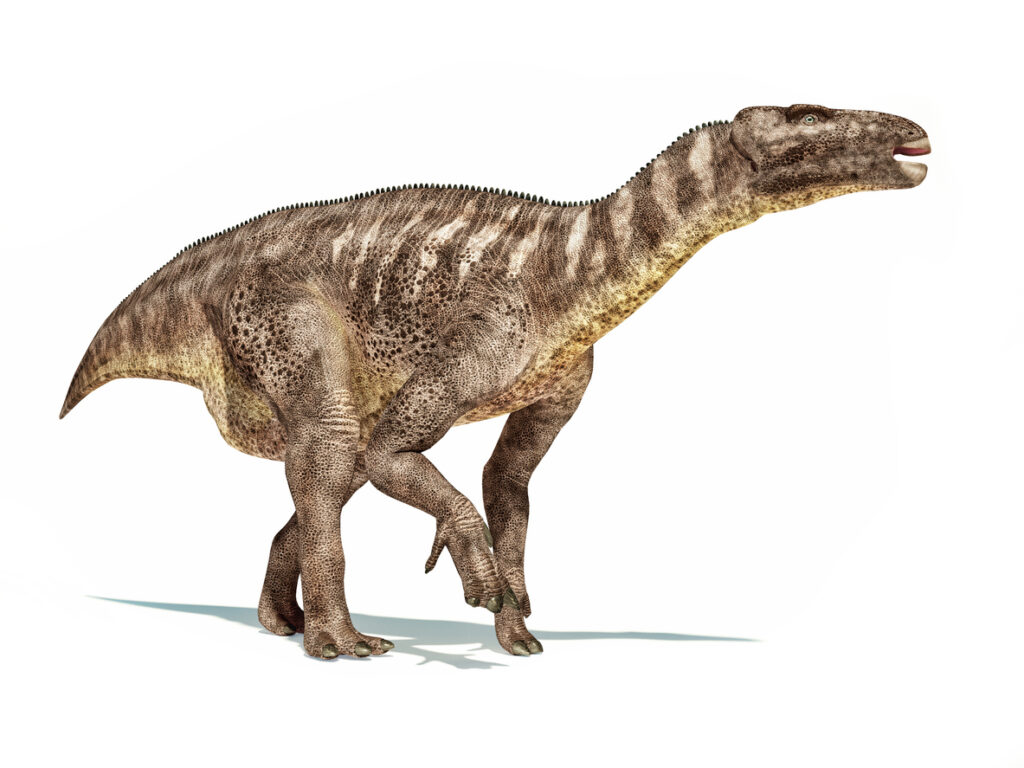
Trackway evidence suggests Iguanodon could move much faster than early scientists thought, possibly reaching speeds of up to 25 kilometres per hour when running on their hind legs. They weren’t lumbering giants but surprisingly athletic animals.
Their long, powerful leg bones and the evidence from fossilized footprints show they were built for covering ground quickly when necessary. They could probably outrun many of the predators in their environment, at least over short distances.
They were much more intelligent than originally assumed.
Brain case studies suggest Iguanodon had relatively large brains for their body size and showed evidence of complex behaviours like tool use, social learning, and problem-solving. They weren’t the dim-witted eating machines of old reconstructions.
Evidence for their intelligence comes from things like varied feeding strategies, complex social behaviours, and their ability to thrive in different environments. They were successful for millions of years across multiple continents, which requires serious adaptability and smarts.