
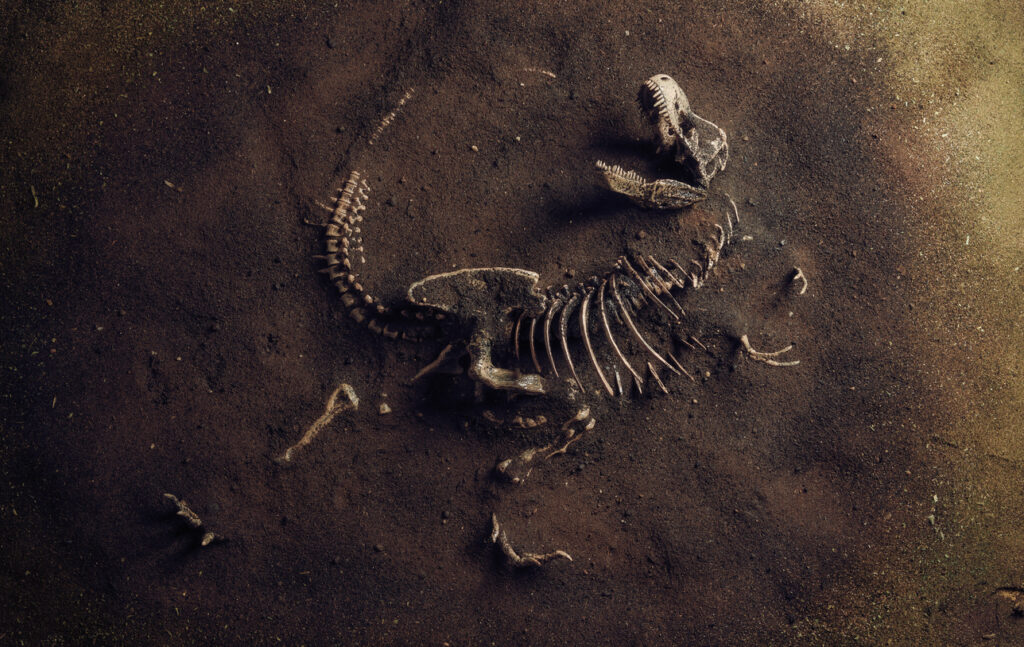
The Tyrannosaurus rex has long been cast as the ultimate predator—a towering, sharp-toothed monster tearing through the Cretaceous like a prehistoric movie villain. That being said, not everyone’s convinced. Some scientists argue that T. rex might not have been the ferocious hunter we imagine, but more of a lumbering scavenger, sniffing out easy meals rather than chasing them down. So what does the evidence actually suggest? Was T. rex a ruthless killer, a giant bin-raider, or maybe something in between?
T. rex had a bone-crushing bite.
One of the strongest arguments for T. rex being a hunter is its bite. It had one of the most powerful bite forces of any land animal to ever exist, strong enough to crush bone with ease. This isn’t just for show; predators need that kind of force to subdue and kill struggling prey.
Scavengers don’t usually need to break bones; they go for soft tissue. The fact that T. rex could pulverise bones suggests it was built to take down big, tough animals, not just nibble leftovers. That’s a big tick in the “hunter” column.
It had forward-facing eyes for depth perception.
Unlike many reptiles, T. rex had forward-facing eyes, giving it binocular vision. That means it could judge distance—an ability that’s incredibly useful for a predator trying to track or strike at moving prey. Most scavengers don’t need this kind of visual precision. So while T. rex may have occasionally feasted on something already dead, its eye setup suggests it was well-equipped for the chase—or at least a stealthy ambush.
Fossil evidence shows prey that survived T. rex attacks.
Palaeontologists have found fossilised bones of herbivorous dinosaurs like Edmontosaurus with healed bite marks from T. rex teeth. That means the animal survived the initial attack, which only makes sense if T. rex was actually hunting it. A scavenger wouldn’t be biting a live, healthy dinosaur in the first place. These bite marks offer some of the most direct evidence that T. rex went after live prey, even if it didn’t always win the fight.
T. rex could move surprisingly fast for its size.
There’s been a lot of debate about how fast T. rex could really move. While it wasn’t sprinting like a cheetah, recent studies suggest it could reach speeds of up to 12–20 mph. For a creature weighing several tonnes, that’s pretty impressive. That speed would have made it more than capable of catching slower or injured prey. It might not have chased things across great distances, but a short burst of speed would be enough for ambush-style attacks.
It likely had an excellent sense of smell.
One of the main arguments for T. rex being a scavenger is its enormous olfactory bulbs, which are the part of the brain linked to smell. That suggests it had a nose capable of detecting dead meat from miles away, which is a classic scavenger trait. However, a good sense of smell also helps predators find prey, especially ones that are injured or hiding. So while its sniffer might have made T. rex an excellent opportunist, it doesn’t rule out hunting. In fact, it might have done both.

Scavenging wasn’t a bad strategy, but not the whole story.
Scavenging gets a bad rap, but many modern predators do it regularly. Lions, hyenas, and even wolves won’t pass up a free meal, and there’s no reason to think T. rex would have either. Eating carrion doesn’t mean it couldn’t also kill when needed. Given the energy it took to sustain such a massive body, it’s likely that T. rex ate whatever it could, dead or alive. In prehistoric ecosystems, food was scarce, and survival meant being flexible, not picky.
Juvenile T-Rexes probably hunted smaller prey.
Younger T-Rexes had different body shapes—longer legs, leaner frames, and quicker movements. That’s led scientists to believe they may have hunted smaller, faster prey on their own before bulking up into adult giants. This life-stage hunting strategy suggests that the species as a whole had hunting instincts from early on. As they grew, their methods may have changed, but the behaviour was likely already there.
The scavenger theory came from a single strong voice.
Much of the “T. rex was just a scavenger” theory traces back to palaeontologist Jack Horner, who argued that its short arms and sense of smell made it a poor hunter. His argument sparked loads of debate and media attention in the 1990s and early 2000s. However, most experts today agree that Horner’s theory was too black-and-white. T. rex likely did both—hunted when it could, scavenged when it made sense. It wasn’t one or the other. It was a highly adaptable apex predator doing what it took to survive.