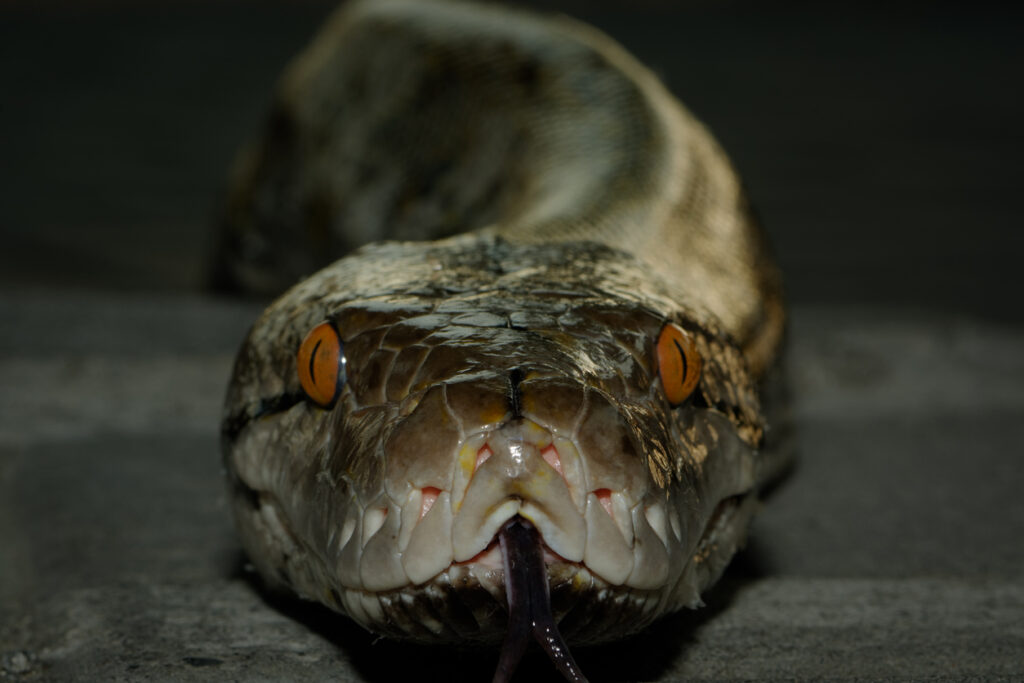
The idea sounds ridiculous at first, like something pulled from a horror film or an internet myth that refuses to die. A snake smaller than a human taking down a fully grown person feels like one of those stories that gets exaggerated every time it’s retold… until you look at the anatomy, the documented cases, and how this particular snake actually hunts.
The reticulated python doesn’t rely on venom or speed. It relies on size, strength, and an unsettling ability to stretch far beyond what most people think is possible. When you understand how its jaws work, how its body expands, and how methodical it can be, the whole thing stops sounding far-fetched and starts sounding deeply uncomfortable.
Reticulated pythons regularly reach over 20 feet long.
These snakes aren’t some rare giant exception, they commonly grow to lengths that dwarf an average human. Wild reticulated pythons typically reach 10 to 20 feet, but individuals over 20 feet are documented regularly in Southeast Asia, where they’re native. The longest verified specimen measured 32 feet, though there are unconfirmed reports of even larger ones.
@crownprinxx The Reticulated Python is a BIG nope rope #python #snake #viral_video ♬ original sound – MoreoddDanny
Their length isn’t just impressive, it’s functional because it gives them the body mass and muscle power needed to constrict and consume large prey. A 20-foot python can weigh over 150 pounds of pure muscle designed specifically for killing and eating things.
Their jaws can unhinge to swallow prey wider than their own head.
The snake’s skull isn’t actually fused together like mammals, instead it’s connected by flexible ligaments that allow the jaw to stretch to ridiculous proportions. They can open their mouth to nearly 180 degrees, and the two halves of their lower jaw can move independently. That means a snake with a head the size of your fist can theoretically swallow something the size of a fully grown pig.
The stretching capability is so extreme that you can watch the snake’s body distend to accommodate prey that looks impossibly large. It’s not a quick process, but it’s relentless, with the snake essentially walking its jaws over the prey using backward-facing teeth.
They’ve actually killed and eaten adult humans.
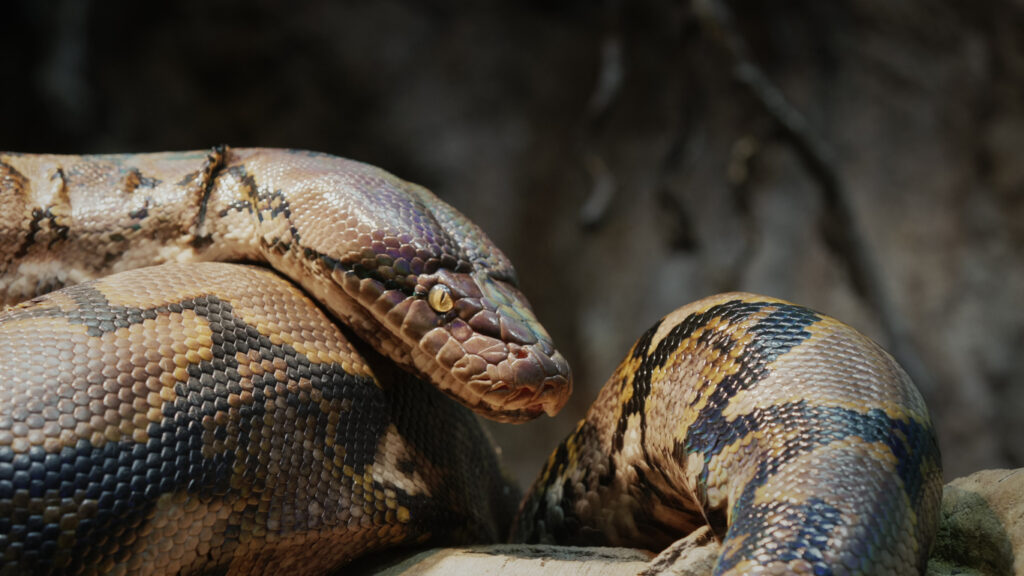
This isn’t theoretical or exaggerated for headlines, there are documented cases of reticulated pythons killing and consuming people. In 2017, a 25-year-old man in Indonesia was found inside a 23-foot python that had swallowed him whole. Another case in 2018 involved a 54-year-old woman, and there have been other incidents across Southeast Asia.
These aren’t common occurrences because humans aren’t their preferred prey, of course, but when hungry pythons encounter people in remote areas, attacks do happen. The victims are typically alone and the snake ambushes them, constricts until they suffocate, then spends hours swallowing the body.
Constriction doesn’t crush bones; it stops you breathing.
The python doesn’t squeeze hard enough to break your ribs or crush your organs, despite what films suggest. Instead, it tightens incrementally every time you exhale, preventing you from drawing another breath. Each time your chest contracts even slightly, the snake takes up that slack and holds it.
Within minutes, you’d pass out from lack of oxygen, and brain death follows shortly after. The snake can feel your heartbeat and breathing through your body and won’t release until both have completely stopped. This method is brutally efficient because the prey dies from asphyxiation whilst remaining intact enough to swallow.
They target the head first to make swallowing easier.
Pythons almost always swallow prey headfirst because it makes the limbs fold back against the body as they go down. If they tried to eat something feet-first, the legs would splay out and get caught. With humans, the snake would position the head first and begin the process of walking its jaws over the skull.
The shoulders are typically the widest part and pose the biggest challenge, but once those are past the jaw, the rest follows more easily. The entire process of swallowing an adult human could take several hours because of the size involved.
Their throat and stomach expand to ridiculous sizes.
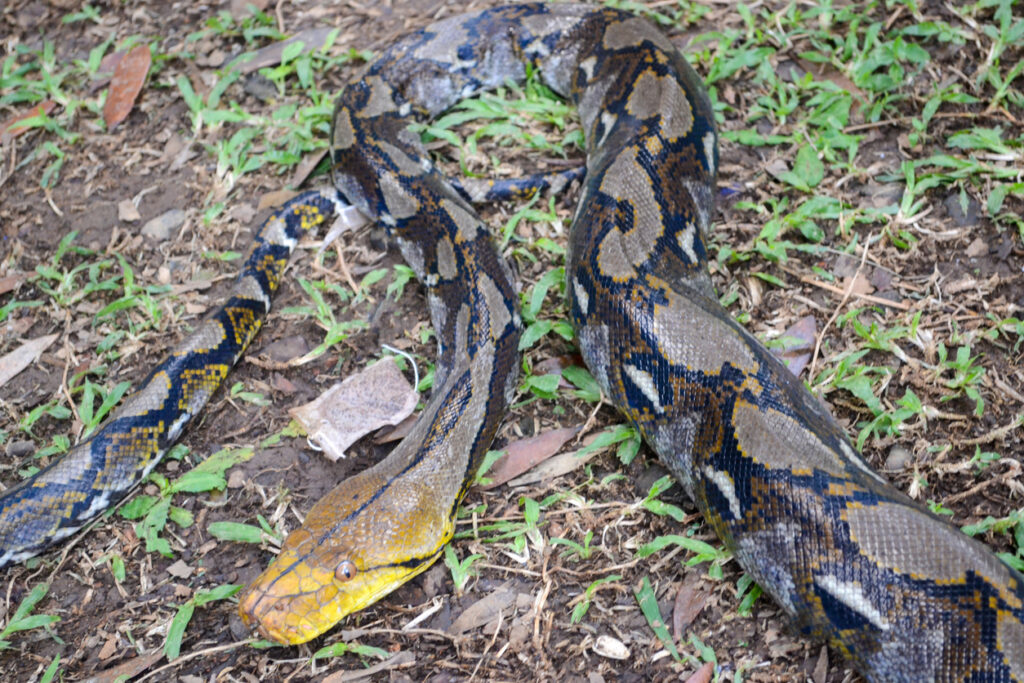
The python’s digestive system is designed to handle prey up to a quarter of its own body weight in a single meal. Their stomach acid is incredibly powerful and can dissolve bones, teeth, and even horns over time. After consuming something large, you can see the distinct outline of the prey animal bulging from the snake’s body.
The snake becomes virtually immobile during digestion, which can take weeks for a large meal. Their metabolic rate increases dramatically during this time to process the massive amount of food.
They hunt by ambush and can strike incredibly fast.
Reticulated pythons are ambush predators that wait motionless for prey to come within striking distance. Despite their size, they can launch forward with shocking speed to grab prey with their teeth before immediately coiling around it. The initial strike happens so fast that prey often doesn’t have time to react or escape.
@thereptilezoo Prettiest snake on earth in the sun wow 🤩 I’m not the only one that can see the 🌈 I hope #😂 #🌈 #snake #rainbow #aminalsoftiktok #reticulatedpython ♬ original sound – The Reptile Zoo
Once the coils are around you, escape becomes nearly impossible because the snake’s muscle power is enormous. A large python can exert enough pressure to prevent any meaningful movement within seconds of grabbing you.
They’re found near human settlements because that’s where the food is.
These pythons aren’t hiding in remote jungles, they’re often found near villages and farms, where they hunt livestock and rodents attracted to human activity. This proximity to people increases the chance of encounters, especially in rural areas of Indonesia, the Philippines, and surrounding regions. Pythons will enter homes, chicken coops, and livestock pens looking for easy meals. The snakes that grow to the largest sizes are often the ones living near humans because the food supply is reliable and plentiful.
You couldn’t physically overpower one if it decided to eat you.
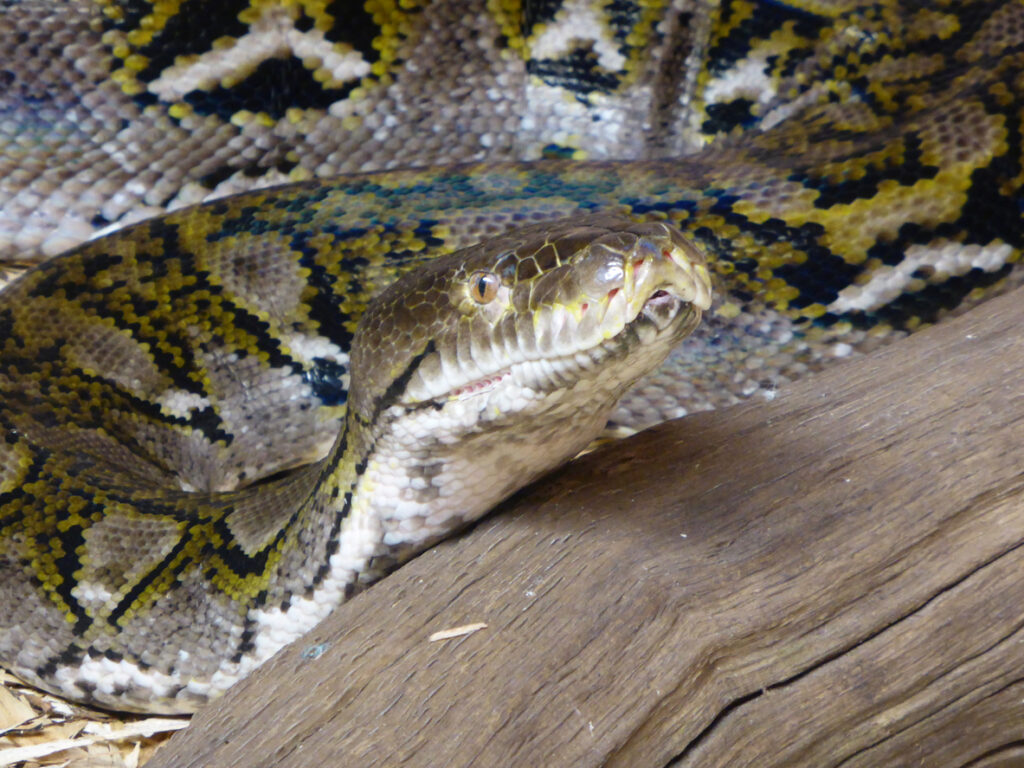
Once a python of this size gets its coils around you, human strength is basically irrelevant. You’d need to prevent the initial grab or get help immediately because fighting off a constricting python alone is virtually impossible. Their entire body is muscle designed for this exact purpose, and they’re patient. Even if you managed to loosen one coil, the snake would just tighten another section. People who’ve survived encounters typically had someone else present who could help pry the snake off before constriction was complete.
Climate change might expand where they can survive.
As temperatures rise and habitats change, pythons could potentially extend their range into new areas. They’ve already established invasive populations in places like Florida, where released or escaped pet pythons have thrived in the subtropical climate. Warmer conditions could make previously unsuitable regions viable for these snakes.
The combination of habitat loss pushing them into more contact with humans and potentially expanded ranges means encounters might become more frequent. Scientists are monitoring populations carefully because large invasive pythons can devastate local ecosystems and pose genuine risks to people and livestock.