If you’re ever swimming in the Mediterranean and spot what looks like a perfectly cooked breakfast drifting past your goggles, don’t worry, you haven’t finally cracked from the heat.
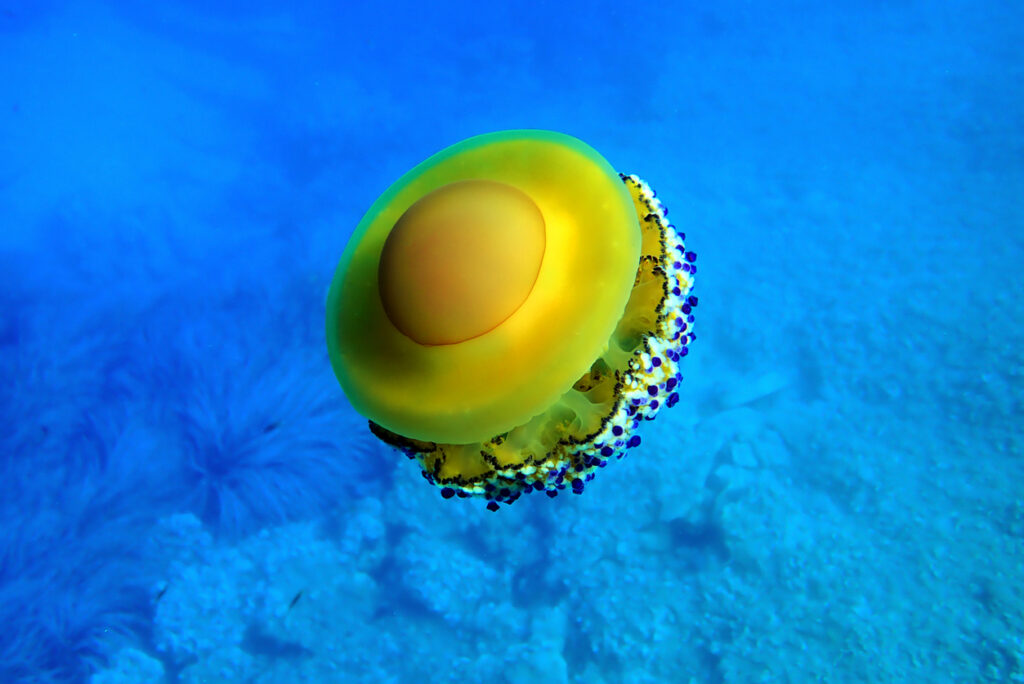
You’ve just run into one of the ocean’s more literal-minded residents. Some jellyfish look like ghosts and others look like tangled bits of bin bag, but this one is a dead ringer for a sunny-side-up egg. It’s a bit of a surreal sight, seeing something that belongs in a frying pan bobbing along in the salt water, but it’s a genuine marvel of the marine world.
The resemblance to a fried egg is genuinely uncanny.
This isn’t one of those cases where you have to squint to see it. The centre of the jellyfish is a raised, bright yellow dome that looks exactly like a yolk, and it’s surrounded by a flat, translucent white ring that looks just like egg whites. When the sun hits it in the clear blue water, the contrast is so sharp that it looks like a bit of 3D art. It’s a very strange experience to be treading water and find yourself looking at what appears to be a large plate of breakfast floating a few feet below your toes.
It has a nickname that just makes sense.
While scientists call it Cotylorhiza tuberculata, literally everyone else calls it the fried egg jellyfish. It’s one of those rare moments where the common name is actually better than the fancy Latin one because it tells you exactly what you’re looking at. There was no need for a complicated naming committee here; the first person to see it likely just pointed and said exactly what it looked like, and the name has stuck ever since. It makes the species feel a bit more approachable and less like a mysterious deep-sea monster.
@allthingsmarinelife The fried egg 🍳 jellyfish. Would you eat it ? #sealife #jellyfish #friedeggjellyfish #facts #oceanlife #edutok #learnontiktok #foryou #fyp #ocean #sea #animalfacts #animalsyouprobablydidntknowabout #seacreatures ♬ snowfall (Slowed + Reverb) – Øneheart & reidenshi
It’s a fan of warmer spots.
You are most likely to bump into these in the Mediterranean Sea, particularly during the late summer months. They love the warm, shallow water near the coast where the sun can reach them easily. If you’re on a boat or swimming near a beach in places like Greece or Italy, you might see them in large groups, pulsing along the surface. They don’t mind being near people, and they tend to stick to the calmest parts of the sea, making them very easy to spot and photograph.
It’s much friendlier than it looks.
Most of us have a bit of a panic when we see a jellyfish, but this one is a bit of a softie. While it does have a sting, it’s incredibly mild. For most people, if you accidentally brush against one, you might not feel anything at all, or perhaps just a tiny bit of an itch. It’s nowhere near as painful as the stings from its more famous, nastier relatives. You shouldn’t go out of your way to hug one, of course, but you don’t need to clear the beach if you see one drifting toward the shore.
It’s a lot bigger than an actual egg.
While it looks delicate, these things can get surprisingly large. They can grow up to 35 centimetres across, which is about the size of a massive dinner plate. Seeing something that big and egg-shaped in the water is a bit of a head-turner. Because of their size, they are quite sturdy, and you can see the intricate details of the yellow yolk dome even from a distance. It’s a bit of a shock when you realise that what looked like a small speck from the surface is actually a substantial creature.
It runs a bit of a fish hotel.
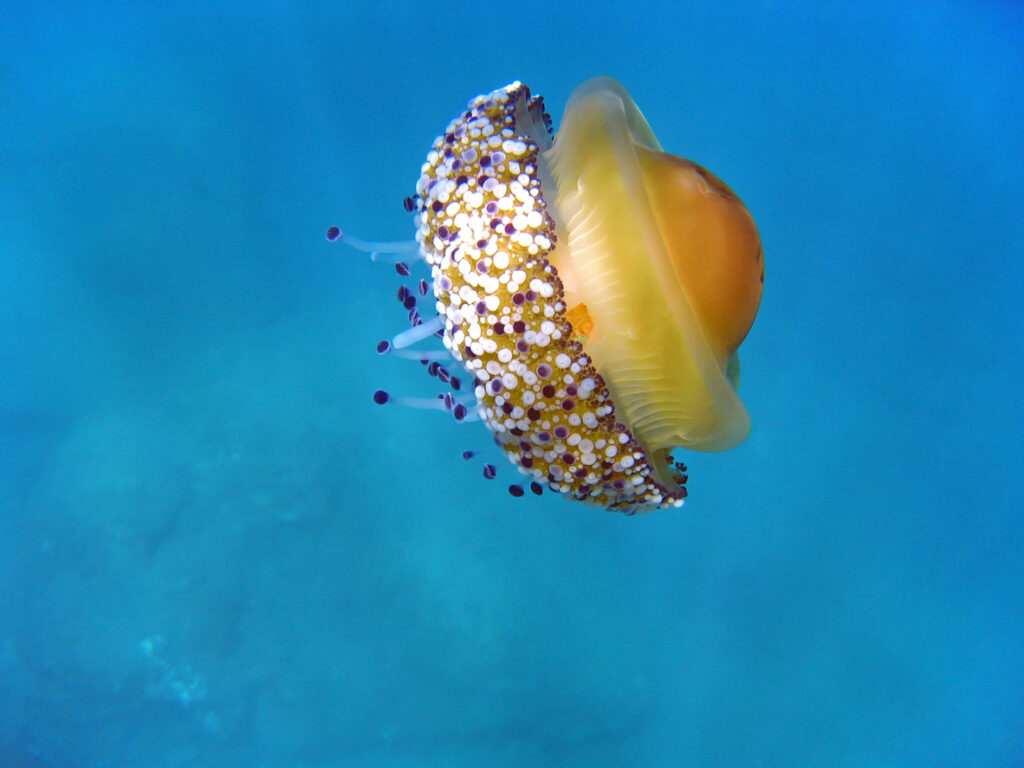
If you look closely at the tentacles underneath the egg-white fringe, you’ll often see a load of tiny fish darting in and out. These little hitchhikers use the jellyfish as a floating shield. Because the jellyfish has a mild sting, it keeps bigger predators away, giving the small fish a safe place to hide. It’s a brilliant bit of teamwork; the jellyfish moves through the water, and the fish get a protected home that’s always on the move. Watching a giant floating egg lead a tiny school of fish through the sea is a bit like watching a weird underwater cartoon.
It’s partially solar-powered.
This is where it gets really clever. The fried egg jellyfish doesn’t just eat plankton and tiny bits of prey; it also has tiny algae living inside its tissues. These algae use the sun to make energy, and the jellyfish gets a share of the nutrients. This is why they love to float right at the surface where the sun is strongest. It’s essentially part animal and part solar panel, which is a pretty efficient way to live if you’re spending all your time in the Mediterranean sun.
It moves with a very relaxed vibe.
There’s no rush when it comes to the fried egg jellyfish. It moves with a very slow, rhythmic pulsing motion, contracting its body to push itself along. It doesn’t fight the current; it just drifts with the tide, looking completely unbothered by the world. This calm, steady movement adds to the illusion that it’s just a bit of decoration rather than a living predator. It’s quite a relaxing thing to watch, provided you’ve remembered that it’s not actually someone’s lunch.
@kira.vincze 🪼🍳 📍Limnonari beach, Skopelos #jellyfish #greece #fyp #foryou #beachvibes ♬ som original – WE ARE 00h.03m 🇨🇭
It’s the star of many holiday photos.
Every summer, social media gets a fresh batch of photos from confused tourists asking why there are eggs in the sea. In places like the Mar Menor in Spain, they can sometimes appear in huge numbers, turning the water into a bit of a giant frying pan. It’s become a bit of a local celebrity in those areas. For people who live there, it’s just a sign that summer is in full swing, but for everyone else, it remains one of those things you have to see to believe.
It’s a reminder that nature has a sense of humour.
Sometimes the ocean feels like a place full of sharp teeth and dark mysteries, but the fried egg jellyfish is a reminder that it can also be a bit silly. There is no real evolutionary reason for it to look exactly like breakfast, it just happens to work out that way. It proves that even the simplest creatures can be fascinating if they’re weird enough. It’s one of those small wonders that makes a day at the beach feel a bit more like an adventure.