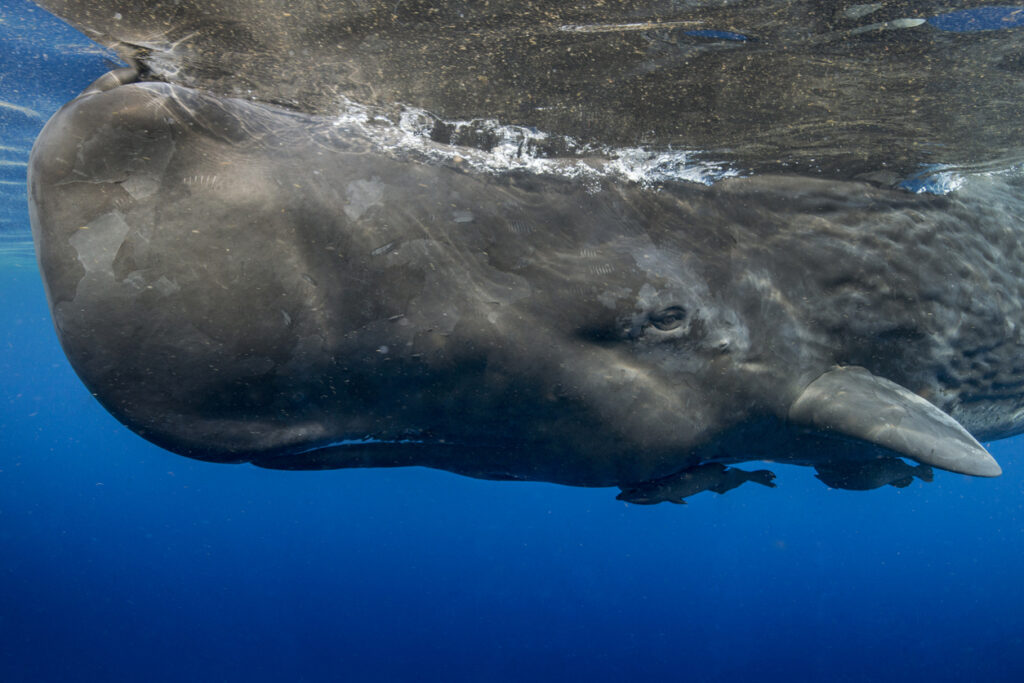
Some of the world’s smartest animals live below the surface, and in the Indian Ocean, a particular kind of whale may just be rewriting everything we thought we knew about intelligence in the deep. From their cultural quirks to their brainpower, sperm whales are showing signs of highly complex behaviour that mirrors some of our own. Not only that, their intelligence levels are off the charts. Here’s why these deep-diving giants are so impressive.
1. They have dialects that vary by social group.
Sperm whales don’t just communicate; they develop unique dialects depending on the group they belong to. These codas (short bursts of clicking sounds) are distinct enough that scientists can identify different whale “clans” just by listening. While some would simply write it off as noise, in reality, the animals’ shared identity and culture passed through generations.
This kind of vocal complexity suggests a social structure more advanced than we often credit animals for. It’s a sign that they’re not just making noise to find each other, but they’re telling stories, maintaining bonds, and building community through sound.
2. They organise into multi-level societies.
These whales don’t just float around in loose pods. Sperm whale society is structured in tiers; small family units come together to form larger clans, which can stretch across thousands of miles of ocean. Each group has its own customs and “accent.” This social complexity rivals that of elephants or even some primates. It means they cooperate, teach their young, and possibly even hold intergenerational knowledge. It’s not just biology, it’s culture.
3. Their brains are the largest in the animal kingdom.
Sperm whales have the biggest brains on the planet. In fact, they’re five times heavier than a human’s. Size isn’t everything, but in this case, it supports complex cognitive functions like long-term memory, communication, and possibly even emotional depth.
It’s thought that their massive neocortex, the part of the brain associated with higher-order thinking, helps them navigate social dynamics, solve problems, and perhaps even reflect. It’s hard not to wonder just what’s going on inside a brain that size.
4. They pass down learned behaviour across generations.
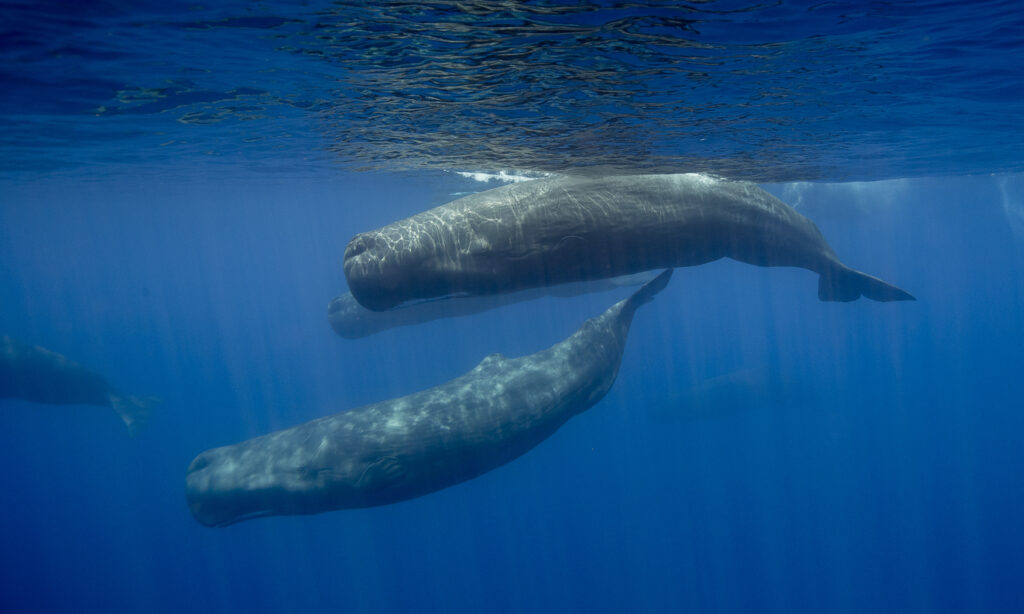
Like human traditions, sperm whales have behaviours that are passed from one generation to the next. These can include hunting strategies, migration paths, and specific vocal patterns. It’s not all instinct; they learn, remember, and teach.
This kind of cultural transmission is rare in the animal world. The fact that sperm whales do it suggests not just intelligence, but the capacity for generational memory, something we usually associate with humans and a handful of other mammals.
5. They form close-knit family units.
Female sperm whales live in tight matrilineal groups, caring for one another’s young and supporting elderly members. This kind of cooperative parenting shows strong emotional ties and social memory, both of which are hallmarks of intelligence.
It’s not just about survival, it’s about bonding. Calves are raised not just by mothers, but by aunties and grandmothers. These deep emotional ties can last a lifetime, suggesting a level of social intelligence that rivals that of elephants or dolphins.
6. They can coordinate across vast distances.
Sperm whales can communicate over hundreds of kilometres using low-frequency clicks. This ability lets them stay connected even when they’re far apart in the vastness of the Indian Ocean. It’s communication, yes, but it’s also coordination on an oceanic scale. Researchers believe these signals may be used to organise hunts, regroup families, or even warn of danger. The logistics of that kind of teamwork across such a huge space? Smart and strategic!
7. They dive deeper than almost any other mammal.
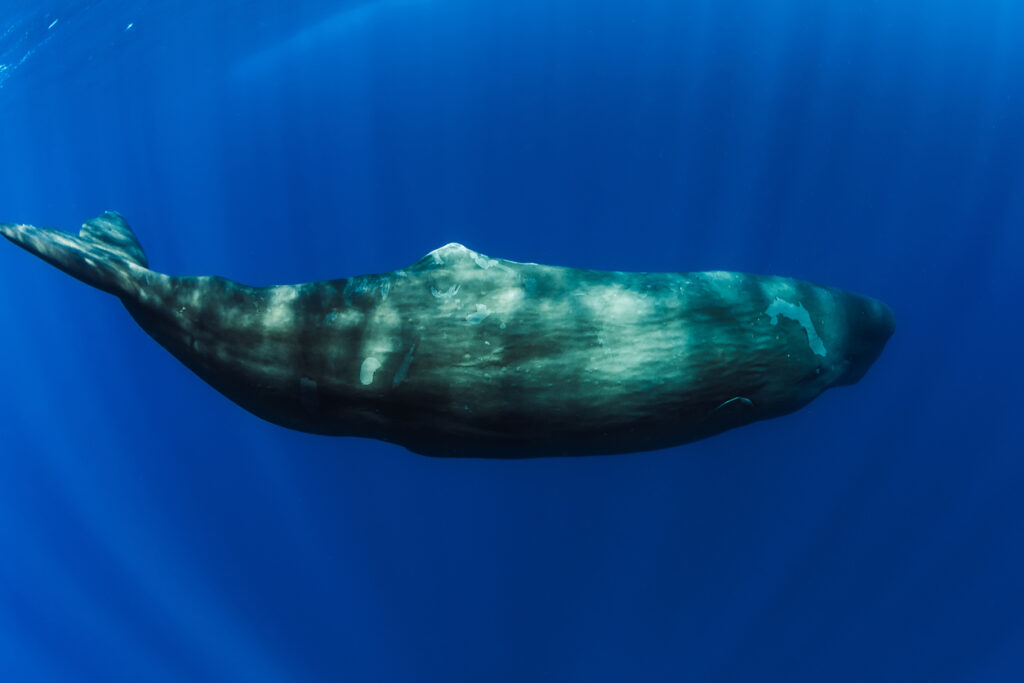
Sperm whales routinely dive more than 1,000 metres to hunt for squid in pitch-black water, staying down for over an hour. This extreme behaviour takes a combination of physical resilience and mental calculation. They navigate total darkness, avoid danger, and track prey using echolocation. It’s like hunting blindfolded in a labyrinth, and doing it successfully, again and again. That takes more than instinct. It takes skill, too.
8. They mourn their dead.
There are documented cases of sperm whales lingering near dead companions, nudging their bodies, and even carrying them for days. While we can’t fully interpret what they feel, their behaviour points to grief, recognition of death, and emotional complexity. This kind of mourning is rare in the animal kingdom and suggests a rich emotional life. When an animal responds to loss in a way that mirrors human sadness, it challenges how we define intelligence, and connection, in the animal world.