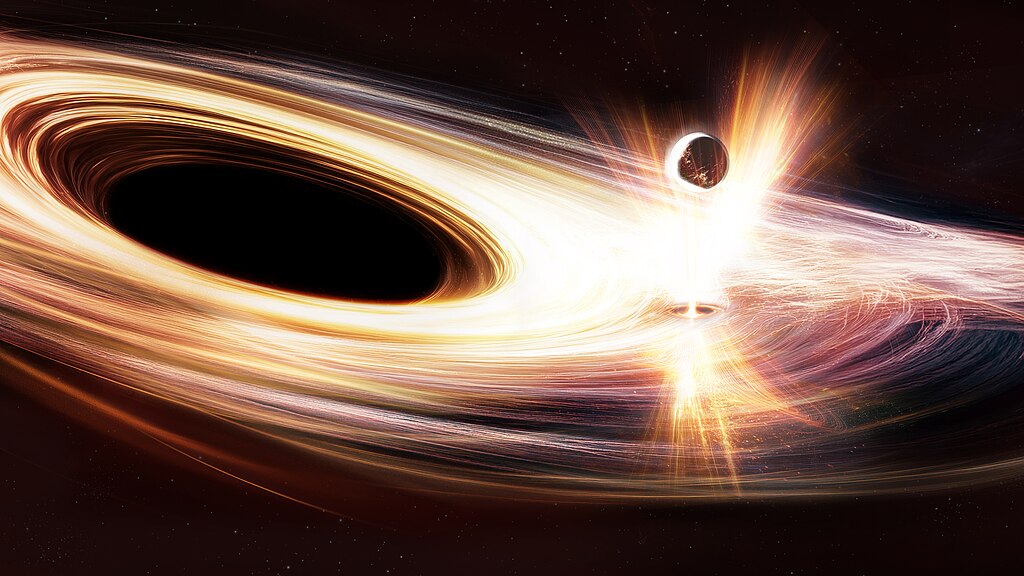
Astronomers have witnessed something incredible: a supermassive black hole that was dormant for decades suddenly waking up and roaring to life. In a galaxy called SDSS1335+0728, about 300 million light‑years away in the Virgo constellation, the cosmic core leapt from near-invisibility to glowing with intense X-ray bursts and optical brightness. The region at the galaxy’s centre is now officially classified as an active galactic nucleus, nicknamed “Ansky,” marking the first time such a transition has been observed in real time.
A once‑quiet galaxy suddenly got loud.
In late 2019, surveys from the Zwicky Transient Facility flagged a sudden brightening in SDSS1335+0728. Follow‑up observations showed the galaxy’s core had shifted from a calm, inactive state to dramatically luminous, and it stayed that way for years. This sustained brightening had never been seen before, signalling something major had changed.
Researchers quickly realised they might be witnessing the activation of a sleeping supermassive black hole. Over time, telescopes across optical and X-ray wavelengths confirmed what was happening was unprecedented and real.
X‑rays flagged the awakening.
In early 2024, observatories like NASA’s Swift, NICER, Chandra, and ESA’s XMM‑Newton all detected sudden X‑ray flares from the same galaxy. That kicked off deeper investigation into what was causing such bursts.
Researchers identified the pattern as quasiperiodic eruptions: short, sharp flashes of X-rays that repeat on a cycle. A first for a black hole that appears to be waking up rather than responding to a one-off star collision.
It has the longest and brightest QPEs ever seen.
The QPEs from “Ansky” were unlike any observed before. They were nearly ten times longer and ten times more luminous than typical, with intervals of about 4.5 days between flares. That makes this event unique, and beyond what existing theories predicted.
Models struggle to explain it, pushing astronomers to rethink how accretion disks and surrounding gas might behave during such an awakening. There’s speculation something small, possibly a compact star or gas clump, is orbiting through the disk, triggering each flare without being torn apart.
Scientists think the black hole began feeding again.
The sudden shift into activity suggests a renewed flow of gas or dust into the black hole’s accretion disk. While a tidal disruption event (where a star is torn apart) is a familiar trigger, there’s no evidence a star was destroyed here.
Instead, the bursts likely come from gas falling in from the galaxy itself or small orbiting bodies crossing the disk repeatedly. Whatever sparked it, Ansky’s transition marks a rare event in black hole behaviour, one that’s also visible across light and X-ray wavelengths.
This is the first real-time AGN birth observation.
Although astronomers knew black holes can turn on and become active galactic nuclei, no one had observed the process live—until now. The years since 2019 show how a silent galaxy core can switch into a luminous engine over time. This real-time awakening offers an invaluable window to study how AGNs form, from accretion dynamics to feedback processes. It’s the first time scientists can watch the full transformation unfold.
It’s a testbed for black hole physics.
Because the eruptions challenge existing models, researchers now have a rare case to stress-test theories about how black holes feed and emit energy. Ansky’s behaviour stands out, and is sparking debates about what conditions create QPEs in the first place. It’s one thing to observe a black hole eating a star. It’s another to watch one gradually awaken over years, with repeated bursts. That makes SDSS1335+0728 a goldmine for astrophysics.
Insights extend to our own galaxy’s black hole.
It’s entirely possible that Sagittarius A*, the supermassive black hole at the Milky Way’s centre, could experience similar quiet-to-active transitions someday. While there’s no immediate danger or change on the way, studying Ansky gives clues about what might happen if our own galactic core wakes up.
Understanding how dormant black holes reawaken could inform everything from galaxy evolution to how energy and jets are launched in cosmic systems.
It shows how powerful coordinated telescopes can be.
This discovery wouldn’t have been possible without the combined power of surveys like Zwicky’s, plus space-based X-ray observatories and ground follow-ups. The real-time monitoring across wavelengths was key to linking optical brightness with eventual X-ray flares. That kind of coordination is becoming the future of astronomy: tracking rare events across the spectrum, in near real-time, and piecing together what was once missed.
A black hole reborn helps us understand galaxies.
Active galactic nuclei profoundly affect their galaxies through powerful radiation, jets, and winds that shape star formation and gas distribution. Witnessing Ansky switch on gives new insight into how those feedback processes begin. Galaxies live and evolve partly based on how their central black hole behaves. Seeing ingestion and subsequent activation in real time helps fill gaps in our cosmic evolution models.
A rare reminder of how dynamic space really is.
It’s easy to think of galaxies as static islands of stars, but events like this show how dynamic and variable they can be. A black hole can sit dormant for decades and then, triggered unexpectedly, roar to life in sustained activity. Ansky’s awakening reminds us how much of the universe’s drama is hidden until we observe the right moment, and how much we still have to learn about even the most massive objects in space.