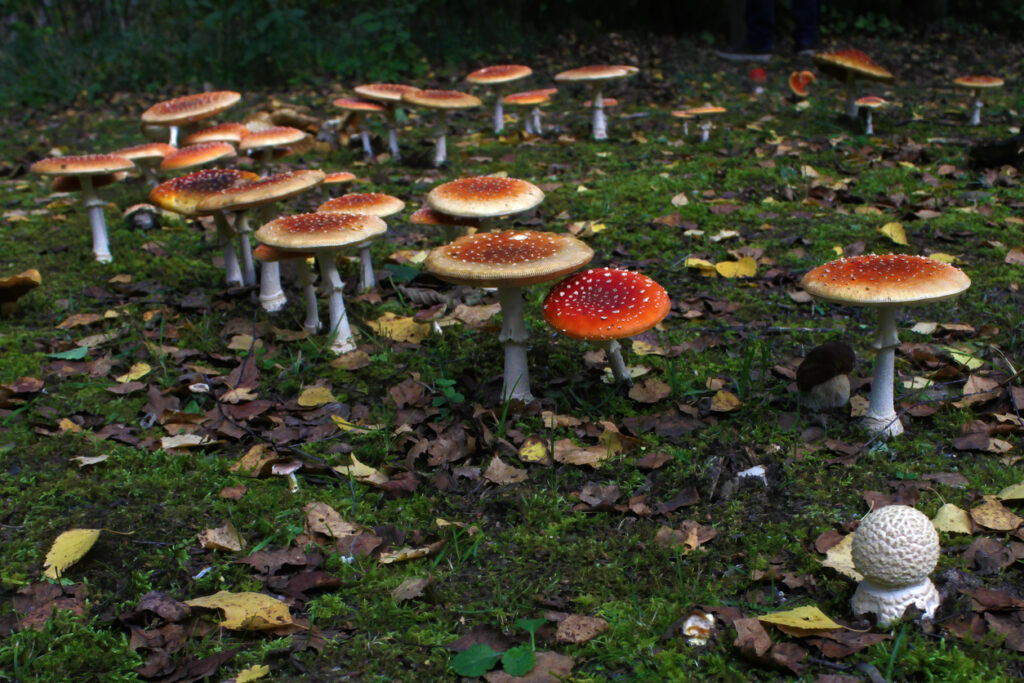
If you’ve ever stumbled across a perfect circle of mushrooms growing in the grass and felt a weird urge to stare at it for longer than necessary, chances are you’ve found a fairy ring. They’re one of nature’s more mysterious-looking tricks, and while the science behind them is solid, the stories are even better. So, what actually is a fairy ring, and what makes them look like something out of a fantasy film? Here’s what you need to know.
A fairy ring is a naturally occurring circle of mushrooms.
Despite the name, fairy rings aren’t made by fairies (sadly), but by fungi. When certain types of mushrooms grow in a circular formation, they create what looks like a ring or arc on grass or soil. You’ll usually spot them in open grassy areas—lawns, meadows, woodland clearings. Some rings are small and neat, others are huge and patchy, but the basic shape is what makes people stop and stare.
They start from a single fungal spore.
It all begins with one microscopic fungal spore landing on the ground. That spore then grows into a web-like structure underground called mycelium, which is basically the hidden body of the fungus. As the mycelium spreads outwards in all directions, it eventually reaches a point where it produces mushrooms, above-ground fruiting bodies, right at the edge of that growing circle.
The ring shape happens because of how fungi spread.
Fungi grow outwards from their starting point, and the older inner parts eventually die off as the new growth moves further out. This outward movement creates a ring-shaped pattern where mushrooms appear along the edges. That’s why you usually don’t see mushrooms in the middle of a fairy ring, only around the outer rim, where the fungus is still actively growing and feeding.

They can appear and disappear over time.
Some fairy rings come and go within a few weeks. Others can last for years or even decades, getting wider as the fungus slowly spreads underground. It all depends on conditions like moisture, soil nutrients, and whether the grass gets mowed regularly. Some can reach several metres across before fading out entirely.
Fairy rings can affect how grass grows.
Sometimes you’ll notice that the grass inside or just outside the ring looks different—either greener and thicker, or oddly dry and patchy. That’s also down to the fungi. They release chemicals into the soil that can either boost or limit how well grass grows in different areas of the ring. It adds to the “magical” look, even though it’s just biology doing its thing.
There are different types of fairy rings.
Not all fairy rings are the same. Some are “free” rings made up of just mushrooms. Others are “tethered” to changes in grass growth, or they might even leave behind visible dead zones. The species of fungus behind the ring makes a big difference. Common culprits in the UK include Marasmius oreades (the fairy ring champignon) and various Lepiota or Clitocybe species.
They’ve been around for centuries, and so have the legends.
Before people understood fungi, they assumed something supernatural was at work. Many European folktales linked fairy rings to—you guessed it—fairies, elves, or witches dancing in circles at night. Stepping into one was said to bring bad luck, get you whisked away by fairies, or trap you in their realm for years. These stories added to their eerie reputation, and honestly, still kind of do.

They’re not actually rare, but they are easy to miss.
You’re more likely to spot fairy rings in late summer or autumn, especially after a few damp days. But because the mushrooms often blend into the grass or get mown down quickly, they can go unnoticed. Still, once you know what to look for—mushrooms forming a circle, or patches of lush or dying grass in a circular shape—you’ll realise they’re more common than you think.
Some fairy ring mushrooms are edible, but be careful.
The fairy ring champignon is actually edible and popular with foragers. However, as always with mushrooms, identification is crucial. Many species look similar, and a mistake could be dangerous. So unless you’re completely confident in your fungi knowledge, it’s best to leave them be and enjoy the view rather than turn them into dinner.
They’re harmless to most gardens.
Fairy rings might look odd, but they’re usually not damaging. In lawns, they might create patches of uneven grass or mushrooms that pop up now and then, but they’re not doing anything sinister. If you really want to get rid of one, it can be tricky since fungi live deep in the soil. However, most gardeners just mow over them and let nature take its course.
They can get absolutely massive.
Some fairy rings grow to incredible sizes. There are rings in parts of Europe and North America that span over 10 metres across and are estimated to be hundreds of years old. One particularly famous ring in France is thought to be more than 600 years old. Not so much a patch of mushrooms, more like a long-term tenant quietly living under the lawn.
They’re a perfect mix of science and folklore.
What makes fairy rings so interesting is that they straddle two worlds: science and story. On one hand, they’re a great example of fungal growth and ecology. On the other, they’re wrapped up in old myths and childhood curiosity. Even when you understand exactly how they work, it’s hard not to feel a flicker of something mysterious when you spot one. Which, let’s be honest, is half the fun.