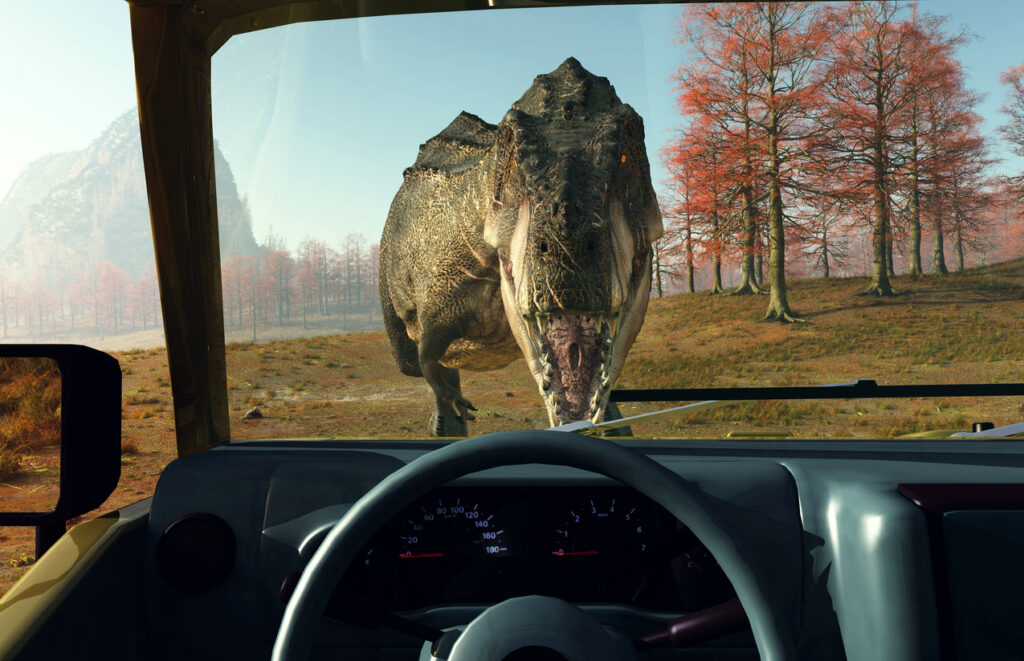
The scene of a T.Rex chomping down on a car door in Jurassic Park has become iconic, but is it even close to realistic? Could a real Tyrannosaurus rex genuinely tear through metal like that, or is it just movie magic? With one of the strongest bite forces in history and a skull built for crushing, the answer’s more complex, and fascinating, than you might think.
The T. rex had an incredible bite force.
Scientists estimate that a full-grown T. rex could deliver up to 12,800 pounds of force with its bite. That’s stronger than a modern-day crocodile and several times more than a lion. In short, its jaws were brutally powerful and capable of crushing bone like it was bread crust.
This kind of pressure was enough to crack open the thick bones of other dinosaurs, including the heavily built herbivores of its time. So from a raw force perspective, yes, the T. rex had the tools needed to do some serious structural damage.
Its teeth were more like railway spikes.
Unlike the sharp slicing teeth of a shark, a T. rex’s teeth were thick, conical, and serrated, built for puncturing and crushing, not slicing clean through. Each tooth was about the size of a large banana and could withstand enormous stress without snapping.
This design allowed it to tear into flesh and mash bone, rather than delicately cut or peel. That crushing ability is more aligned with smashing through hard materials than piercing thin sheets of metal, which makes the idea of it biting through a car slightly more plausible.
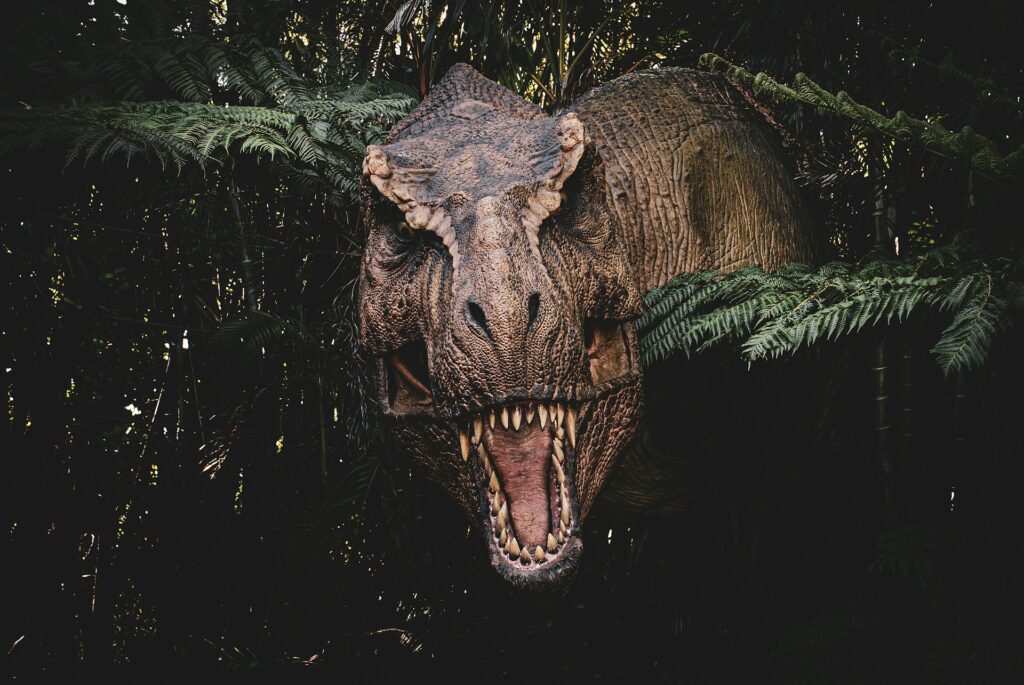
It likely bit with twisting power too.
The T. rex didn’t just clamp and release. It could twist its head and pull with force, turning that bite into a ripping and tearing motion. This combination allowed it to pull prey apart or wrench off limbs with terrifying efficiency. Applied to an object like a car, this method would mean it might not neatly “bite through” steel like scissors through paper, but it could potentially crush, deform, and tear parts off with a violent wrench. So while it wouldn’t be clean, it’d definitely be destructive.
Modern cars are stronger than you’d think.
Despite how flimsy they sometimes look on screen, cars are built to absorb and resist impact. A standard car door is made of reinforced steel or aluminium, layered with safety bars and internal components designed to withstand crashes. That doesn’t mean a T. rex couldn’t damage it, but it would likely take more than one bite to completely shear through. Crushing the roof or ripping off a door? Very possible. Cleanly biting a car in half like it’s made of tinfoil? Not likely.
Its skull was engineered for punishment.
The T. rex had a skull over 5 feet long, reinforced with a structure that helped absorb and distribute bite pressure. It wasn’t just a big jaw. It was a biomechanical battering ram. The fusion of bones in its head made it incredibly strong and shock-resistant. This meant it could bite hard again and again without damaging itself, a critical trait for a predator relying on brute force. That same skull could be used as a tool for smashing and crushing objects in its path, even ones as tough as car parts.
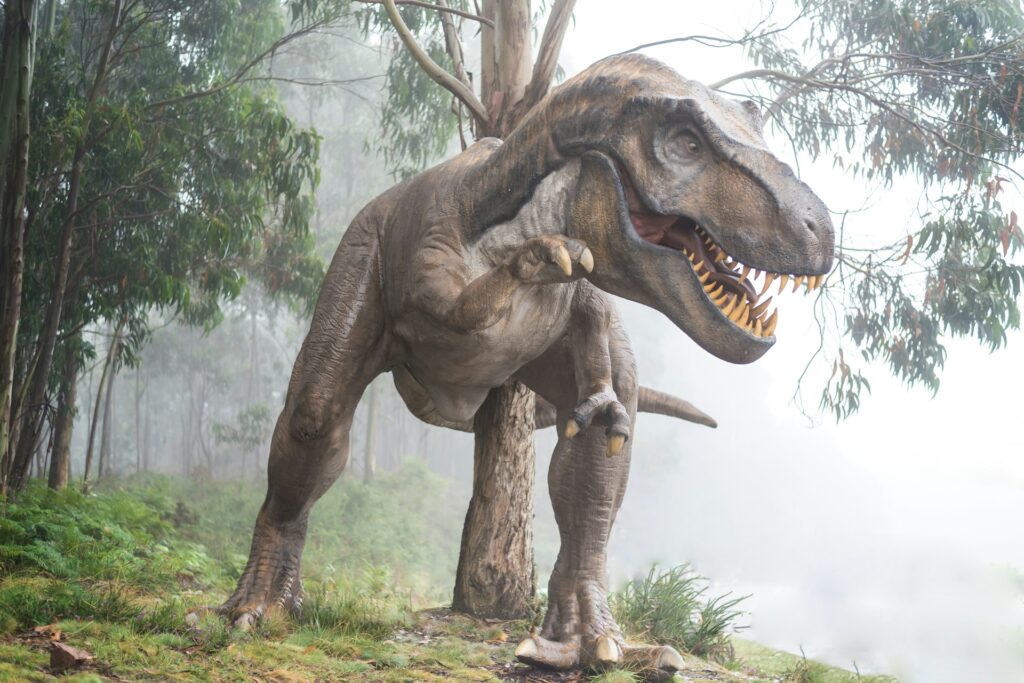
Bone is tougher than people realise.
Many of the animals a T-Rex preyed on had thick, dense bones, and it regularly crushed and digested them. In fact, fossil evidence shows T. rex teeth marks embedded deep into the bones of triceratops and hadrosaurs, which had tough, reinforced skeletons.
Since bone has a higher strength-to-weight ratio than many metals used in cars, the fact that a T. rex could chomp through those gives us a good idea of its biting capability. If it could chew through solid femurs, it’s fair to assume it could at least wreck a car door.
The angle of attack matters.
If a T-Rex bit down on the roof or hood of a car—thin, flat surfaces—it would likely cause major crushing damage. But trying to bite through the car’s engine block, wheel hub, or chassis? That’s where it might struggle or at least need more effort.
The softer parts of a car (doors, roofs, boots) are more vulnerable, while structural parts would be more challenging to pierce or crush fully. So depending on what it grabbed, the damage could range from cosmetic dents to complete destruction.
It had the neck muscles to follow through.
Bite force alone doesn’t get the job done. You also need the muscle power to hold, shake, and rip. T. rex had an insanely powerful neck, with strong ligaments and muscles that allowed it to whip its head with devastating control and force.
This added a violent twisting action to its bite, letting it snap or shake prey apart. Applied to a car, this might translate into wrenching the roof or door clean off with a combination of bite pressure and brute-force tugging. It’s not tidy, but it’s devastating.
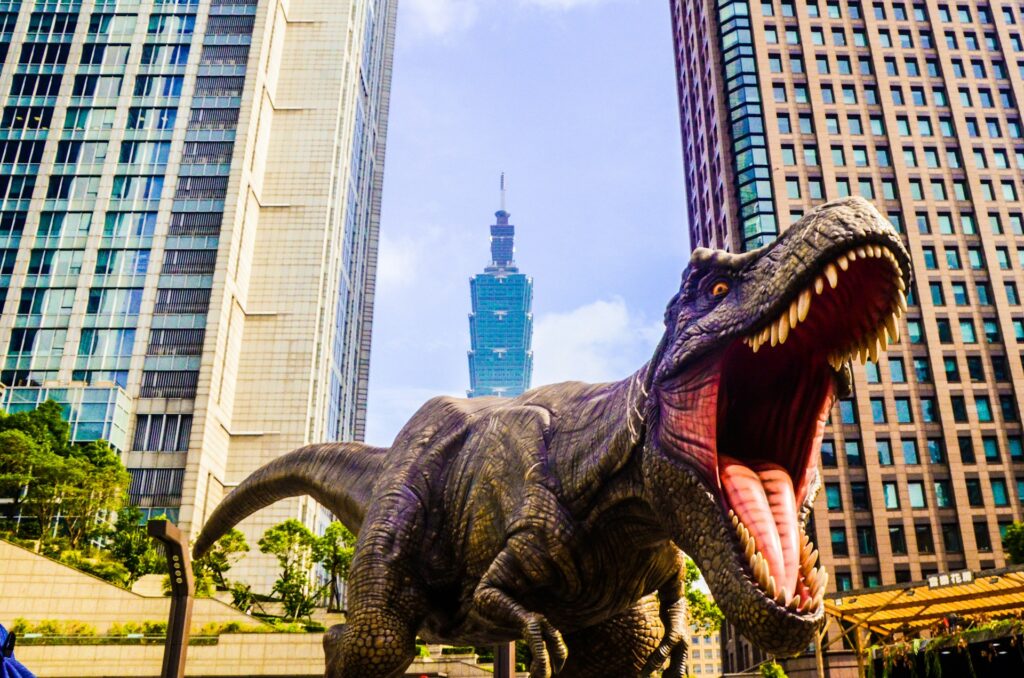
It wouldn’t just chomp, it would thrash.
Predators often don’t rely solely on a static bite. Like modern crocodiles, T. rex probably combined biting with thrashing movements to tear things apart. This means that even if it couldn’t instantly bite through a car’s structural frame, it could damage it through brute chaos.
Imagine it locking onto a car’s rear end and yanking, shaking, and pulling—the result would be a twisted wreck. It may not be a clean sever like in CGI-heavy films, but the destruction would absolutely be believable in a more realistic setting.
Hollywood exaggerates for drama.
In most films, the T. rex biting a car is exaggerated for effect. A single bite that cleanly snaps a Jeep in half makes for great cinema, but it skips over the physical resistance of real-world materials. Cars are built to absorb damage. They don’t just fold like cardboard.
That said, the base idea isn’t pure fantasy. With enough time and effort, a T. rex could cause major destruction to a car. But the dramatic, split-second devastation you see on screen is more about storytelling than strict scientific accuracy.
Its teeth could pierce metal, but not easily.
Tests using 3D models and simulations suggest that T. rex teeth could pierce some softer metals, especially if focused on thinner areas. But unlike biting into flesh or bone, metal offers no give, meaning more pressure would be needed to push through.
Over time or with multiple bites, it could pierce panels and tear them back. But a single, surgical chomp through thick steel? Probably not. Its teeth were better suited to organic material, and repeated impact would be more effective than sheer slicing.
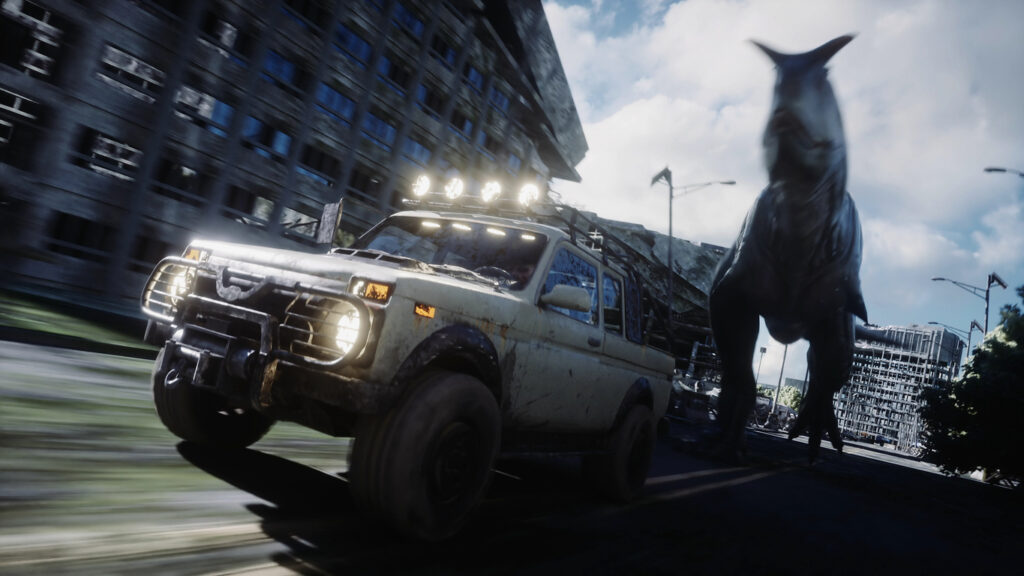
It may have used its whole body to crush.
In a real-world scenario, a T-Rex might not rely solely on its jaws to destroy a car. If agitated or curious, it could stomp, shoulder-barge, or push a vehicle over. At 7 tons of weight and around 40 feet long, its sheer mass was enough to flatten smaller obstacles.
So while the bite gets all the attention, the reality is it had more than one way to cause damage. Whether through crushing, ripping, or trampling, a T. rex had all the tools needed to leave a car in pieces. It just might not happen as fast or cleanly as Hollywood shows.
So, could it bite through a car?
In short: yes, but not like in the movies. A T. rex could absolutely bite into and damage a car, especially the softer parts like doors, roofs, or boots. With repeated effort, it could rip chunks away, crush panels, and cause massive structural damage. Its bite was no joke.
However, a single, neat chomp through thick steel or solid framework isn’t realistic. It would take more time, effort, and a lot of twisting and shaking. The movie scenes exaggerate for drama, but they’re rooted in a truth that’s actually even more terrifying when you break it down scientifically.