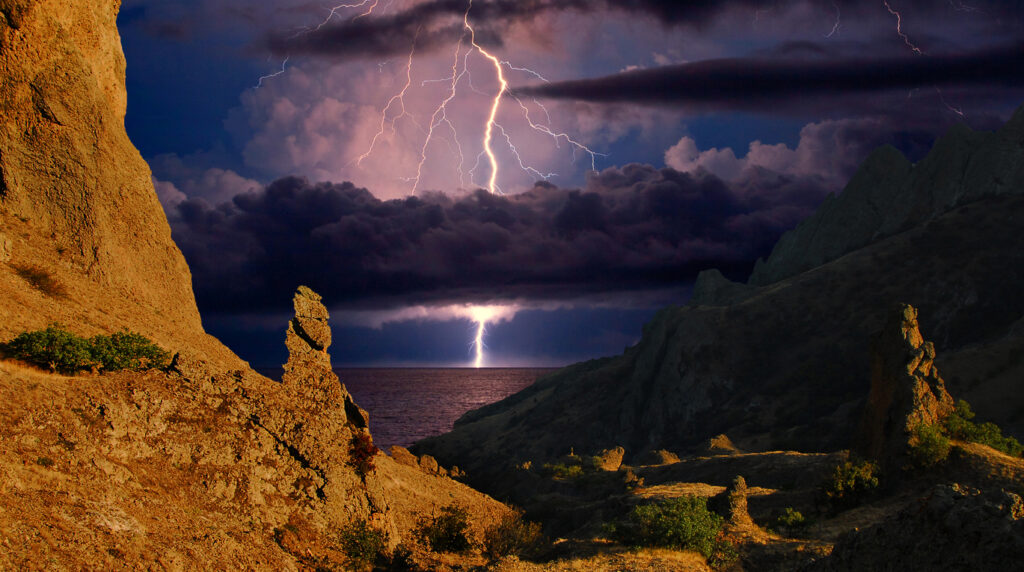
It sounds like something out of a fantasy film—lightning hits the beach and leaves behind a sculpture made of glass. However, it’s actually based on real science. Here’s how and why lightning can sometimes turn ordinary sand into something extraordinary.
Yes, lightning can turn sand into glass.
It’s not a myth—when lightning strikes the ground in the right conditions, it can fuse sand into glass. The result is called a fulgurite, which is basically a glassy tube formed by the extreme heat of the lightning bolt hitting silica-rich soil. These aren’t rare exactly, but they’re not something you’d stumble across every day either. They usually form underground and look like branching roots or twisted tubes. And yes, they’re 100% real glass—formed in a split second.
It takes an insane amount of heat.
Lightning is ridiculously hot. A single bolt can reach temperatures of around 30,000 °C—hotter than the surface of the sun. That’s more than enough to melt sand instantly, especially if the sand is dry and packed with quartz or silica. When the heat melts the sand, it fuses together into glass before cooling and solidifying almost immediately. It’s basically nature’s way of flash-forging something without a furnace or tools—just raw energy and a lucky hit.
Not all sand will react the same way.
For lightning to create a fulgurite, the sand has to be just right. It needs to be dry, have a high silica content, and not be too mixed with other debris or moisture. Wet or muddy ground usually prevents the reaction from happening. This is why you won’t see fulgurites forming after every storm. Conditions have to line up perfectly. That’s also why they’re more likely to show up in deserts or dry beaches than in your back garden or a grassy park.

Fulgurites are often hidden below the surface.
Even when lightning does hit the right kind of sand, the glass it creates usually forms just below the ground, not on top. So, unless you know where to dig—or you’re incredibly lucky—you probably won’t spot one easily. They’re fragile, too. Many break when unearthed, and others remain buried for years until someone stumbles across them during a dig or erosion exposes them naturally. Think of them as secret souvenirs from a storm.
They’ve fascinated scientists (and collectors) for years.
Fulgurites aren’t just pretty—they’re also scientifically valuable. Researchers use them to study ancient weather patterns, soil chemistry, and even the energy transfer in lightning strikes. Some fulgurites date back thousands of years and offer clues about past climate conditions.
On the flip side, they’re also prized by collectors and crystal enthusiasts for their wild shapes and natural origins. You can even buy them online—but the real thrill is knowing they formed in an instant, in one of the most extreme conditions on Earth.
They’re proof of nature’s creative chaos
Fulgurites are one of those strange reminders that nature is constantly shaping and reshaping the world in surprising ways. One second, it’s just an ordinary patch of sand. The next, it’s been blasted into a glass sculpture by a bolt of energy. They’re chaotic, unpredictable, and kind of beautiful, like most of nature’s best work. You might not see one in person anytime soon, but knowing they exist adds a bit of wonder to even the wildest thunderstorm.

They’ve even been found on other planets.
Fulgurites aren’t just an Earth thing—scientists believe similar structures could exist on other planets too. For example, Mars has sand, dust storms, and possibly had lightning in the past, which means Martian fulgurites might be buried beneath its surface. Finding one would offer clues about Mars’ past climate and atmosphere. It’s one of those quiet science mysteries we’re still unravelling—how electrical energy might’ve shaped alien landscapes the same way it does ours.
They can be surprisingly big.
Most people picture fulgurites as tiny glass twigs, but some are seriously impressive. The longest fulgurite ever found was over 4.9 meters long—that’s about the height of a double-decker bus. These longer ones form when the lightning travels deep underground before dispersing.
The shapes vary wildly, depending on how the lightning branches out and how dry the sand is. Some look like coral, others like petrified vines. It’s pure, chaotic design—no two are exactly alike, and that’s part of what makes them so captivating.