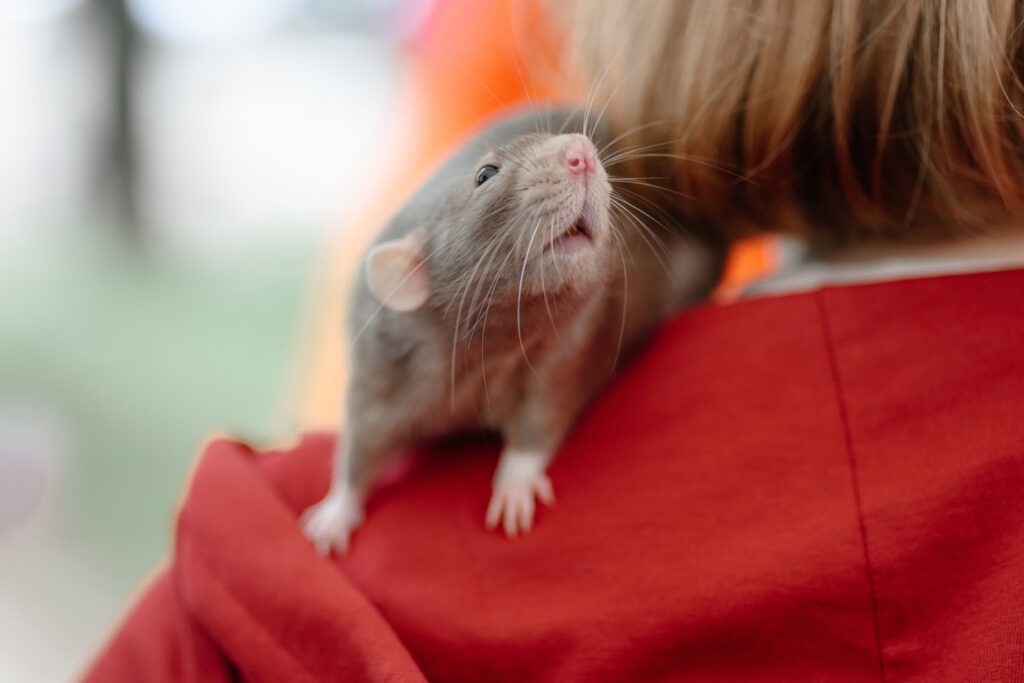
Rats have one of the worst reputations in the animal kingdom, almost none of which is deserved. The domestic rat is a different creature entirely from what most people picture, and anyone who’s actually kept one tends to become an evangelist for them pretty quickly.
They groom themselves constantly.
Rats are fastidious about cleanliness in a way that genuinely surprises most people who’ve never kept one. They spend a large portion of their waking hours grooming themselves and each other, washing their faces, cleaning their paws, and tending to their coats with the same kind of dedication you’d associate with a cat.
Unlike many small animals, they don’t produce a strong body odour, and their coats stay clean without any intervention from their owner. The smell people associate with rats almost always comes from the cage or bedding rather than the animal itself, and with regular cleaning that’s easily managed.
They form genuine bonds with their owners.
This is the thing that catches most people off guard. Rats don’t just tolerate being handled the way some pets do. They actively seek out interaction with the people they’re attached to, running to the front of the cage when you approach, climbing onto your shoulder unprompted, and settling down against you when you’re sitting still.
It’s not the blank compliance of a goldfish or the indifferent tolerance of some reptiles. It’s a relationship, and one that develops quickly and becomes surprisingly meaningful. People who’ve kept rats often describe the bond as closer to what you’d expect from a dog than from a small animal.
@richyanimals Pet Rat 🐀 🥰 #rat #mouse #fyp #animals #richyvidz ♬ [Animals and dishes] Cute BGM – Sound Owl
They recognise their owners as individuals.
Rats can distinguish between different people using a combination of scent, voice, and visual cues. They respond differently to familiar people than to strangers, and they remember individuals over time. Studies have shown they can learn their own name and respond to it being called, which again puts them closer to dogs in terms of social cognition than to the small caged animals they’re usually compared to. The recognition is genuine rather than just a conditioned response to whoever is holding the food, and it’s one of the reasons the bond between a rat and its owner can feel so unexpectedly personal.
They groom their owners too.
Mutual grooming is one of the primary ways rats show affection, and they extend this behaviour to the humans they’re attached to. A rat that grooms your hand or nibbles gently at your hair isn’t being difficult, it’s doing the thing it does for the rats it likes most.
In rat social life, grooming is an act of care and trust, and directing that behaviour towards a person means you’ve been accepted into their social circle. It’s one of those small things that means very little until you understand what it actually represents.
They’re far more intelligent than most people give them credit for.
Rats are used extensively in scientific research partly because their cognition is sophisticated enough to make them useful test subjects, but the implications of that don’t always filter through to how people think about them as pets. They can solve puzzles, navigate mazes, learn sequences of behaviour, and adapt their approach when something stops working.
They get bored without stimulation, which is a sign of a brain that needs engaging. Owners who provide toys, challenges, and regular interaction find that rats approach these things with genuine curiosity and persistence, learning new tasks at a speed that tends to impress people who were expecting something far more limited.
They show empathy in ways that are hard to dismiss.
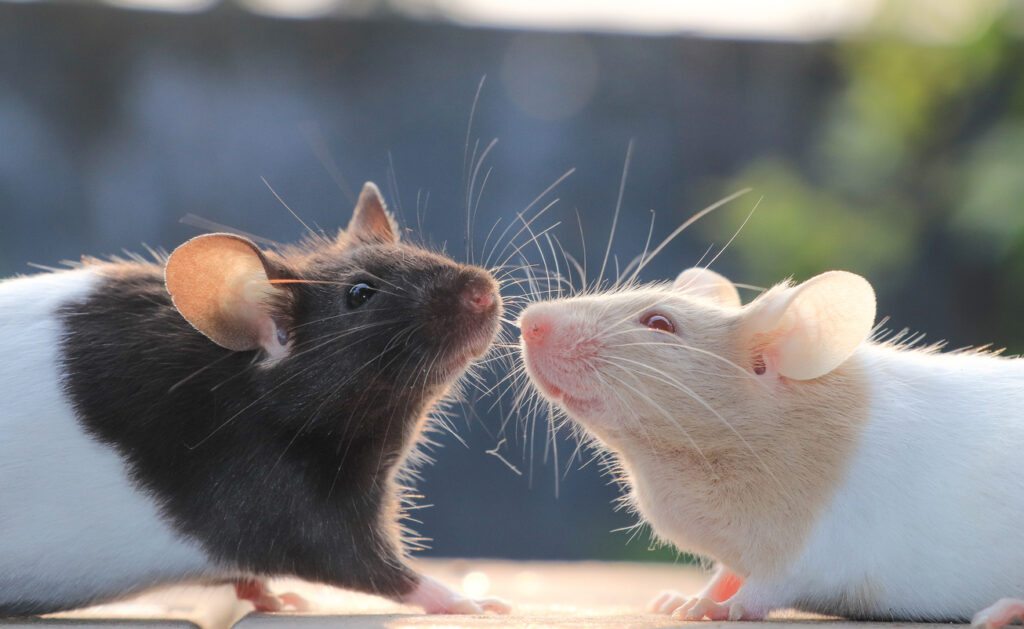
Research has demonstrated that rats will help other rats in distress, including freeing trapped companions, even when there’s no reward for doing so. They also share food with hungry rats, and they appear to modulate their own behaviour based on the emotional state of those around them.
This sort of prosocial behaviour was once considered a uniquely human or at least primate characteristic, and finding it in rats genuinely surprised the scientific community. For pet owners it shows up as attentiveness to mood, with many rat owners reporting that their animals respond differently when they’re upset or unwell, seeking contact in a way that feels deliberate.
They’re sociable with other rats and much happier in pairs.
Rats are colony animals, and they suffer genuinely when kept alone. A single rat without company will become depressed and withdrawn in ways that are measurable and visible. Kept in pairs or small groups, they’re active, playful, and relaxed, spending time grooming each other, playing, and sleeping in a pile.
The good news for owners is that the social needs rats have for each other actually make them lower-maintenance in some respects because they’re not entirely dependent on human interaction to meet their need for company. Two rats entertain and comfort each other in a way that makes the whole arrangement healthier for everyone involved.
They don’t scratch or bite without good reason.
A well-handled, properly socialised rat is remarkably gentle. They explore with their whiskers and noses before their teeth, and they’re far less likely to scratch or bite defensively than rabbits, hamsters, or guinea pigs, all of which are considered more family-friendly by default.
A rat that bites is almost always one that was poorly handled early on or is in pain, and even then, the response tends to be a single warning nip rather than sustained aggression. People who are nervous around animals are often surprised by how calm and careful a domestic rat actually is in practice.
@chiaralouisex Your sign to get a rattie companion or 10 😜 #ratatouille #petrat #companion #foryou #animallover ♬ Little Life – Robert Gromotka
Their cage hygiene is easier to manage than most small pets.
Rats are naturally inclined to use one area of their cage as a toilet, which makes cleaning much easier than it is with animals that go wherever they happen to be standing. Many owners litter-train their rats with minimal effort, placing a small tray in the corner they’ve already chosen and finding that the rats use it consistently.
This doesn’t just make cleaning simpler, it keeps the rest of the cage noticeably cleaner and reduces odour considerably. Given that cage hygiene is the main practical concern people have about keeping small animals indoors, this is a bigger advantage than it might initially sound.
They’re playful in a way you can actually participate in.
Rats play, and they play in ways that involve their owners rather than just happening independently behind a cage door. They respond to gentle rough-and-tumble handling, they explore new environments with visible enthusiasm, and they engage with toys in ways that change and develop over time.
Young rats especially have a bounciness and energy to them that’s genuinely entertaining to watch and interact with. Unlike watching a hamster run on a wheel or a fish circle a tank, time spent with rats tends to be actively engaging for the person involved, which is part of why people who expected a low-key pet often end up more invested than they anticipated.
They communicate in ways you can learn to read.
Rats are expressive animals once you know what you’re looking at. Ear position, body language, tooth grinding, and a behaviour called boggling, where the eyes vibrate rapidly, all communicate different emotional states. Bruxism, the soft grinding of teeth, indicates contentment in the same way a cat’s purring does.
A rat pressing itself flat against the floor is uncomfortable, while one that approaches with a loose, bouncy gait is in a good mood. Learning to read these signals gives the relationship a conversational quality that most people don’t expect from a small animal, and it makes you a better owner because you can respond to how your rat is actually feeling rather than just assuming everything is fine.
They have distinct personalities that differ between individuals.
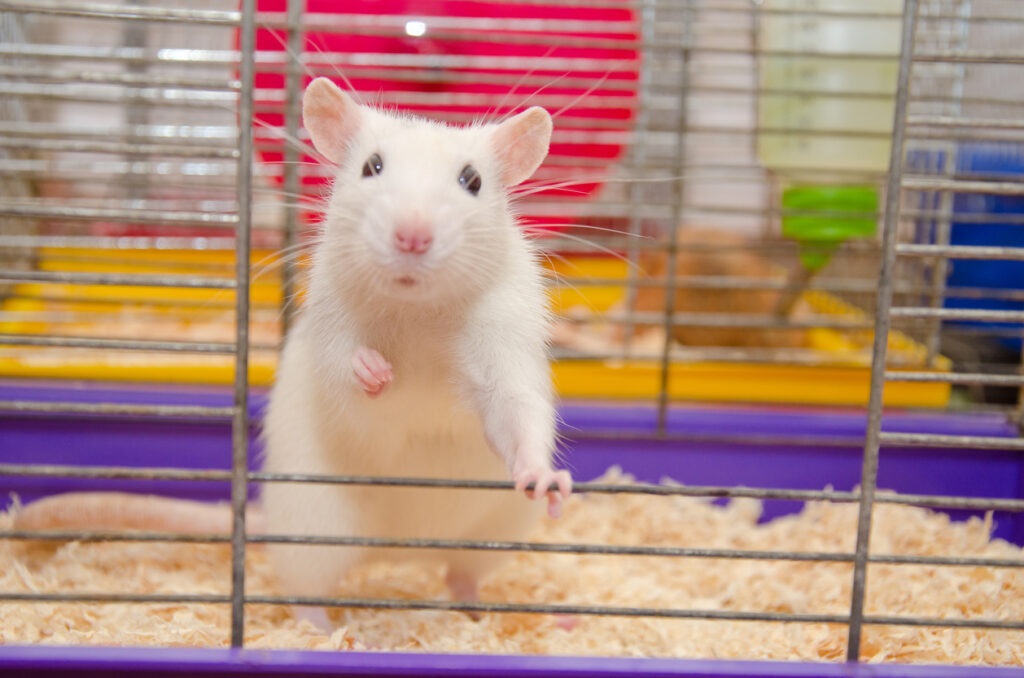
Anyone who has kept more than one rat will tell you that they are not interchangeable. Some are bold and immediately comfortable with new people and situations. Others are cautious and take longer to warm up. Some are lap rats who want nothing more than to sit on you for hours, while others are restless explorers who treat you primarily as an interesting obstacle course.
These personality differences are consistent over time and make each animal a distinct individual rather than a generic representative of the species. It’s one of the things that makes rat keeping genuinely absorbing rather than just a novelty that wears off quickly.
They don’t live long, and that changes how you relate to them.
Rats typically live between two and three years, which is one of the genuine downsides of keeping them and something any potential owner should know going in. But the short lifespan also creates something else, a concentrated intensity to the relationship that makes owners very present with their animals.
You notice changes, you pay attention, and you’re aware that the time is limited in a way that’s easy to take for granted with a longer-lived pet. People who have lost rats often describe the grief as disproportionate to the size of the animal, which is really just a reflection of how much of themselves they put in, and how much the rat gave back.