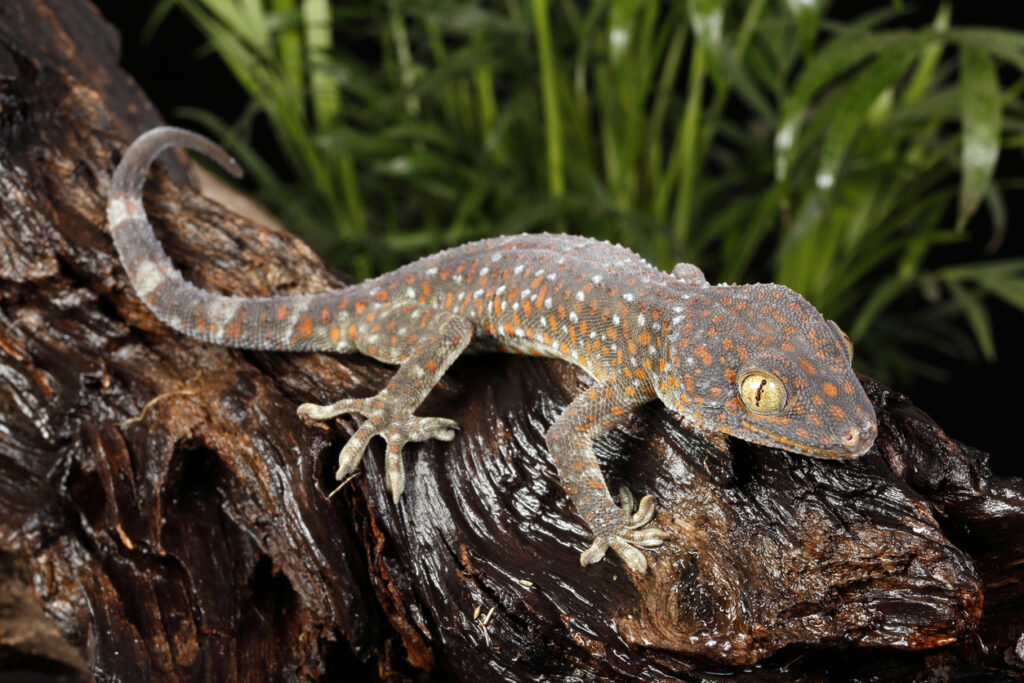
They’re loud, territorial, spectacularly coloured and completely unbothered by your opinion of them. The Tokay gecko is one of the most distinctive reptiles on the planet, and there’s a lot more going on with them than most people realise.
They’re one of the largest gecko species in the world.
Most geckos are small, unassuming little things. The Tokay is neither. Adults typically reach between 25 and 35 centimetres in length, making them one of the biggest gecko species on earth. Males tend to be larger than females and considerably more territorial about it. They’re solidly built too, with a thick body and a strong jaw that they’re not shy about using. Anyone who’s been bitten by one will tell you they mean it.
That name comes directly from the sound they make.
The Tokay gecko is named after its own call, which is a loud, distinctive two-syllable bark that sounds remarkably like “to-kay.” They’re not quiet about it either. Males call repeatedly, particularly at night and during breeding season, and the sound carries further than you’d expect for an animal that size. In parts of Southeast Asia you can hear them from inside buildings, through walls, across courtyards. Once you know what it is, it’s unmistakable.
Their colouring is genuinely striking.
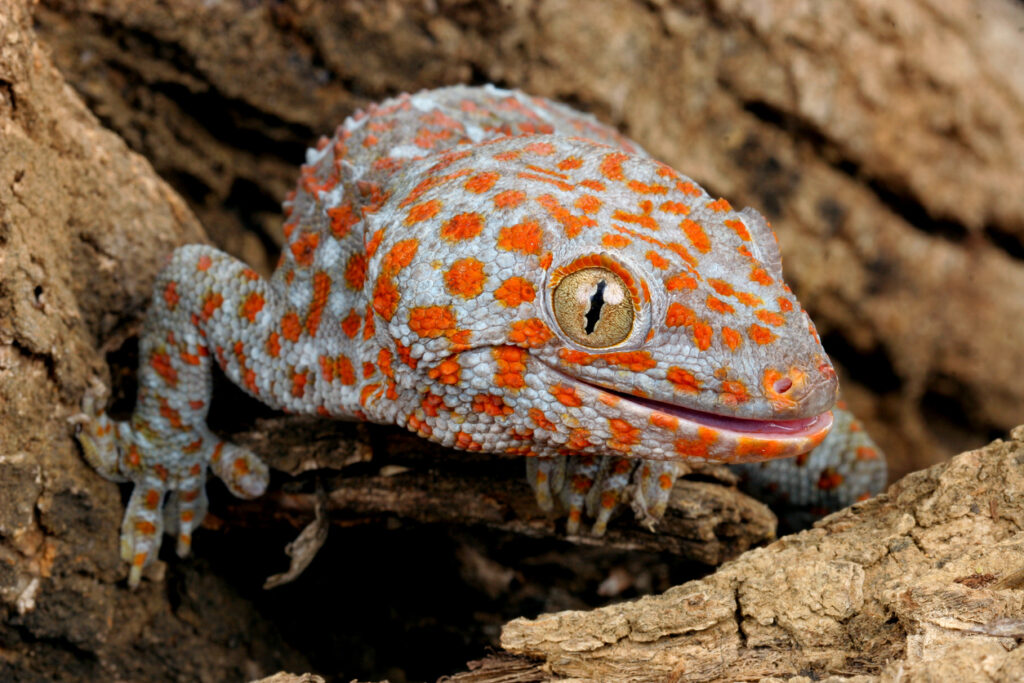
They’re blue-grey to grey-green in base colour, covered in bright orange or red spots scattered across the body. It’s not subtle. In the wild, that colouring serves as a warning as much as anything else, signalling to potential predators that this isn’t an animal that’s going to be easy to deal with. Juveniles tend to be more boldly marked, and colouring can shift slightly depending on temperature, mood, and light. No two are quite identical.
They live across a vast range of Southeast Asia.
Tokay geckos are native to a broad stretch of South and Southeast Asia, from northeast India and Bangladesh through to Indonesia, the Philippines and beyond. They’ve also established introduced populations in parts of Florida, Hawaii, Belize and other places where the climate suits them. They’re highly adaptable, which is a big part of why they’ve spread so successfully. They do well in rainforest, on rocky cliff faces, in agricultural land and very comfortably in human buildings, which they seem to treat as perfectly adequate habitat.
They’re nocturnal hunters with impressive grip.
Like most geckos, Tokays are nocturnal and do their hunting after dark. Their diet is broad, and it includes insects, smaller lizards, small rodents, and the occasional small bird if the opportunity presents itself. They’re fast and accurate when they strike. Their toes are covered in microscopic hair-like structures called setae that allow them to cling to almost any surface, including glass, which is why you’ll often find them walking across walls and ceilings with complete confidence. It’s not sticky in the traditional sense. It’s closer to a molecular-level adhesion that they can switch on and off.
They’re fiercely territorial and not easily intimidated.
Tokay geckos don’t back down. Males will defend their territory aggressively against other males, and they extend that attitude fairly freely towards anything else they perceive as a threat, including humans. They’ll open their mouth wide, vocalise loudly and bite without much hesitation if they feel cornered. The bite is strong enough to break skin, and they sometimes hold on rather than releasing immediately. They’re not aggressive without reason, but they have a very low threshold for deciding that a situation calls for a response.
@reptiliatus Tokay Trust. Working on building trust with Tiki, my Tokay gecko (Gekko gecko)! Here you can Tiki accepting food from and on my hand! I use a few different methods to get these lovely geckos used to being hand as well as tong fed ✨🦎! • #tokaygecko #reptiliatus #reptile #pet #animal #tiktok #viral #petsoftiktok #tokay #gecko #lizard #foryou #lizardsofinstagram #tikithetokaygecko #blue #eating #food #bugs #animals ♬ original sound – Dayyan
Their eggs are remarkable in their own right.
Females lay two hard-shelled eggs at a time, which they typically attach to a surface rather than burying them. The shells harden on contact with air and the eggs are often cemented to bark, rocks or walls in spots that are difficult to reach. Both parents have been observed guarding the eggs, which is relatively unusual in reptiles. The eggs take around two to six months to hatch depending on temperature, and hatchlings emerge fully formed and immediately independent. They receive no parental care beyond the protection of the eggs before hatching.
They play a genuine role in controlling insect populations.
In the parts of the world where they live alongside humans, Tokay geckos earn their keep. They eat large quantities of insects including cockroaches, moths, beetles, and mosquitoes. Many households across Southeast Asia actively welcome them for exactly this reason and consider them good luck as well as practical pest controllers. There’s a long cultural history in the region of Tokays being seen as beneficial creatures to have around, which is a reasonable attitude given what they contribute.
They have significant cultural meaning in parts of Asia.
Beyond pest control, the Tokay gecko holds a particular place in the folklore and belief systems of several Southeast Asian cultures. They’re considered good omens in many traditions, and the number of calls a gecko makes is thought to carry specific meaning in some communities. They appear in traditional medicine, art, and superstition across the region, and attitudes towards them are generally positive in a way that reflects how long humans and Tokays have been sharing the same spaces.
They’re unfortunately targeted by the illegal wildlife trade.
The same cultural significance that protects them in some contexts makes them a target in others. There’s a persistent and damaging trade in Tokay geckos driven by claims in some traditional medicine circles that they have curative properties, particularly for conditions like asthma and HIV. There’s no scientific evidence to support these claims, but the trade continues and puts real pressure on wild populations in certain areas. Large specimens command higher prices, which has led to particularly intense collection pressure on the bigger animals.
@emzoticofficial How I catch my Tokay Geckos for weighing. Keeping accurate health records is so important 🦎 #pettips #howto #tokaygecko #gecko #petcare #petcaretips ♬ original sound – emzoticofficial
They can shed and regrow their tails.
Like many lizards, Tokays can drop their tail as a defence mechanism when grabbed by a predator. The detached tail continues to move briefly, which distracts the threat while the gecko escapes. A new tail grows back over time, though it’s typically made of cartilage rather than bone and looks slightly different to the original. It’s a significant energy cost for the animal, so they don’t do it casually, but it’s an effective last resort when other options have run out.
They’re popular in the exotic pet trade, but not always easy to keep.
Tokay geckos are widely kept as pets, partly because of their looks and partly because of their personality, which some people find entertaining, even when that personality involves being bitten regularly. They’re not a beginner’s reptile. They need specific humidity, temperature and space, they stress easily in captivity if conditions aren’t right, and their temperament means handling requires patience and time. Captive-bred specimens tend to be more manageable than wild-caught ones, though manageable is relative with a Tokay.
They’re a reminder that nature doesn’t do subtle.
There’s something refreshing about an animal that makes no attempt to blend in or keep a low profile. The Tokay gecko is loud, visually bold, physically capable and entirely comfortable taking on something much larger than itself if it has to. It’s been living alongside humans for centuries across one of the most densely populated regions on earth, and hasn’t remotely lost its edge in the process. That’s not a bad track record for a gecko.