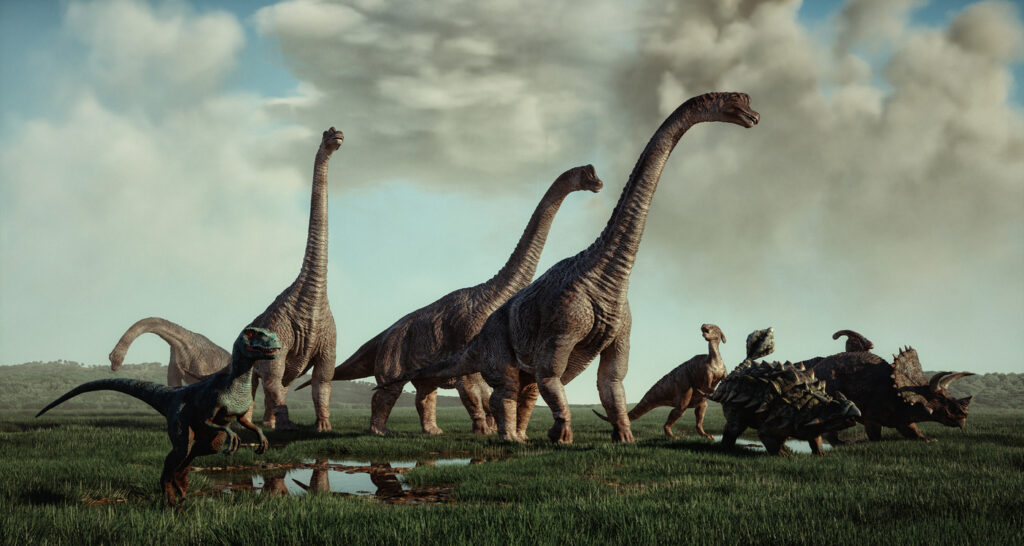
One of the first things people notice about dinosaurs is their size. Some of them grew far larger than any land animals alive today. The question scientists have been asking for years is simple but fascinating. Why did dinosaurs grow so big in the first place? Several factors helped make that possible.
The climate of the dinosaur era was warmer and more stable.
During much of the age of dinosaurs, the planet was warmer than it is today. There were no polar ice caps, and the climate was generally stable across large areas of the world. Warm temperatures meant plants could grow for long periods without harsh winters slowing them down.
For plant-eating dinosaurs, this meant a constant supply of food. With large forests, ferns, and conifers covering huge landscapes, herbivores had the resources needed to grow bigger over time. When the food supply stays reliable for millions of years, evolution often favours animals that can reach larger sizes.
There was enormous plant life to support giant herbivores.
The prehistoric world was filled with thick vegetation. Giant conifers, cycads, horsetails, and fern forests spread across continents. These plants created a vast buffet for herbivorous dinosaurs that spent most of their lives feeding.
Large animals need huge amounts of food every day, so a rich plant world made their size possible. Dinosaurs such as sauropods could eat constantly, sometimes consuming hundreds of kilograms of vegetation daily. Without that enormous plant supply, such massive bodies would never have been sustainable.
@tylerstoneart Replying to @Brandon Davidson TL;DR: they were built different #greenscreen #fyp #foryoupage #dinosaur #birds #paleontology #evolution #anatomy #prehistoric #science #sciencetok ♬ original sound – Tyler Stone
Their breathing system was extremely efficient.
Many scientists believe dinosaurs had a respiratory system similar to modern birds. Instead of lungs that simply expand and contract like ours, birds have air sacs that move oxygen through the body more efficiently. Evidence in dinosaur fossils suggests they may have used a similar system.
That efficient breathing system allowed oxygen to circulate through their bodies more effectively. Large animals require huge amounts of oxygen to support muscles and organs. A powerful respiratory system made it easier for dinosaurs to maintain massive body sizes without collapsing under their own weight.
Large bodies helped protect them from predators.
In nature, size can be a powerful defence. A very large animal is much harder to attack or bring down. For plant-eating dinosaurs, growing bigger may have offered protection from carnivorous species that hunted them.
Predators tend to target animals they can overpower. Once herbivores reached truly enormous sizes, only the largest meat-eating dinosaurs could pose a serious threat. Over millions of years, natural selection favoured individuals that grew larger because they were more likely to survive and reproduce.
Dinosaurs grew differently from most modern reptiles.
Although dinosaurs are often grouped with reptiles, many scientists believe their growth patterns were closer to those of birds and mammals. Fossil studies suggest they grew quickly when young, sometimes reaching enormous size in a surprisingly short time.
This rapid growth allowed dinosaurs to pass through their vulnerable stages faster. Young animals that grow quickly spend less time as small, easy prey. Once they reached a large size, their chances of survival increased dramatically.
@paleopedia Sauropods were pretty much perfectly adapted to being big. Here’s how they did it #Paleopedia #dinosaur #evolution #paleontology #fossil ♬ original sound – Paleopedia
Their bones were strong but surprisingly lightweight.
Many large dinosaurs had hollow or air-filled spaces inside their bones, similar to birds today. These structures reduced weight while still maintaining strength. This design helped support enormous bodies without making them too heavy to move.
Without this adaptation, the sheer weight of giant dinosaurs would have made movement extremely difficult. Lightweight yet strong bones allowed animals such as long-necked sauropods to grow to incredible sizes while still being able to walk and feed.
Long necks allowed them to reach more food.
Some of the largest dinosaurs had extremely long necks. Instead of moving their entire bodies to find food, they could sweep their neck across a wide area and reach vegetation high in trees or spread across the ground.
This feeding strategy meant they could gather food efficiently without wasting energy. Being able to access more plants than smaller animals gave these dinosaurs a major advantage. Over time, this feeding style supported the evolution of even larger bodies.
There were fewer limits on body size at the time.
Modern ecosystems often contain many competing animal groups that keep each other’s populations in balance. During the dinosaur era, however, dinosaurs dominated most land environments for millions of years.
With fewer competing large animal groups, dinosaurs had the evolutionary space to experiment with extreme body sizes. Without strong competition for their ecological roles, some species were able to grow larger and larger across generations.
Bigger animals often live longer.
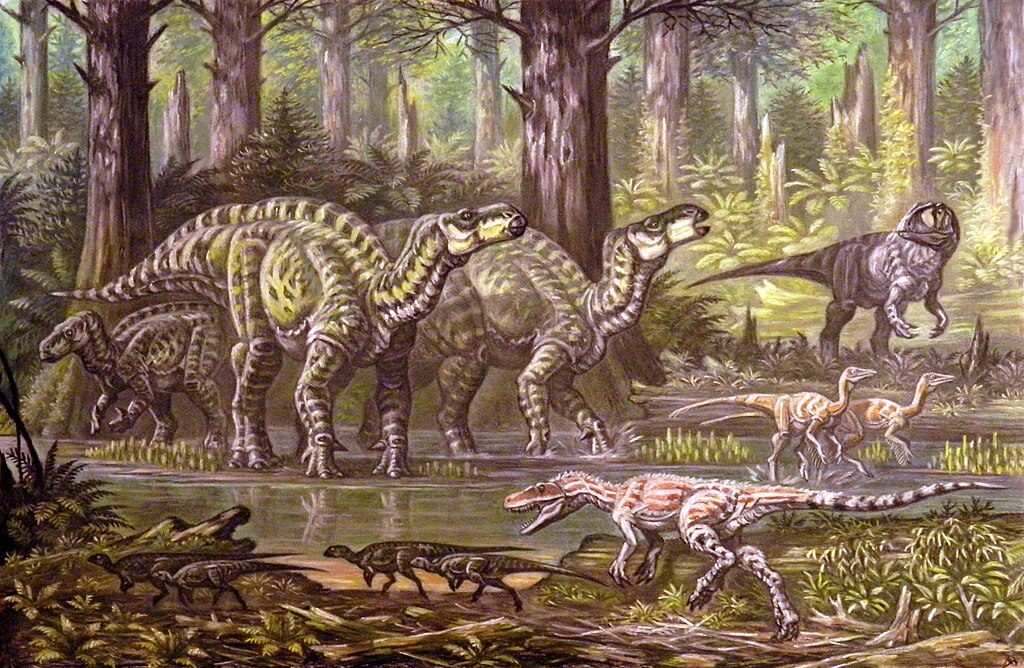
Large body size can sometimes bring longer life spans. Animals that grow big often face fewer predators and may survive for many years. A longer life allows more opportunities to reproduce, which helps those traits spread through the population.
If larger dinosaurs tended to live longer than smaller ones, natural selection would favour those bigger individuals. Over millions of years, this gradual advantage may have pushed certain dinosaur groups toward massive sizes.
Evolution had millions of years to experiment.
Dinosaurs ruled the Earth for more than 160 million years. That enormous stretch of time gave evolution plenty of opportunities to explore different body shapes and sizes. With each generation, small changes accumulated.
Across those vast periods, some dinosaur groups gradually evolved into giants. The result was a prehistoric world filled with animals far larger than anything living on land today. Their incredible size was not the result of one single factor, but a combination of environment, biology, and time.