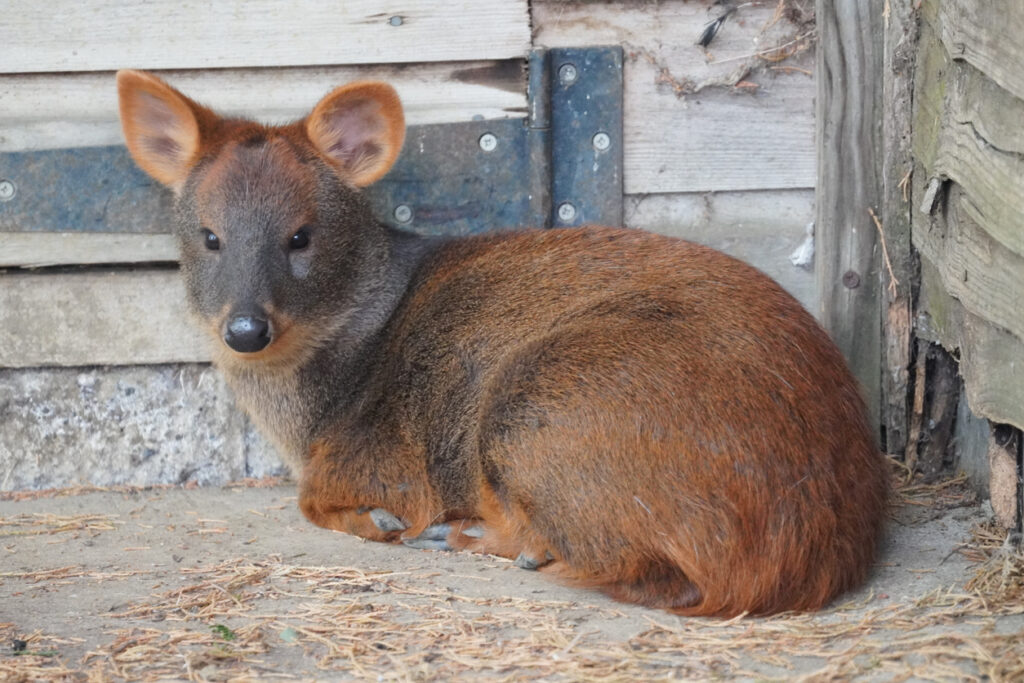
The world’s tiniest deer looks almost unreal when you first see it. It stands barely higher than a large house cat, with short legs, rounded ears, and a soft, shy expression that makes it look more like a woodland creature from a storybook than a wild mammal. But this tiny deer is very real, and it’s under real pressure.
Known as the pudu, it lives in the forests of South America, and its survival is tied directly to the fate of those forests. If its habitat continues to shrink, this miniature deer could quietly disappear before most people even learn its name.
It really is the smallest deer on Earth.
The pudu holds the title of the world’s smallest deer species. Adults stand only around 30 to 45 centimetres tall at the shoulder and weigh roughly 9 to 13 kilograms. That makes them noticably smaller than the red deer, elk, or even roe deer most people picture when they hear the word deer.
There are two species. The northern pudu lives in the Andean regions of Colombia, Ecuador, and Peru. The southern pudu inhabits temperate rainforests in Chile and western Argentina. Both are elusive, forest-dwelling animals that rely on dense vegetation to stay hidden.
They depend on thick forest cover to survive.
Pudus are not open-field grazers. They thrive in dense understory, where tangled shrubs, ferns, and low branches give them cover from predators. Their small size works in their favour when the forest is intact, allowing them to slip quietly through tight spaces.
When forests are cleared or fragmented, that advantage disappears. Open areas leave them exposed to predators and human activity. Because they are shy and secretive, habitat loss hits them especially hard.
@sandiegozoo If you’re having a bad day just remember baby pudus ✨exist✨ #boop #pudu #deardeer #sdzsafaripark ♬ original sound – San Diego Zoo
Deforestation is shrinking their world.
Logging, agriculture, and cattle farming have reduced large areas of South American forest over decades. Even when patches of woodland remain, roads and farmland often split them into isolated fragments.
Fragmentation makes it harder for pudus to find mates and maintain healthy populations. Small, cut-off groups are more vulnerable to disease, accidents, and genetic decline. What looks like “some forest left” on a map might not actually be enough.
Free-roaming dogs are a serious threat.
In parts of Chile and Argentina, free-roaming domestic dogs pose one of the biggest dangers to pudus. Even well-fed dogs retain hunting instincts, and a tiny deer stands little chance if chased.
Conservation workers in some regions regularly treat injured pudus that have survived dog attacks. Many do not survive. This is one of those human-linked threats that could be reduced with better awareness and responsible pet control.
Roads are becoming deadlier.
As rural areas develop, more roads cut through forest habitat. Pudus are small, low to the ground, and often active at dawn or dusk. That makes them hard for drivers to spot. Vehicle collisions are increasingly reported in certain regions. A small deer crossing a narrow forest road might seem like a minor risk, but over time, repeated losses can take a toll on already vulnerable populations.
Disease risk is rising.
Contact between wildlife and livestock brings disease risks that scientists are still trying to understand fully. Parasites and infections can move between domestic animals and wild species. Because pudus live close to the ground and browse low vegetation, they can encounter contaminated areas more easily. Disease outbreaks in small populations can have a disproportionate impact.
@animalogic This is the smallest deer in the world! The Pudu #Pudu ♬ original sound – Animalogic
Their biology makes recovery slow.
Pudus typically give birth to just one fawn at a time. That means population growth is gradual, even in ideal conditions. If adult survival drops due to habitat loss or predation, recovery can be slow. The animal’s slow reproductive rate means conservation needs to be proactive rather than reactive. Waiting until numbers are critically low makes recovery much harder.
They play a quiet role in forest ecosystems.
Though small, pudus are part of a broader ecological system. As browsers, they influence plant growth and seed dispersal. Healthy forests rely on balanced relationships between plants and animals.
When species like the pudu decline, it signals that something in the ecosystem is out of balance. Protecting them helps maintain the health of the forest as a whole.
Captive breeding offers a safety net.
Some zoos and wildlife institutions participate in breeding programmes designed to maintain healthy pudu populations in human care. These programmes help preserve genetic diversity and provide opportunities to study their behaviour and health more closely. However, captive breeding alone cannot solve habitat loss. A species cannot thrive long-term without secure, connected wild environments.
Forest protection is the real long-term solution.
The future of the world’s tiniest deer depends largely on protecting and reconnecting forest habitats. Larger, continuous stretches of woodland give pudus space to move, breed, and hide safely. Conservation efforts that limit deforestation, manage road development, and reduce human-wildlife conflict offer the strongest hope. Supporting sustainable forestry practices and wildlife protection initiatives makes a real difference.
The pudu may be small, but its story is part of a much bigger one. When forests shrink, quiet species like this are often the first to suffer. Protecting them means protecting the wider web of life they belong to. The world’s tiniest deer does not need fame. It needs healthy forests, responsible human behaviour, and attention before it is too late.