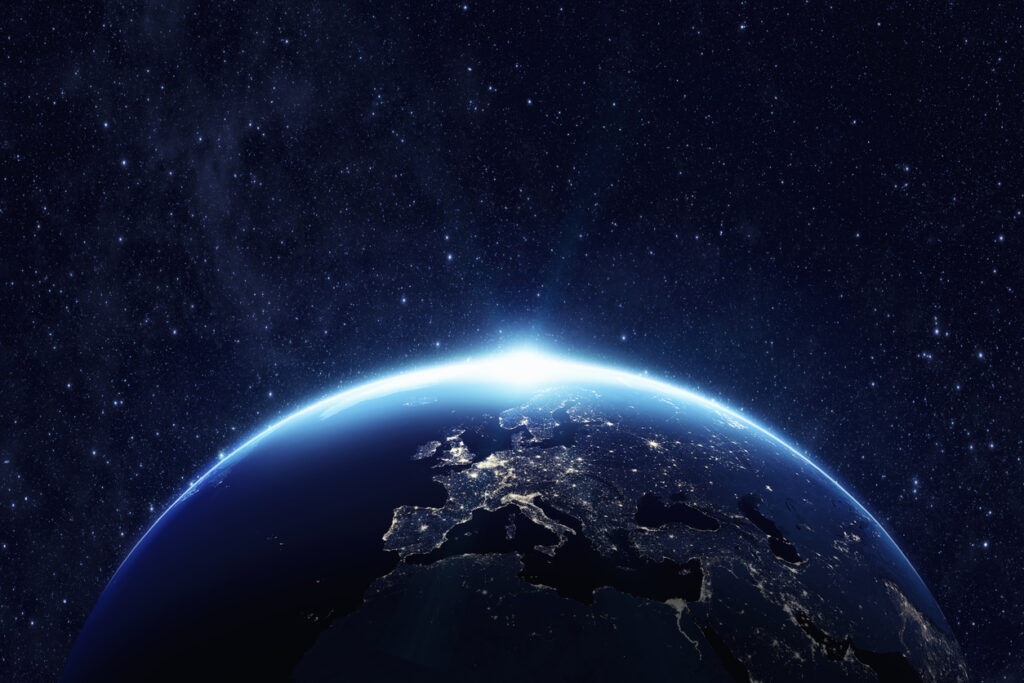
It sounds like the premise of a disaster film, but the physics behind it are real, the historical precedent exists, and the infrastructure vulnerability has been confirmed by researchers who study it seriously. A large enough solar event hitting Earth at the right angle could cause disruption to global communications and power systems on a scale that’s genuinely difficult to imagine from inside a world where connectivity is assumed. Here’s how it might play out (though hopefully, it never will).
The sun regularly produces powerful bursts of energy that reach Earth.
Solar flares are intense releases of electromagnetic radiation from the sun’s surface, produced when magnetic field lines in active regions snap and reconnect, releasing energy equivalent to millions of nuclear bombs in a matter of minutes. They travel at the speed of light and reach Earth in around eight minutes, carrying X-rays and ultraviolet radiation that interact with the upper atmosphere.
Accompanying many large flares are coronal mass ejections, enormous clouds of magnetised plasma that travel more slowly, arriving at Earth between one and three days after the initial flare. It’s the combination of these two phenomena that poses the most serious threat to technology.
The real danger comes from what solar plasma does to Earth’s magnetic field.
When a coronal mass ejection reaches Earth, its magnetised plasma interacts with the planet’s own magnetic field in a process that can compress and distort it in a big way. This distortion generates geomagnetic storms, and during severe storms the fluctuations in Earth’s magnetic field induce electrical currents in any long conducting material on the surface, including power cables, pipelines, and railway lines.
These induced currents are called geomagnetically induced currents, and they flow through infrastructure that wasn’t designed to handle them, potentially burning out transformers, disrupting grid operations, and causing cascading failures across interconnected power systems.
@short_infomationNo WiFi for a month 🤮🤬🤯♬ original sound – Short Clips
A historical event shows exactly how much damage is possible.
The Carrington Event of 1859 is the benchmark against which all subsequent solar storms are measured. A coronal mass ejection of exceptional size hit Earth and produced geomagnetic storms so intense that auroras were visible as far south as the Caribbean, telegraph systems across Europe and North America failed, some operators received electric shocks, and telegraph paper caught fire.
The technological infrastructure of 1859 was rudimentary compared to today’s, but it was comprehensively disrupted by the event. A Carrington-scale event hitting Earth in the present day would encounter a civilisation that is incomparably more dependent on electrical infrastructure and incomparably more vulnerable as a result.
The internet’s physical infrastructure is more exposed than most people realise.
The internet is not a cloud. It’s a physical system of cables, routers, data centres, and satellites that depend on stable power and functioning hardware. Submarine cables carrying the vast majority of international internet traffic run along ocean floors and are connected to land through amplifier stations that require continuous power.
Satellites in low Earth orbit are directly exposed to the radiation environment of space. The transformers that power data centres and routing equipment are large, custom-built pieces of hardware that take months or years to manufacture and replace. A solar event severe enough to damage huge numbers of these components simultaneously would create a restoration challenge that the world’s supply chains and engineering capacity would struggle to meet quickly.
Satellites are particularly vulnerable.
During a major solar event the increased radiation environment in space can damage satellite electronics directly, and the expansion of Earth’s upper atmosphere that accompanies geomagnetic storms increases drag on low-orbit satellites, altering their trajectories and accelerating orbital decay. The 1989 Quebec geomagnetic storm caused the failure of a communications satellite within minutes of the storm beginning.
Modern satellite constellations including those providing GPS, weather monitoring, and direct internet access represent a layer of infrastructure that’s simultaneously more extensive and more exposed to solar weather than anything that existed in previous decades. A severe event could disable huge numbers of satellites without warning.
@the_great_joe_gillespie #greenscreenvideo #greenscreen #greenscreensticker #solarstorm #solarflare #newsmedia #cheesehead ♬ Horror train, horror piano, BGM(1230538) – syummacha
Power grid failures would disable the internet indirectly, even where cables survived.
Even in regions where the physical internet infrastructure remained intact, widespread power grid failure would take most of it offline within hours. Data centres have backup generators and battery systems capable of running for hours to days, but a geomagnetic storm severe enough to cause grid failures across multiple regions simultaneously would exhaust those backups faster than the grid could be restored.
The internet requires not just cables and servers but the continuous power to run them, and a large portion of the world’s power infrastructure is operated through transformers and control systems that are vulnerable to geomagnetically induced currents in ways that haven’t been fully remediated.
The 2003 Halloween storms give a more recent indication of the risk.
A series of powerful solar storms in October and November 2003 produced effects important enough to damage or disable around 28 satellites, caused power outages in Sweden, disrupted aviation communications, and produced GPS errors significant enough to affect safety-critical navigation.
These storms were large but not Carrington-scale events, and they still produced widespread and costly infrastructure effects across multiple countries. Researchers who modelled the likely effects of a Carrington-scale event on modern infrastructure concluded that the economic impact in the United States alone could reach between one and two trillion dollars, with full recovery taking four to ten years.
The timing and direction of a solar event determines how bad the impact would be.
Not every large solar flare or coronal mass ejection hits Earth because the sun ejects plasma in all directions, and only those aimed toward Earth’s position in its orbit create geomagnetic storms here. The geometry of a direct hit, where a coronal mass ejection’s magnetic field is oriented in a way that maximises its interaction with Earth’s own field, is what produces the most severe effects.
A near-miss in July 2012 involved a coronal mass ejection that researchers estimated was comparable to the Carrington Event in scale. It missed Earth by nine days in terms of orbital position. Had it hit directly, the effects on modern infrastructure would have been enough to make it one of the most consequential events in recorded history.
Early warning systems exist, but the response window is short.
Space weather monitoring through satellites including NASA’s Advanced Composition Explorer provides some advance warning of approaching solar events, and the time between a coronal mass ejection leaving the sun and arriving at Earth, typically between one and three days, is theoretically enough time to take some protective measures. Utilities can place transformers in protective states, operators can power down vulnerable satellites, and some grid hardening can be implemented rapidly.
The challenge is that the severity of an incoming event is difficult to assess accurately until it’s very close to Earth, the most critical information about its magnetic orientation only becomes clear with around fifteen to sixty minutes of warning, and coordinating protective action across multiple countries and operators in that timeframe is not straightforward.
The infrastructure hasn’t been hardened to the degree the risk warrants.
The gap between what researchers who study space weather recommend in terms of infrastructure protection and what has actually been implemented is pretty large in most countries. Replacing or shielding the most vulnerable high-voltage transformers, improving grid sectioning to prevent cascading failures, hardening satellite systems against radiation, and establishing internationally coordinated response protocols are all identified measures, and all of them have been implemented partially and unevenly.
The cost of preparation is considerable, the probability of a major event in any given year is relatively low, and the result is a familiar pattern where large-scale low-frequency risks receive less investment than the research community believes is warranted. The sun, for its part, is indifferent to the preparedness of the civilisation it’s pointing at.