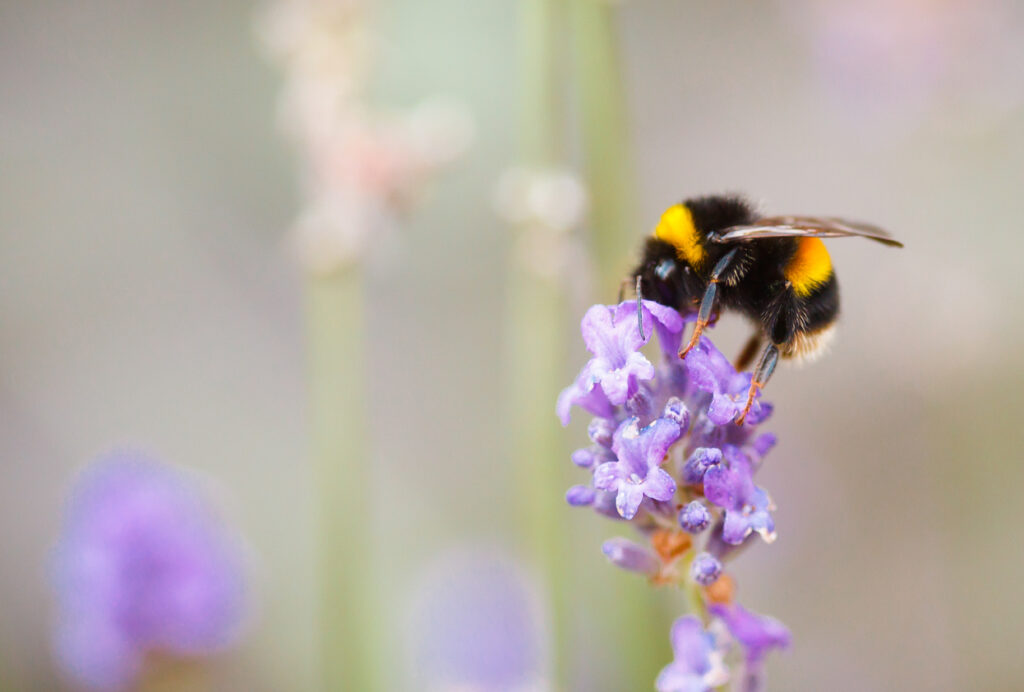
If you’ve ever watched a garden on a warm day and noticed that bees seem to spend a disproportionate amount of time on lavender, catmint, and other purple flowers while ignoring things that seem equally abundant, it’s not coincidence and it’s not random. There are real biological and evolutionary reasons behind the preference, and they tell you something interesting about how bees experience the world.
Bees see colour differently from humans.
The human eye detects red, green, and blue light and combines those signals to produce the full range of colour we perceive. Bees also have three types of colour receptors, but they’re shifted relative to ours, detecting green, blue, and ultraviolet light rather than extending into the red part of the spectrum.
That means bees are essentially red-blind, seeing red flowers as a dull, indistinct colour similar to how we might see something in very low light, while the blue and violet end of the spectrum is where their colour vision is sharpest and most detailed. Purple, violet, and blue flowers sit right in the sweet spot of bee colour perception.
Purple flowers often reflect ultraviolet light in ways that are invisible to us.
Many flowers that appear simply purple or violet to human eyes have ultraviolet patterning on their petals that’s completely invisible to us, but highly visible to bees. These UV patterns often form lines, spots, or rings that guide bees directly toward the nectar and pollen at the centre of the flower, functioning as a kind of landing guide that makes foraging faster and more efficient.
When researchers photograph flowers under ultraviolet light, the patterns that emerge are often strikingly different from what we see, and bees navigating toward these flowers are responding to a level of visual information that we’re not even aware exists.
@kerbysnursery Those who love purple are visionaries, wise, and mysterious 🐝💜 #bees #bee #beesoftiktok #savethebees #pollination #pollinator #pollinators #pollinatorsareimportant #pollinatetheplanet #purpleflowers #purpleflower #pollinatorfriendly #salvia #pollinatorgarden ♬ Golden Hour: Piano Version (Cover) – Andy Morris
Bees have been shown in experiments to prefer blue and violet over other colours.
Controlled studies where bees are offered identical rewards in differently coloured containers consistently show a preference for blue and violet options over red, orange, and yellow ones. The preference isn’t absolute and bees will learn to visit other colours if that’s where the reward is reliably found, but given a free choice with no prior learning, the blue-violet range wins consistently. This isn’t a cultural or learned preference within bee populations. It’s wired into their visual system and consistent across different bee species that have been tested.
The preference evolved alongside flowering plants over millions of years.
Bees and flowering plants have been co-evolving for around 130 million years, and the relationship between bee vision and flower colour is not accidental. Plants that attracted bee pollinators more effectively left more offspring, which over millions of generations produced selection pressure toward the colours bees find most attractive.
Bees that were better at finding those flowers left more offspring, too, reinforcing the visual sensitivity at the blue-violet end of the spectrum. The result is a relationship shaped by mutual evolutionary pressure, in which purple flowers and bee colour vision have influenced each other into their current forms.
Purple flowers tend to be excellent nectar and pollen producers.
The correlation between purple colouring and good nectar production isn’t purely about colour. Many of the plants that have evolved to attract bee pollinators have also evolved to reward them well, because a bee that gets a good return from a visit is more likely to return and more likely to carry pollen to another flower of the same species.
Lavender, borage, catmint, alliums, and phacelia are all strong nectar producers as well as being purple or violet, which reinforces the association in bee memory. The colour and the reward become linked through experience as well as through the underlying visual preference.
@fourseasons.naturePrime Pollentior Bait – What Is That? Ever wondered why bees seem to love purple flowers more than red ones? It’s all about how they see the world. Bees can’t see red, but they can see ultraviolet – and purple flowers often reflect UV light in a way that’s super attractive to them. That makes purple blooms prime pollinator bait in your garden. Boost biodiversity, help the bees, and plant with purpose.♬ original sound – fourseasons.nature
Bees learn and remember which flowers have been rewarding.
Beyond their innate preference for blue and violet, bees are also sophisticated learners that associate colours, shapes, and scents with previous foraging success. A bee that visits a purple flower and finds good nectar is more likely to seek out similar flowers on subsequent foraging trips, which reinforces the purple preference through experience even in cases where the innate preference might not have been as strong.
This associative learning is fast and accurate, and bees can distinguish between subtly different shades and patterns with a reliability that researchers find consistently impressive.
The scent of purple flowers plays a role alongside colour.
Bee attraction to purple flowers isn’t purely visual. Many strongly scented plants that bees favour happen to be purple or violet, including lavender, catmint, and thyme, and scent operates alongside colour as a navigation cue at different distances. Colour tends to guide bees in when they’re close enough to see the flower clearly, while scent can attract them from considerably further away.
The combination of a highly visible colour in bee terms and a strong attractive scent makes purple aromatic flowers particularly effective at drawing bee attention, which is why a lavender hedge in flower can be humming with activity from a considerable distance.
Not all bees have identical colour preferences.
While the general preference for blue and violet holds across bee species, there are differences between species in how strongly the preference is expressed and which colours within that range are most attractive. Bumblebees and honeybees have been the most studied and show clear blue-violet preferences, but solitary bee species including mason bees and leafcutter bees show somewhat different patterns in their foraging choices.
Some solitary species show stronger preferences for yellow flowers than honeybees and bumblebees do, reflecting differences in the visual systems and foraging strategies that have evolved within different bee lineages.
@robdoingrob Bees love lavender and now i know why. #gardening ♬ Belonging – Muted
Yellow flowers aren’t ignored, and there’s a reason for that too.
While purple and blue dominate the list of bee-preferred colours, yellow is also strongly attractive to bees and appears frequently in their foraging choices. Yellow sits at the boundary of what bees see well and, importantly, many yellow flowers also reflect strongly in the ultraviolet, giving them a high visibility in bee colour terms despite being at the less-favoured end of the spectrum.
The popularity of dandelions, sunflowers, and goldenrod with bees reflects this, and in terms of sheer availability yellow flowers represent such a large proportion of what’s on offer in many environments that even a secondary preference translates into major foraging time.
Red flowers aren’t invisible to bees, but they’re much less attractive.
The idea that bees can’t see red at all is a simplification of what’s actually happening. Bees can detect red to some degree at the boundaries of their visible spectrum, and some red flowers have ultraviolet components that make them more visible than their human-perceived colour suggests.
However, as a general rule red flowers without ultraviolet patterning are among the least attractive options in a bee’s visual field, which is why many red flowers including poppies have evolved ultraviolet markings to compensate. Flowers that are exclusively pollinated by birds rather than insects have less evolutionary pressure to be attractive to bees and are often red as a result.
This has practical implications for garden planting.
Understanding bee colour preference has real applications for anyone who wants to support bee populations in their garden. Planting heavily in the blue, violet, and purple range, lavender, borage, catmint, phacelia, salvia, alliums, and verbena, provides a garden that’s highly visible and attractive to bees in visual terms as well as being typically well-stocked with nectar and pollen.
A succession of purple-flowering plants across the season, from early borage in spring through to late-flowering salvia in autumn, supports bees across the periods when they’re most actively foraging and when food sources can become scarce.
The relationship between bees and purple flowers tells you something broader about how nature is shaped by perception.
The fact that flowers are the colours they are is not arbitrary. The colour of a flower is in large part a signal evolved for a specific audience, and understanding who that audience is and how they see changes how you look at a garden entirely. The purple of a lavender spike isn’t decorative in the way that human decoration is.
It’s a communication, refined over millions of years of interaction with the animals that the plant depends on, and the bees responding to it are doing exactly what both species evolved for them to do. It’s one of those places where paying attention to the mechanism behind something you’d otherwise take for granted makes it considerably more interesting rather than less.