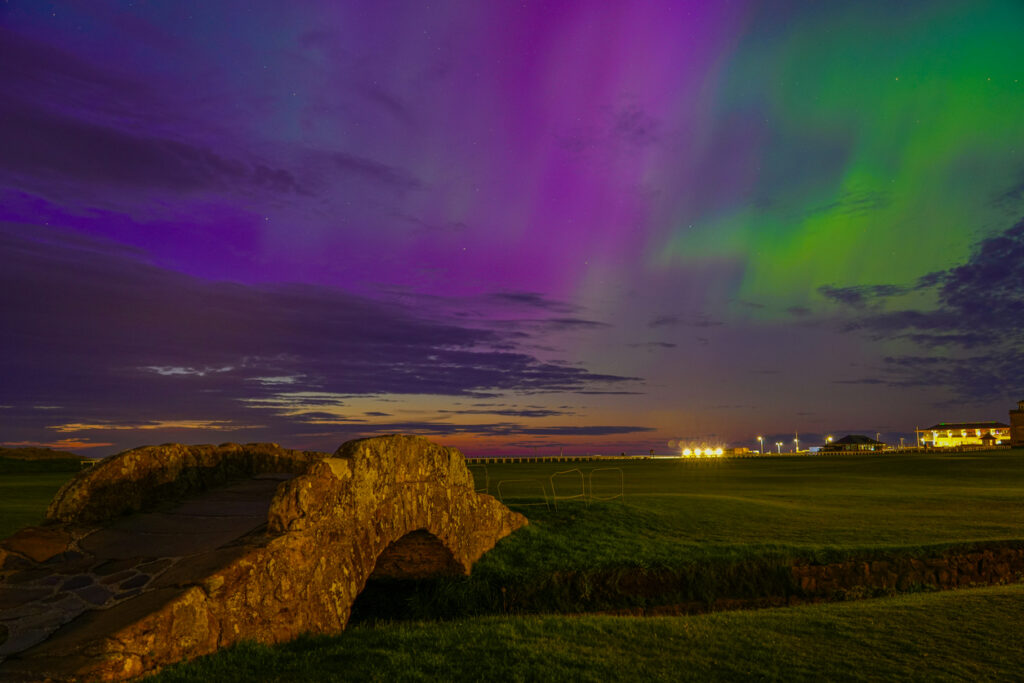
We’ve been seeing the Northern Lights pop up across the UK far more than usual lately, and it’s all down to the Sun reaching the peak of its 11-year cycle. This period, known as the solar maximum, means the Sun is throwing out way more energy than it has in over a decade, sending massive bursts of charged particles our way. When these solar storms hit the Earth’s magnetic field, they don’t just stay at the poles; they push the light show much further south, occasionally making it visible as far down as Cornwall.
It’s not just a change in space weather that’s making the difference, though. Our phones have become much better at catching these faint glows in the dark, meaning people are spotting the aurora through their camera lenses even when it’s barely visible to the naked eye. While we’ve just passed the official peak of this cycle in 2024, the Sun is still incredibly active, so we’re likely to see these rare displays continue for at least another year or two before things start to settle back down.
The sun is currently at solar maximum in its 11-year cycle.
Solar activity follows a predictable pattern that peaks roughly every 11 years, and we’re currently in or near the peak of Solar Cycle 25. During solar maximum, the sun’s magnetic field becomes more chaotic and produces significantly more solar storms, flares, and coronal mass ejections. The increased activity means more opportunities for auroras at lower latitudes than we see during quieter periods, so the UK getting regular displays isn’t abnormal for this phase of the cycle.
@bbcnews The Aurora Borealis is the result of solar eruptions sending particles towards the Earth and interacting with particles in the atmosphere. #NorthernLights #AuroraBorealis #Aurora #BBCNews ♬ original sound – BBC News
Coronal mass ejections are happening more frequently right now.
These massive eruptions of plasma and magnetic fields from the sun’s corona are the main drivers of strong auroral displays on Earth. When a coronal mass ejection hits Earth’s magnetic field, it can trigger geomagnetic storms that push the aurora oval much further towards the equator than usual. The sun has been producing particularly powerful CMEs lately, some of the strongest in decades, which explains why people in southern England and similar latitudes have been seeing lights they’ve never witnessed before.
Earth’s magnetic field channels solar particles towards the poles.
The aurora happens when charged particles from the sun collide with gases in Earth’s atmosphere after being funnelled by our magnetic field towards polar regions. During strong geomagnetic storms, the influx of particles overwhelms the usual containment near the poles and the aurora oval expands significantly southward. That’s why auroras that normally stay near Scotland suddenly become visible in Cornwall or even further south across Europe.
Social media and smartphones make auroras seem more common than they are.
Part of the reason it feels like auroras are everywhere lately is that phone cameras can capture them far better than the human eye, especially long-exposure modes. People are also sharing images instantly on social media, so a single aurora event gets amplified through hundreds of photos and posts. Auroras that would have been missed entirely in previous decades because they were too faint to see clearly are now photographed and shared widely, creating an impression of increased frequency.
@itvnews The skies in parts of the UK were lit up with a dazzling display of the Northern Lights, also known as aurora borealis, on Tuesday night. But if you missed it you may be able to catch a glimpse tonight. #itvnews ♬ original sound – ITV News
This solar maximum is stronger than the previous one.
Solar Cycle 24, which peaked around 2014, was unusually weak with relatively few strong geomagnetic storms. The current cycle is significantly more active, producing the kind of solar storms that were more typical in earlier decades. If you’ve been paying attention to aurora activity for the past 10 to 15 years, the increase feels intense because you’re comparing it to an abnormally quiet period rather than normal solar behaviour.
Improved forecasting means people actually know when to look.
Space weather prediction has advanced enormously in recent years, with satellites monitoring the sun and providing advance warning of incoming coronal mass ejections. Apps and websites now alert people when auroras are likely, so instead of randomly happening to look up at the right moment, people are going outside specifically to watch. That means more people are successfully seeing auroras when they occur, which wasn’t possible when previous strong solar cycles happened.
The aurora oval expands southward during geomagnetic storms.
The aurora typically occurs in an oval shape around each magnetic pole, and during quiet conditions this stays at high latitudes. When a strong geomagnetic storm hits, the oval can expand by hundreds of miles, bringing aurora displays to places that normally never see them. The UK sits at a latitude where it occasionally catches the southern edge of the expanded oval during major storms, which is why displays here are impressive but not guaranteed during every solar event.
@truefarter2.0 Northern Lights lighting up the UK like it’s no big deal… but since when was this normal? When rare becomes regular and the sky keeps getting covered, it’s worth asking questions. #NorthernLights #UKSky #LookUp #QuestionEverything #aurora ♬ Horror BGM of piano and strings – Shinnosuke Shibata
Red auroras visible in the UK indicate very high altitude activity.
The northern lights people see in the UK often include red colours alongside the more typical green, and red auroras occur at higher altitudes where oxygen is thinner. These high-altitude displays are visible from much greater distances than the lower green auroras, which is partly why they can be seen from southern latitudes. The red colour indicates particularly energetic particle interactions happening above 200 kilometres altitude.
Historical records show auroras reached the UK during previous solar maximums, too.
Strong auroral displays in Britain aren’t new, and historical accounts describe northern lights visible from London and even further south during powerful geomagnetic storms in previous centuries. The Carrington Event of 1859 produced auroras visible as far south as the Caribbean, showing that exceptional solar storms can push displays to incredibly low latitudes. What we’re seeing now is unusual for recent decades, but not unprecedented in the longer historical context.
Solar maximum will continue for another year or two before declining.
The peak of solar activity typically lasts for a couple of years rather than being a single moment, so the increased aurora frequency in the UK will likely continue through 2025 and possibly into 2026. After that, solar activity will gradually decline towards solar minimum, and aurora displays at UK latitudes will become rare again. If you’ve been hoping to see the northern lights from Britain, the next year or two offers the best opportunity until the next solar maximum around 2035-2036.