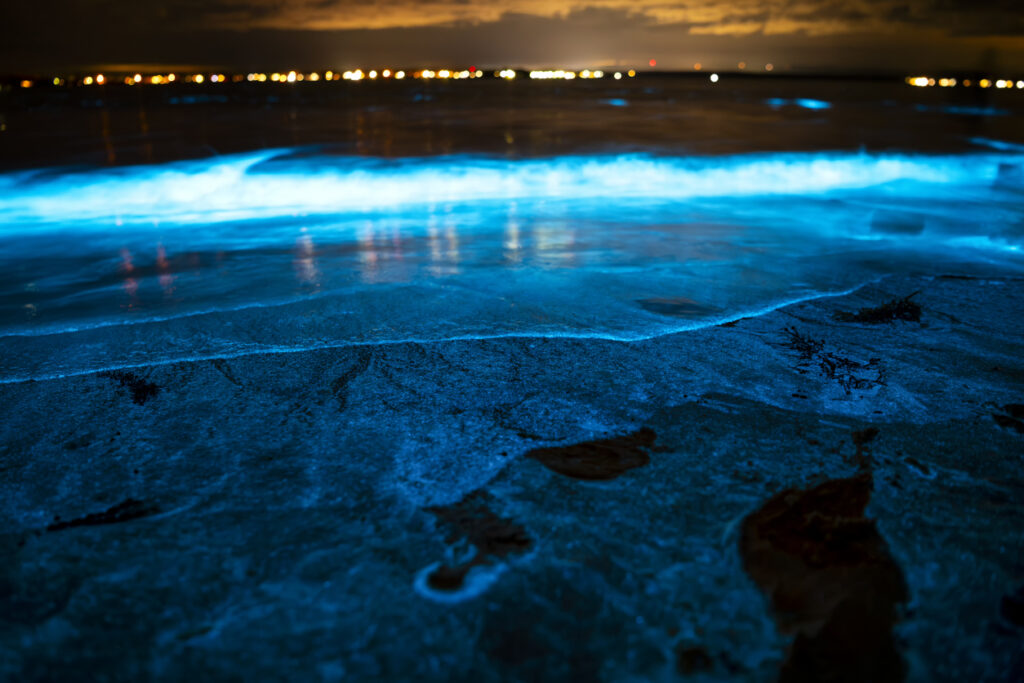
Most of us have seen photos of glowing blue waves at night. It looks magical, almost staged. But sometimes the ocean doesn’t just sparkle around your feet or behind a boat. It glows across huge areas, spreading in every direction like a layer of light sitting on the water.
Sailors have described it as moving through glowing fog, with the horizon itself faintly shining. Scientists have studied these events for decades, and the real reasons behind them are stranger and far more fascinating than most people expect. Here’s what’s really going on.
Tiny plankton flash when they’re disturbed.
One of the most common causes of glowing seas is bioluminescent plankton, especially a group called dinoflagellates. These microscopic organisms emit light when they’re physically disturbed. Waves breaking, a swimmer moving, or a boat cutting through the water can trigger a sudden blue flash.
When millions or even billions of these organisms are present, each tiny spark adds up. Instead of scattered flashes, the water can appear coated in light. In areas with extremely high concentrations, the glow spreads across the surface like a low, shimmering mist.
Huge plankton blooms can make entire coastlines shine.
Plankton populations sometimes explode under the right conditions. Warm water, nutrient rich currents and calm weather can combine to create dense blooms that stretch for kilometres. At night, these blooms transform the ocean surface. What looks dark by day becomes softly glowing after sunset. If the bloom is thick enough and evenly distributed, the effect can look less like sparkles and more like a wide, luminous haze lying over the sea.
@see.the.woorld 🌌✨ The Sea of Stars. When the ocean glows at night, it’s caused by bioluminescent plankton lighting up with every movement 🌊💙 You can see this magical phenomenon in: 📍 Maldives (Vaadhoo Island) 📍 Puerto Rico 📍 Thailand 📍 Indonesia 📍 Australia 📍 California (seasonal) 📍 Florida (Indian River Lagoon & Mosquito Lagoon — best May–Oct) #bioluminescent #maldives #seaofstars #travel #beach ♬ original sound – mega
Bioluminescent bacteria can glow constantly.
Unlike flashing plankton, certain marine bacteria produce a steady glow rather than a quick burst of light. These bacteria don’t need disturbance to shine. They emit continuous light through a chemical reaction inside their cells. When massive numbers gather near the surface, they can create what’s known as a milky sea event. Instead of bright blue flashes, the ocean appears pale white or greenish, glowing evenly in all directions.
Milky seas can be unbelievably vast.
Milky sea events are rare, but when they happen, they can cover enormous areas. Satellite images have confirmed glowing patches over 100,000 square kilometres in size. That’s bigger than some entire countries. Sailors who have passed through these events describe the water as looking like glowing fog or liquid moonlight. There’s often no clear boundary where it starts or ends. It can feel like entering a different world entirely.
The light comes from a chemical reaction called bioluminescence.
The glow isn’t caused by reflection from the moon or pollution. It’s generated inside living organisms through a reaction between a molecule called luciferin and oxygen, helped by an enzyme called luciferase. This reaction produces light very efficiently, with almost no heat. That’s why it’s sometimes called cold light. The ocean isn’t warming up when it glows. It’s biology working at microscopic scale.
@nbcnews #Bioluminescence happens when groups of tiny #planktons are physically disturbed by something — like a breaking wave — at night, causing a chemical reaction that makes them #glow. #California ♬ original sound – nbcnews
Calm seas make the glow appear thicker and more fog like.
Weather plays a big role in how visible the glow becomes. When the sea is rough, light gets broken up and scattered by waves. The result is more flashing and less uniform glow. On calm nights, the surface stays smooth. That allows the light to spread evenly across the water. Instead of sparkles, you get a wide, almost misty layer of illumination.
Nutrient surges trigger explosive growth.
Plankton blooms don’t happen randomly. They often follow nutrient increases in the water. Upwelling currents bring nutrient rich water from deep below to the surface. River run-off can also introduce nutrients after heavy rainfall. When nutrients rise, plankton multiply rapidly. More plankton means more potential light. Under the right nighttime conditions, that growth becomes visible as glowing seas.
The colour changes depending on the species involved.
Most glowing waves appear bright blue, but not all bioluminescence looks the same. Some bacteria produce a softer white glow. Others lean green. The colour depends on the type of organism and the exact chemistry behind the reaction. That’s why different glowing events can look subtly different, even if they’re happening for similar biological reasons.
Fish and boats create moving patterns beneath the surface.
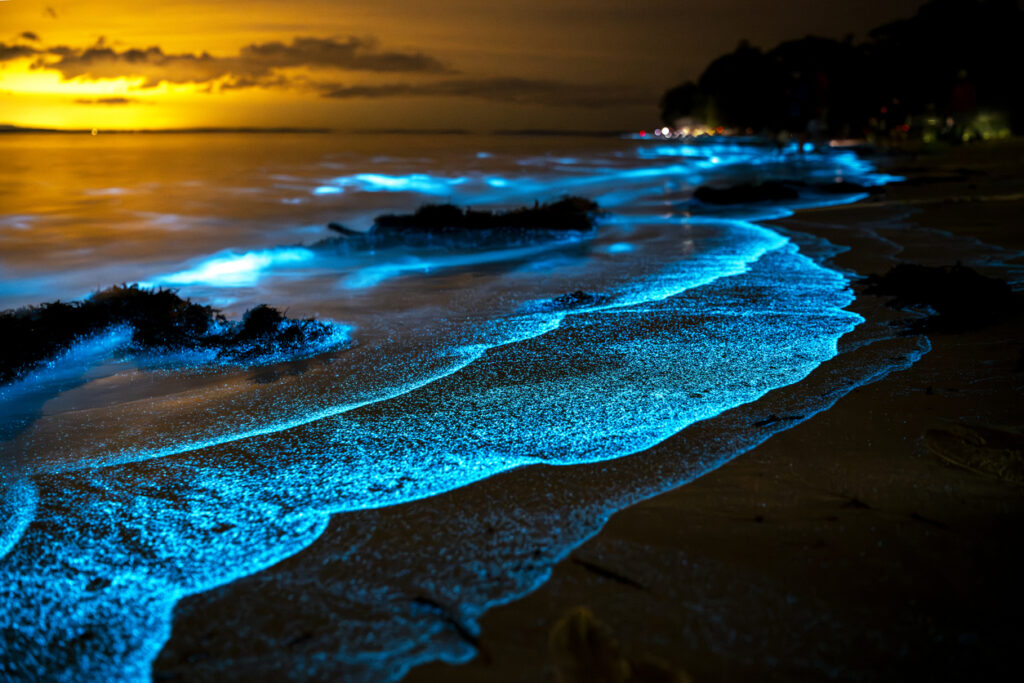
Even when the ocean surface looks calm, activity below can trigger waves of light. Schools of fish swimming through plankton clouds leave glowing trails. Predators chasing prey can create sudden streaks and bursts. From above, these patterns can look like shadows moving inside glowing fog. The fish themselves aren’t glowing. They’re simply disturbing organisms that are ready to light up.
Some glowing events are still not fully understood.
Despite modern research and satellite tracking, scientists still don’t fully understand every glowing ocean event. Milky seas in particular remain partly mysterious. We know bacteria are involved, but predicting when and where these huge glowing fields will appear is difficult.
The ocean is vast and complex. Temperature changes, nutrient cycles and microbial activity all interact in ways that are still being studied. In some cases, glowing events happen far from shore, in remote parts of the Indian Ocean or Pacific, where direct observation is limited.
The glowing ocean might look supernatural, but it’s driven by tiny life forms responding to movement, chemistry, and environment. What feels like fog made of light is actually billions of living organisms reacting together. In a strange way, it’s a reminder of scale. The glow isn’t coming from something huge. It’s coming from something microscopic, multiplied beyond imagination.