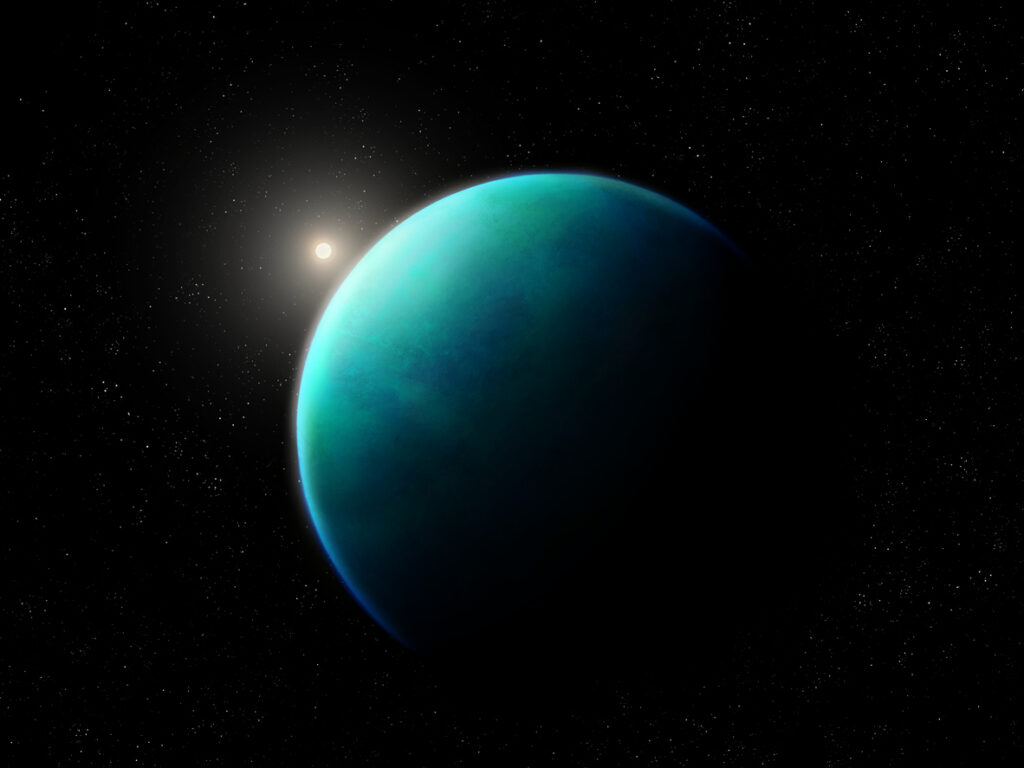
Exoplanets come up a lot these days, usually in headlines about distant stars, strange atmospheres, or the possibility of life somewhere far beyond our solar system. The word sounds technical enough to make some people tune out straight away, as though it belongs firmly in the realm of specialists with telescopes and equations.
In reality, the idea behind exoplanets is far more approachable than it first appears. They sit at the centre of some of the biggest questions humans ask about space, origins, and whether what we see around us is unique or just one example among many. Understanding why they matter starts with getting clear on what we’re actually talking about, and why scientists care so much about objects that, for now, remain completely out of reach.
Simply put, they’re planets beyond our solar system.
At its most basic level, an exoplanet is any planet that doesn’t orbit our Sun. Instead, it travels around a distant star somewhere else in the Milky Way. These stars can be similar to the Sun or completely different, such as small red dwarfs or massive blue stars.
This idea might sound obvious now, but for most of human history, we didn’t actually know that planets existed anywhere else at all. The discovery of exoplanets confirmed that planet formation is not unique to our solar system, which was a huge shift in how we see the universe.
@cbsunstoppable Exoplanets are planets that orbit a star different from our sun ☀️ How do we study these far-out planets? Our high-tech telescopes can help 🔭 Learn more this weekend on #missionunstoppabletv ♬ original sound – CBSUnstoppable
We can’t usually see exoplanets directly.
Exoplanets are incredibly hard to spot because stars are so bright compared to the planets orbiting them. From Earth, a planet is drowned out by its star’s light, even with powerful telescopes. Because of this, most exoplanets are detected indirectly. Scientists look for subtle clues in how a star behaves, rather than trying to photograph the planet itself, which would be like spotting a firefly next to a floodlight from miles away.
Many exoplanets are found when they pass in front of their star.
One of the most successful detection methods is watching for tiny dips in a star’s brightness. When a planet crosses in front of its star, it blocks a small amount of light for a short time. This method, used extensively by missions like the Transit Photometry Method, allows scientists to estimate a planet’s size and orbit. Even a slight dimming can reveal a planet hundreds of light years away.
Some exoplanets are detected by how they tug on stars.
Planets and stars orbit a shared centre of gravity. As a planet moves, it causes its star to wobble slightly. The movement is tiny, but measurable with sensitive instruments. By tracking that wobble, scientists can estimate a planet’s mass. This method helped confirm many early exoplanet discoveries and is still used today to learn more about how heavy and dense these distant worlds are.
Exoplanets come in types we don’t have here.
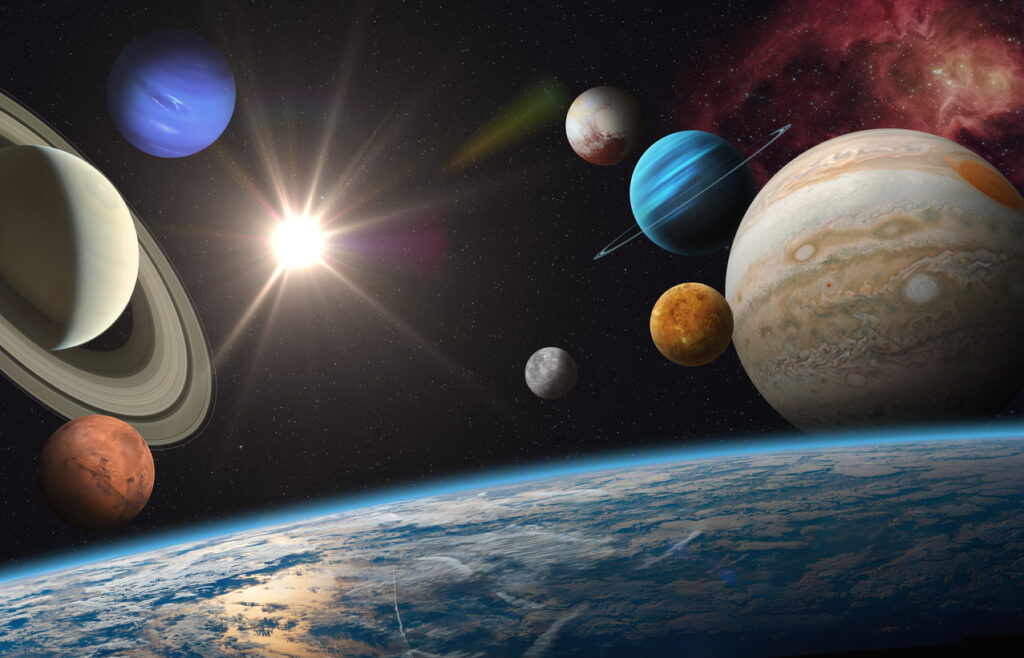
Our solar system contains rocky planets near the Sun and gas giants further out. Exoplanets do not always follow that pattern. Some gas giants orbit extremely close to their stars, completing a year in just a few days. Others are super-Earths, rocky planets larger than Earth but smaller than Neptune, which do not exist in our system at all. These discoveries showed that planet formation can take many different paths.
Some exoplanets are incredibly extreme places.
There are exoplanets hot enough to melt metal, with temperatures soaring above thousands of degrees. Others are icy worlds far from their stars, locked in deep freeze. Some are tidally locked, meaning one side always faces the star while the other remains in darkness. These conditions stretch our understanding of what a planet can be like and still remain stable.
Not all exoplanets are round or calm.
Many exoplanets experience violent weather. Scientists have detected winds moving thousands of miles per hour and clouds made of glass or metal compounds. Gravity on some of these planets is far stronger than Earth’s, while others may have thick atmospheres that behave in ways we are only beginning to understand.
Some exoplanets orbit in the so-called habitable zone.
The habitable zone is the region around a star where temperatures might allow liquid water to exist on a planet’s surface. This doesn’t guarantee life, but it makes a planet more interesting to study. Several exoplanets have been found in these zones, particularly around red dwarf stars. However, factors like radiation, atmosphere, and stellar activity also play major roles in whether a planet could support life.
@astrogsc James Webb Space Telescope and Exoplanets!! #astronomy #space #jwst #exoplanets ♬ Sweet and joyful lighthearted ballad Tell A Story – pinegroove
Exoplanets help us understand how common planets are.
Before exoplanets were discovered, we did not know whether planets were rare or common. Now we know they are everywhere. Most stars likely host at least one planet. This means our galaxy alone may contain billions of planets. Understanding their variety helps scientists work out how planetary systems form and evolve over time.
Studying exoplanets changes how we see Earth.
Looking at distant worlds gives context to our own planet. Earth’s atmosphere, orbit, and temperature range are not guaranteed outcomes of planet formation. By comparing Earth to exoplanets, scientists can better understand what makes our planet stable and life-supporting, and how fragile those conditions might be.
Some exoplanets have atmospheres we can analyse.
In a few cases, scientists can study the light passing through an exoplanet’s atmosphere as it transits its star. This reveals hints about the gases present. Water vapour, carbon dioxide, and other molecules have already been detected. These findings help scientists learn how atmospheres behave under very different conditions from Earth.
Exoplanet discoveries are still accelerating.
New telescopes and missions continue to find more exoplanets every year. Each discovery adds to a growing catalogue of worlds with wildly different characteristics. As technology improves, scientists expect to detect smaller, Earth-sized planets more easily and study them in greater detail than ever before.
Exoplanets raise questions about life beyond Earth.
Finding a planet in the right location with the right size doesn’t mean life exists there, but it raises important questions. Life may require conditions we do not yet fully understand. Exoplanets give scientists real targets to study instead of pure speculation, turning the search for life into a practical scientific question rather than science fiction.
An exoplanet is simple in definition, huge in meaning.
At heart, an exoplanet is just a planet orbiting another star. That simple fact has reshaped astronomy and our place in the universe. Each one discovered reminds us that Earth is part of a much larger story, shared with countless other worlds scattered across the galaxy.