The universe is absolutely massive in ways that are hard to properly get your head around, but what’s even more frustrating is that most of it will always be completely out of reach. It’s not just about building better telescopes or faster rockets, there are actual physical limits that mean huge chunks of the universe are forever hidden from us. These barriers aren’t things we can engineer our way around, they’re just how reality works.
The universe is expanding faster than light can travel.
Space itself is stretching out in all directions, and the further away something is, the faster it’s moving away from us. Eventually, you get to a point where things are moving away faster than light can travel towards us, which means that light will never reach Earth, no matter how long we wait.
This creates a sort of cosmic horizon where anything beyond it is completely invisible to us forever. We’re not talking about waiting a really long time, we mean literally never because the light from those distant parts of the universe physically cannot reach us due to how fast space is expanding between here and there.
Light from distant objects hasn’t reached us yet.
The universe is only about 13.8 billion years old, which sounds like ages, but it means light from really far away objects simply hasn’t had enough time to get here yet. Some things are so distant that their light is still travelling through space towards us and won’t arrive for billions more years.
By the time that light finally reaches Earth, those objects might not even exist anymore, or they’ll have changed so much they’re unrecognizable. We’re basically watching an ancient history documentary of the universe, not seeing what’s actually happening right now in those distant places.
We can only see the observable universe.
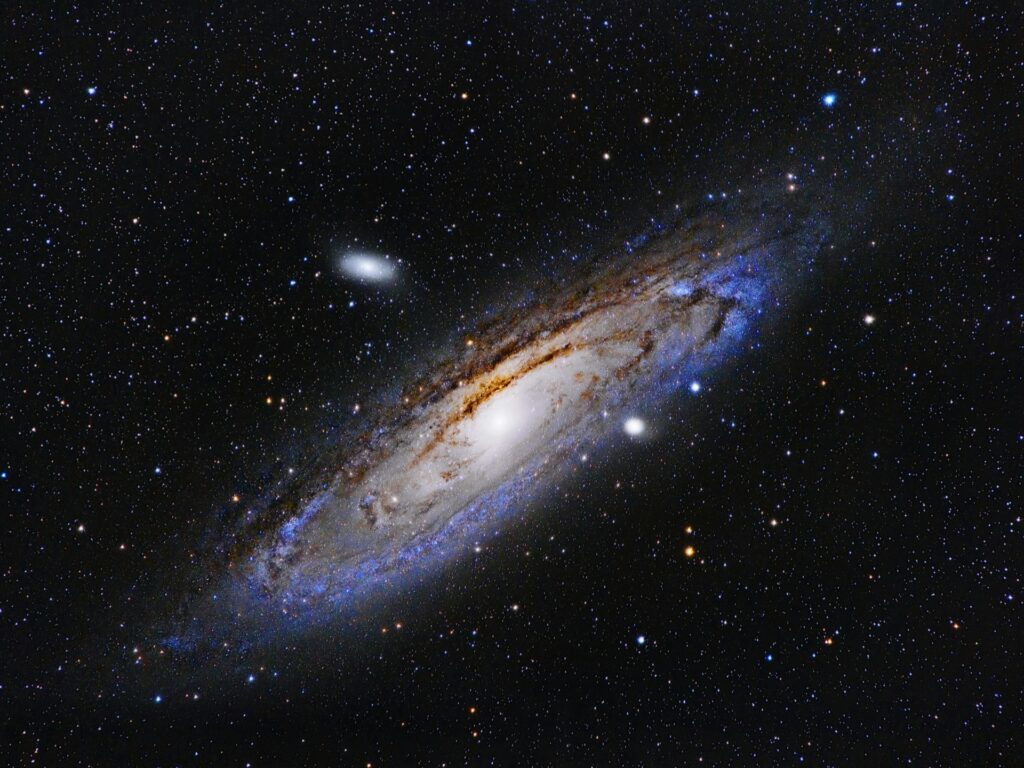
When scientists talk about the observable universe, they mean the bubble of space around us where light has had time to reach Earth since the Big Bang. Beyond that bubble, there’s definitely more universe, probably loads more, but we can’t see it and never will from our current position.
The observable universe is only a tiny fraction of what’s probably out there. It’s like standing in a massive field at night with a torch that only shines a few metres, you know there’s more field beyond your light, but you can’t see it. Except with the universe, we can’t just walk forward to see more.
The cosmic microwave background blocks our view.
About 380,000 years after the Big Bang, the universe was so hot that it was basically opaque, like trying to see through fog. Before that moment, light couldn’t travel freely because it kept bouncing off all the hot particles, so we can’t see anything from earlier than that no matter what we do.
This wall of ancient radiation called the cosmic microwave background is as far back as we can see using light. Anything before that is completely hidden from telescopes forever. It’s the ultimate curtain that we can’t pull back, no matter how clever our technology gets.
Dark matter and dark energy are invisible.
About 95% of the universe is made of stuff we can’t actually see because it doesn’t interact with light. Dark matter and dark energy are only detectable through their effects on things we can see, like how gravity bends light or how galaxies move.
We know this invisible stuff is there because of how it affects normal matter, but we can’t directly observe it, no matter what instruments we build. It’s like knowing someone’s in a room because you can hear them walking around, but you can never actually see them, no matter how bright you make the lights.
Black holes hide information forever.
@astro_alexandra Can black holes suck you in? What would happen if you got near a black hole?! #space #astronomy #nasa #learn ♬ original sound – ASTRO ALEXANDRA 🪐
Once something crosses the event horizon of a black hole, that information is lost to the rest of the universe forever. We can’t see what’s happening inside a black hole because not even light can escape once it’s past that point, so whatever’s in there is completely unknowable.
Black holes are scattered throughout the universe, and they’re basically deleting information from reality as far as outside observers are concerned. Anything that falls in becomes permanently hidden, taking its secrets with it in a way that no future technology could ever reverse.
We’re stuck in one location in space and time.
We can only see the universe from Earth’s perspective, or at least from our solar system’s general area. If there’s something massive blocking our view in a particular direction, we’re just stuck with that blind spot unless we can somehow travel ridiculous distances to get a different angle.
Some of the most interesting stuff in the universe might be hiding behind other objects from our point of view. It’s like trying to watch a football match when you’re sat behind a massive pillar, you miss all the action happening in that direction and moving seats isn’t really an option when we’re talking about cosmic distances.
The heat death will eventually make everything invisible.
The universe will keep expanding forever, and eventually, everything will be so spread out and cold that no new stars will form, and all existing ones will burn out. In the far future, the universe will be dark, cold, and basically empty from any observer’s perspective.
Future civilizations billions of years from now won’t be able to see distant galaxies because they’ll have moved beyond the cosmic horizon. They’ll live in an increasingly dark and isolated universe where most of the interesting stuff has disappeared from view or stopped existing altogether.
Quantum mechanics makes some things fundamentally uncertain.
At the tiniest scales, particles don’t have definite positions or velocities until you measure them, and measuring them changes them. This isn’t a technology problem that better instruments could solve, it’s just how reality works at the quantum level.
There’s a hard limit on how much information we can know about quantum particles at once, which means some details about the universe are fundamentally unknowable. It’s not that we haven’t figured it out yet, it’s that nature itself doesn’t allow complete information about everything at the same time.
Cosmic inflation made most of the universe unreachable.
Right after the Big Bang, the universe went through a period of incredibly fast expansion called inflation. This spread matter and energy over such vast distances so quickly that most of the universe was already beyond our reach before things even properly got started.
The bits of universe that inflated away from us are now so far away that we’ll never be able to travel to them or even receive light from them. They might as well be separate universes entirely because there’s no way we’ll ever have any contact with or knowledge of what’s happening there.
Our own galaxy blocks our view.

The Milky Way has loads of dust, gas, and stars between us and the rest of the universe. When we try to look through the thickest part of our galaxy, all that stuff blocks our view of what’s behind it, creating blind spots in certain directions.
Some really interesting objects might be hiding behind the plane of our galaxy, and we simply can’t see them with optical telescopes. Radio telescopes can see through some of this stuff, but we’re still missing out on loads of detail about what’s being blocked by our own galactic neighbourhood.
The laws of physics might be different elsewhere.
There’s a chance that in really distant parts of the universe, the fundamental laws of physics could be slightly different from what we observe here. If that’s true, we might not even recognize what we’re seeing because it doesn’t behave according to the rules we understand.
Some scientists think different regions of space might have different physical constants or properties, which would make those areas essentially incomprehensible to us. We’d be trying to understand something that literally doesn’t work the same way as our bit of reality, which might be impossible even in principle.