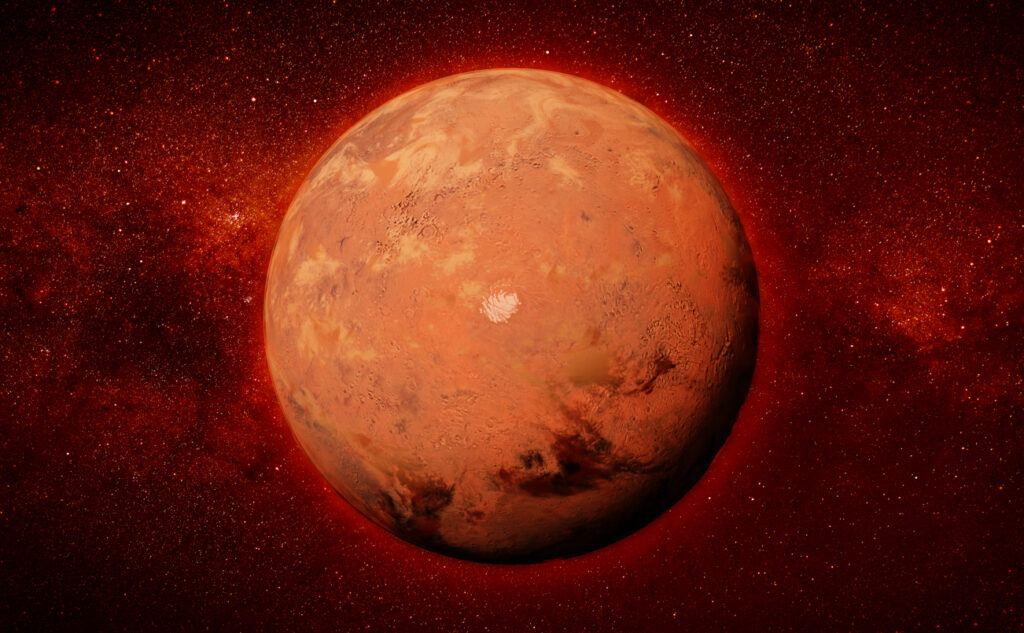
Time isn’t this fixed universal thing that works the same everywhere, and Mars is a brilliant example of how location in space actually affects how fast time passes. A clock on Mars would literally tick faster than an identical clock on Earth, not because of anything wrong with the clocks, but because of how physics works. This isn’t science fiction, it’s actual measurable reality that comes from how gravity and speed impact the flow of time itself.
Einstein’s relativity says time isn’t constant.
Einstein figured out that time doesn’t flow at the same rate everywhere in the universe. Things like gravity and how fast you’re moving influence how quickly time passes for you compared to someone else, which sounds mental, but it’s been proven over and over with really accurate clocks.
That means time on Mars genuinely runs at a different rate than time on Earth because the conditions are different. It’s not a huge difference you’d notice day to day, but it’s real and measurable with precise instruments. Time is relative to where you are and what’s happening around you.
Gravity makes time slow down.
Stronger gravity actually makes time pass more slowly. Earth has stronger gravity than Mars, which means time on Earth is running slightly slower than time on Mars. The difference is tiny, but it’s there, and if you had synchronised clocks on both planets, the Mars one would gradually get ahead.
This happens because gravity warps spacetime, which is the fabric that time and space are made of. The stronger the gravity, the more warped spacetime gets, and the slower time flows. Mars has only about 38% of Earth’s gravity, so time there is slightly less slowed down.
It’s called gravitational time dilation.
The official term for gravity affecting time is gravitational time dilation. It sounds complicated, but it just means that time dilates or stretches out differently depending on how strong gravity is where you’re measuring it.
This effect happens everywhere, even on Earth at different altitudes. Time runs slightly faster on top of a mountain than at sea level because you’re further from Earth’s centre and gravity’s a tiny bit weaker. The Mars effect is the same principle, just on a planetary scale.
Mars is also moving at a different speed.
Mars orbits the Sun at a different speed than Earth does, and speed also affects time according to Einstein’s special relativity. The faster you’re moving, the slower time passes for you compared to someone who’s standing still or moving slower.
Earth travels around the Sun at about 30 kilometres per second, while Mars goes at roughly 24 kilometres per second. This speed difference also contributes to the time difference between the planets, though it’s a smaller effect than the gravity difference.
The difference is incredibly small.
We’re not talking about massive time differences here. Over the course of a year, the time difference between Earth and Mars would only amount to fractions of a second. You’d need extremely precise atomic clocks to even measure it.
Even though it’s tiny, the effect is real and has to be accounted for in some situations. For future Mars missions with precise timing requirements, scientists will need to factor in that Mars time and Earth time aren’t running at exactly the same rate.
GPS satellites deal with this problem constantly.
We already handle time dilation in everyday technology. GPS satellites orbit Earth where gravity is weaker than on the surface, so time runs faster for them. If we didn’t correct for this, GPS would become inaccurate really quickly.
The satellites’ clocks run about 38 microseconds faster per day than clocks on Earth’s surface due to weaker gravity, and they’re also moving fast, which makes time slower for them. Engineers have to account for both effects to keep GPS working properly, and the same issues would apply to Mars navigation systems.
It affects communication with Mars rovers.

When we send signals to Mars rovers or receive data back, we’re dealing with two planets where time is flowing at slightly different rates. For most purposes this doesn’t matter, but for ultra-precise timing or long-term missions, it could become relevant.
Mission controllers have to think about these tiny time differences when synchronising events or planning coordinated activities. It’s not a huge problem now, but as Mars missions get more complex, accounting for time dilation will become more important.
Every planet has its own time rate.
This isn’t unique to Mars. Every planet and moon in the solar system has time flowing at a slightly different rate depending on its gravity and orbital speed. Jupiter’s massive gravity would make time slower there, while time on small asteroids with barely any gravity would flow faster.
If humans ever establish bases across the solar system, we’ll need to develop ways to coordinate time between locations where clocks are literally ticking at different rates. It’s a weird problem that doesn’t exist on Earth because we’re all in basically the same gravitational field.
Black holes have extreme time dilation.
To see time dilation taken to extremes, look at black holes. Their gravity is so intense that time near the event horizon slows down massively compared to time far away. Someone falling into a black hole would experience time normally, but to an outside observer, they’d appear to freeze.
Mars and Earth’s time difference is nothing compared to what happens near black holes, but it’s the same physics principle. Gravity affects time, full stop, and the Mars-Earth difference is just a really mild version of what happens in more extreme situations.
Future Mars colonists won’t notice it.
If people ever live on Mars permanently, they won’t feel time moving differently because everything around them will be experiencing the same time flow. Their clocks, their bodies, everything will tick at Mars rate, so from their perspective time will feel completely normal.
The difference would only show up when comparing extremely precise measurements with Earth. Mars colonists wouldn’t age faster or slower in any way they’d notice, they’d just be on a slightly different timeline than Earth that would only matter for specific scientific or coordination purposes. Time would feel exactly the same, it would just technically be moving at a different rate.