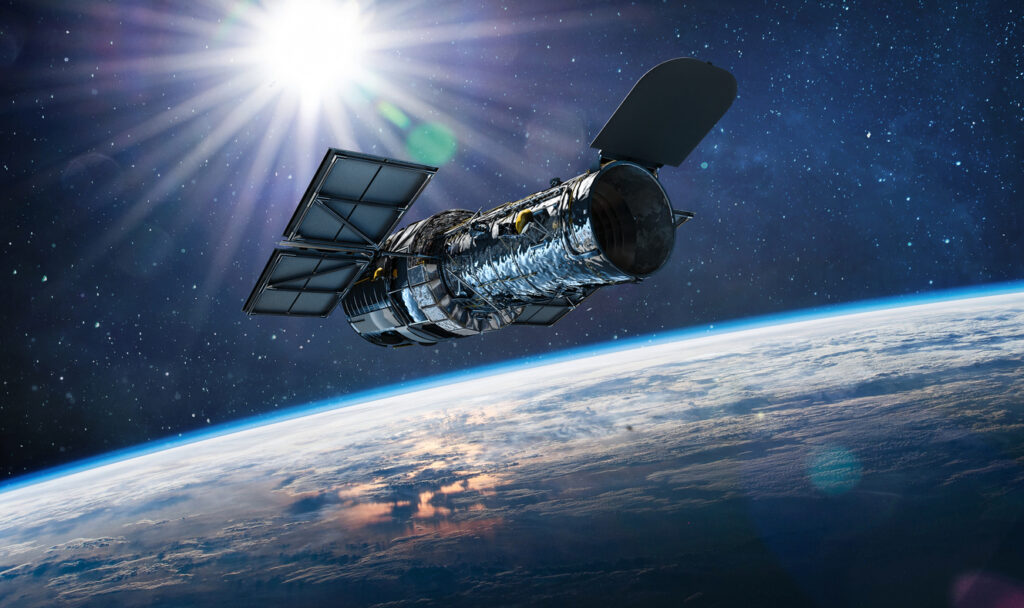
The Hubble Space Telescope has been quietly orbiting Earth for decades, but it’s still one of the most valuable tools we have for understanding the universe. Because it sits above the atmosphere, it sees space with a level of clarity that ground telescopes can’t match. There’s no cloud cover, no air movement and no weather blocking the view, so it captures things that would look fuzzy or impossible from the surface.
Even though there are now newer telescopes being launched into space, Hubble continues to deliver discoveries that change how scientists think about the universe. It watches galaxies being born, sees stars in different stages of life and helps us understand how planets form. It’s basically a history book floating above us, collecting information we’d never notice from Earth.
Hubble is a giant telescope floating above Earth.
People often imagine Hubble as a small satellite, but it’s closer to the size of a bus. It orbits Earth at a height far above the atmosphere, which means the images it takes aren’t affected by the air or weather below. That difference is why Hubble’s pictures look so sharp compared with telescopes we use on the ground.
When you picture the telescope floating freely in space, you start to understand why scientists rely on it so much. It sees things in detail we could only dream of before it launched. Planets, galaxies, and even enormous clouds of gas become clearer because Hubble isn’t trying to look through the constantly moving air around our planet.
It uses a massive mirror to collect light.
Hubble doesn’t take pictures the way a phone or normal camera does. Its main mirror is over two metres wide, which helps it collect light from objects that are unbelievably far away. That mirror gathers faint light for long periods, revealing stars and galaxies from the early universe.
Understanding how much light it can collect makes it obvious why the telescope is so powerful. Every tiny increase in collected light means more detail for scientists to study. That’s why Hubble’s images look bright and incredibly crisp, even when they’re showing objects most of us didn’t know existed.
It points with extreme accuracy.
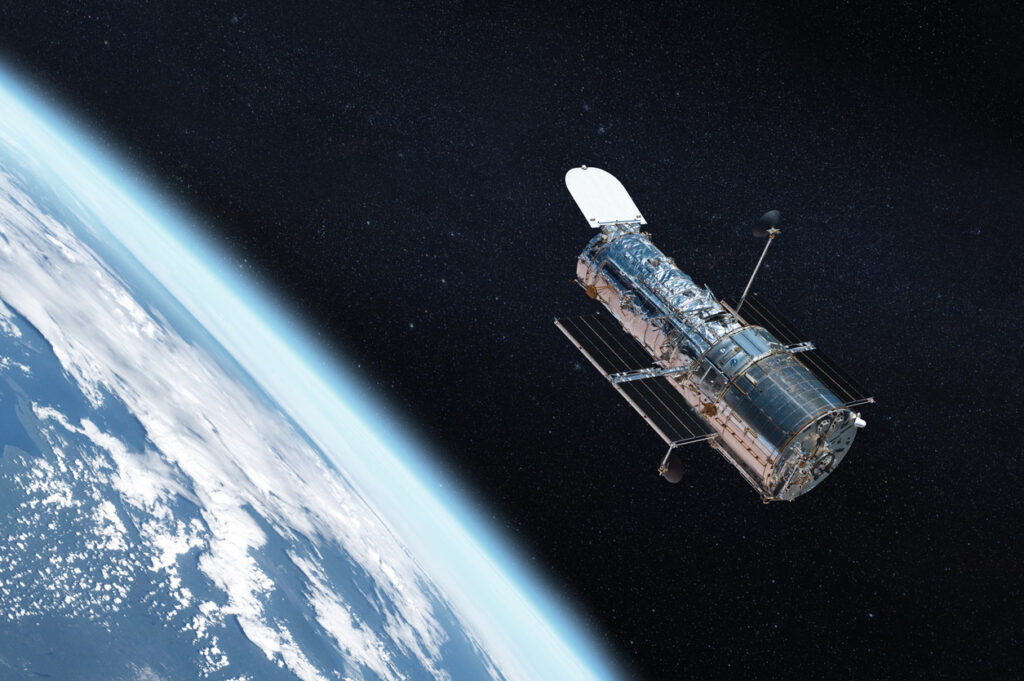
People tend to imagine a telescope floating loosely through space, drifting wherever it likes. Hubble actually has to hold itself completely steady while it takes long exposures, even though it’s hurtling around Earth at huge speeds. If it moved even slightly, the image would blur immediately.
It keeps itself stable using precise guidance systems that lock onto stars and hold the telescope in place. That stability lets Hubble stare at tiny points of light for hours or even days, slowly building detailed images that would be impossible to collect during a quick snapshot.
It uses different instruments to study space.
Hubble is famous for beautiful photographs, but those pictures are only one part of what it does. It studies ultraviolet and infrared light, which means it detects details our eyes could never see. Those hidden wavelengths reveal information about gases, temperature, and movement inside galaxies and stars.
By switching between different scientific tools, Hubble collects a complete picture of whatever it’s looking at. Each instrument focuses on a different kind of data, and when scientists combine everything, they get a richer understanding of what’s going on in deep space.
It sends data back to Earth using radio waves.
Hubble doesn’t send photos like a phone sending a message. It stores information and slowly transmits it through radio signals to receiving stations on the ground. The data is then processed, organised and finally turned into pictures.
Those colourful images we see online aren’t just snapshots. Scientists add colour based on different filters to show temperature, gas composition and other details that would be invisible otherwise. It’s a careful process that turns raw data into something we can actually understand.
Astronauts repaired Hubble in space.
When Hubble was first launched, its mirror had a flaw that caused blurry images. It was a huge problem because the telescope was supposed to be a major step forward in astronomy. Most space equipment would have been abandoned at that point because fixing something in orbit is incredibly difficult.
Instead, astronauts travelled up to Hubble several times, installing new instruments and correcting the issue. Their work saved the mission and turned Hubble into one of NASA’s biggest successes. Without those repairs, we would have missed out on decades of discoveries.
It shows us galaxies billions of light years away.
@astrokobi The most important image ever taken… #spacetok #space #telescope #universe #astrokobi ♬ Solas – Gibran Alcocer
The images Hubble takes often show galaxies that formed shortly after the universe began. The light from those galaxies has been travelling towards us for billions of years, which means Hubble is effectively looking back through time. Seeing that distant light helps scientists understand how galaxies grow and change. Hubble can’t watch the universe evolve in real time, but by looking at objects from different ages, it reveals how everything slowly developed.
It watches planets in our own Solar System, too.
People often associate Hubble with distant galaxies, but it also looks a lot closer to home. It observes storms on Jupiter, dust on Mars and weather patterns on Saturn. These observations help scientists track changes and learn how our neighbouring planets behave.
By studying them over many years, researchers can see how their climates shift and how their atmospheres behave. That long-term view is something surface telescopes struggle to achieve with the same level of clarity.
It never stops orbiting the Earth.

Hubble doesn’t sit still in one place. It travels around our planet roughly every ninety minutes, constantly passing through sunlight and shadow. That constant movement gives it regular opportunities to take new observations and aim at different targets. Because it never stops, the telescope is always ready to collect new information. Every orbit gives scientists another chance to study something else or continue watching a single object in detail.
It works like a time capsule for the universe.
When we look at a distant galaxy through Hubble, we’re not seeing it as it looks today. The light we’re seeing left that galaxy a very long time ago, sometimes before Earth even formed. That means the telescope gives us a chance to study the early universe without needing to time travel.
Understanding this is what makes Hubble so important. It doesn’t only show us what’s in space right now. It reveals the story of how everything began, helping scientists trace the universe back to a time when galaxies were just starting to form.