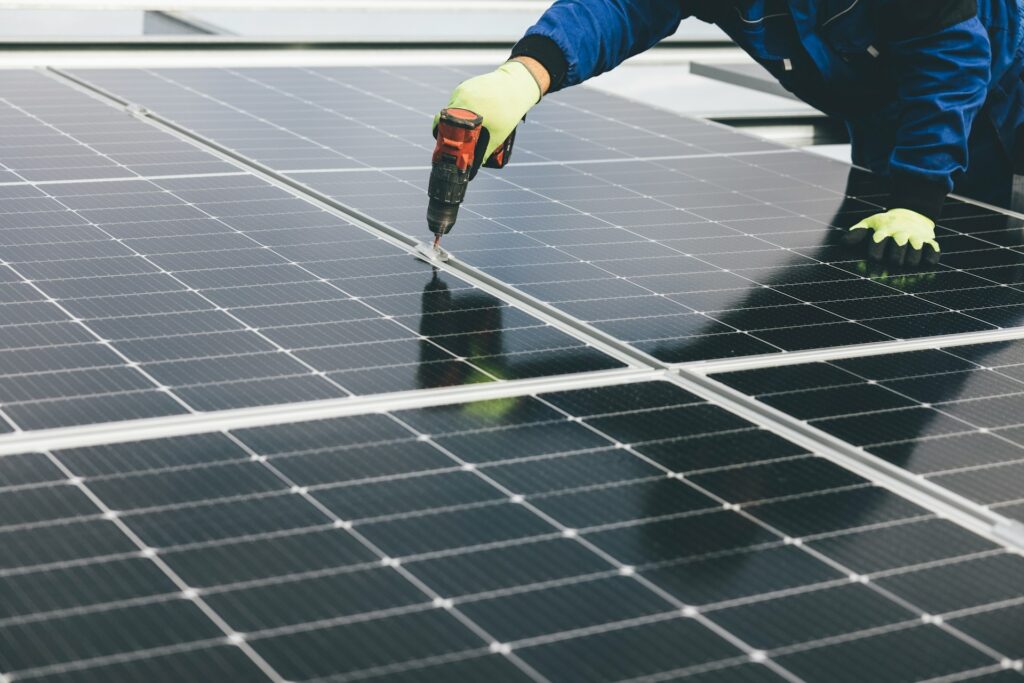
The government has announced that Great British Energy will expand its clean power programme across the public estate, installing solar panels and micro-renewables not only on schools and hospitals but now on military sites as well. According to the official press release, around 15 defence bases will be included alongside 50 more schools and 70 NHS facilities, with the budget for the scheme rising to £255 million. The aim is to cut bills, strengthen energy security and accelerate progress toward net zero by making renewables a core part of everyday public infrastructure.
Many schools and hospitals have struggled with rising energy costs in recent years, and renewables are seen as one way to protect stretched budgets. By extending the programme to the armed forces, the government is also addressing the needs of sites that consume large amounts of energy and, in some cases, operate partly off-grid. The Financial Times noted when the scheme was first announced earlier this year that the creation of Great British Energy was central to Labour’s pledge to make the UK a “clean energy superpower,” with public buildings being the first proving ground for the model.
Military sites offer unique opportunities but also unique challenges. Large roof space and open land could make them ideal for solar generation, yet engineers will need to ensure new systems don’t interfere with sensitive communications or radar equipment. The Ministry of Defence has already signalled that part of the rationale for adoption is resilience: local generation can reduce reliance on vulnerable supply lines, an argument that carries weight in both peacetime and crisis planning.
Scaling the scheme isn’t straightforward.

The solar sector has been facing a shortage of trained installers and maintenance engineers, something industry analysts highlighted in Solar Power Portal when discussing the government’s wider net-zero goals. Rolling out hundreds of projects simultaneously across different types of sites will require careful workforce planning and procurement.
Costs must also be managed. While upfront investment is high, the expectation is that the panels will pay for themselves through reduced bills over 20 to 30 years. That calculation depends on panels being well maintained, inverters replaced on schedule and systems integrated efficiently into the grid. Defence sites, in particular, may need bespoke connections that add complexity and expense.
Finally, there is the environmental side. Manufacturing, transporting and eventually recycling solar panels all carry their own footprint. For a scheme on this scale to deliver genuine sustainability, attention must be paid not only to deployment but also to end-of-life planning and circular supply chains.
Great British Energy, launched in 2025, is intended to spearhead investment in renewables and show how the state can drive the transition alongside private industry. By expanding its reach into schools, hospitals, and now the military, the company is embedding clean energy across the country’s public estate. The government hopes that a visible commitment to renewables in everyday institutions will normalise the technology while delivering savings to the taxpayer.
If successful, the scheme could mark a shift in how Britain sees energy infrastructure. Solar panels would no longer be confined to private homes or large commercial projects but would become as standard a feature of public buildings as electricity meters or heating systems. That, ministers argue, is how the UK will meet its climate targets and build resilience against volatile fossil fuel markets.