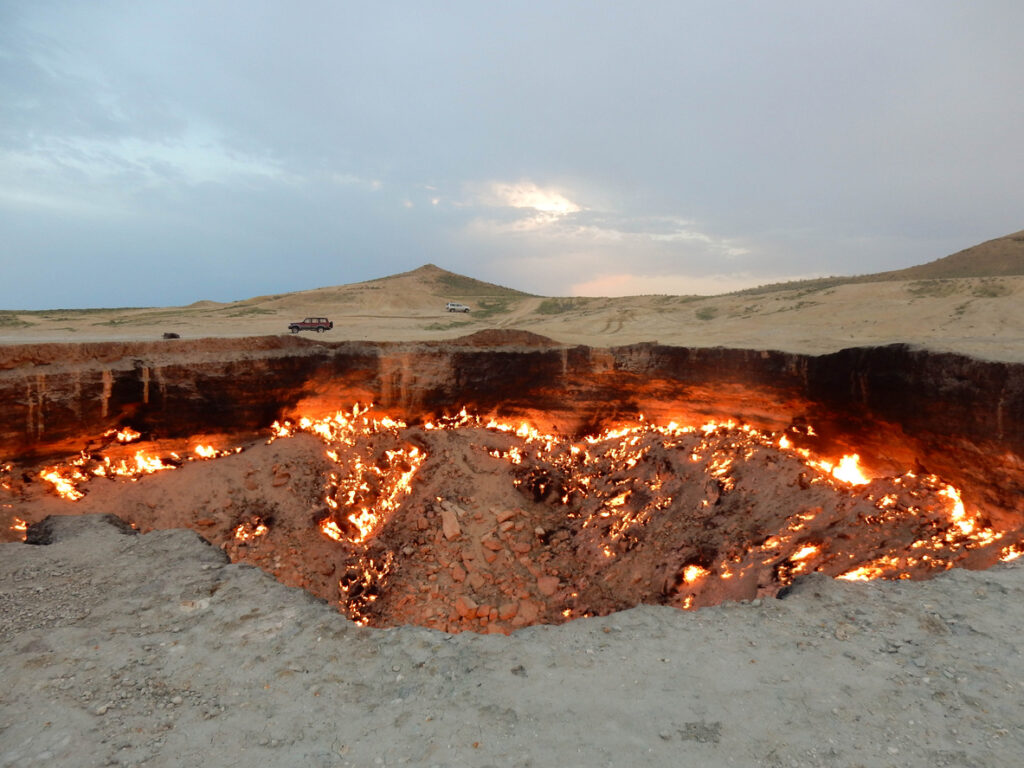
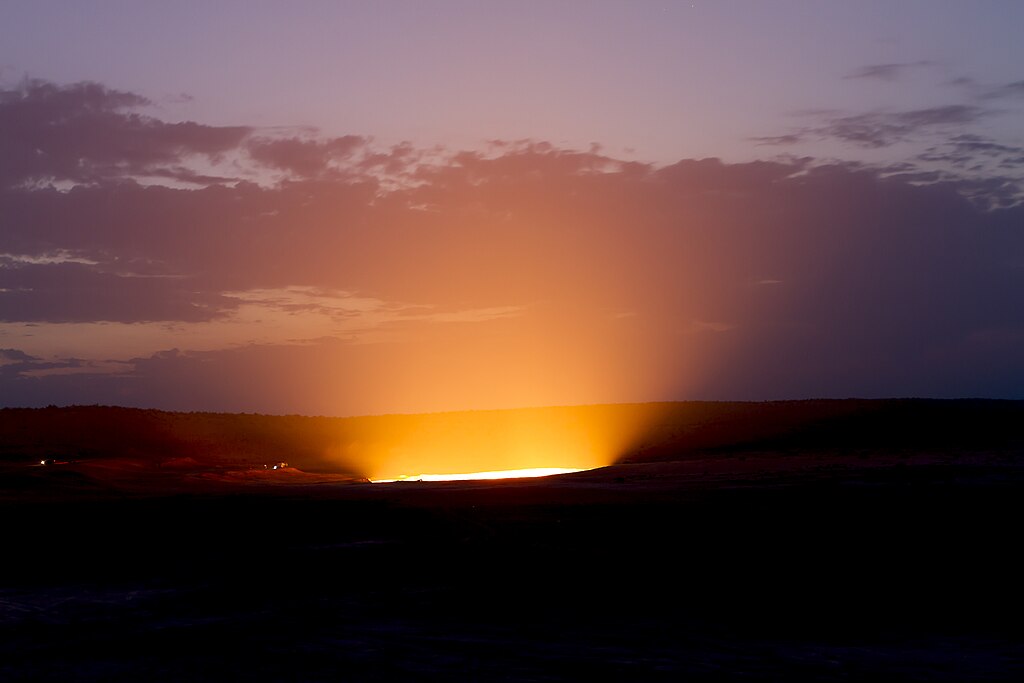
After more than 50 years of blazing flames, the “Door to Hell” in Turkmenistan may finally be dying down. The Darvaza gas crater, a fiery pit in the middle of the desert that’s been burning nonstop since the early 1970s, has long been one of the strangest and most haunting sights on Earth. Its orange glow can be seen for miles, drawing travellers and scientists alike to marvel at how something so unnatural could become oddly beautiful.
Now, though, the flames that have defined it for decades might be fading. The Turkmen government has been trying to extinguish the blaze for years, worried about wasted gas reserves and environmental impact, but the process isn’t simple or guaranteed. What started as a drilling mishap has become a living symbol of human error and resilience, and now, it might finally be nearing its end. Here’s what’s happening to the Darvaza gas crater, and whether it might actually go out for good.
The blaze was never meant to last decades.
Back in 1971, Soviet geologists accidentally drilled into a gas cavern in the Karakum Desert. When the ground collapsed, methane began leaking rapidly. To stop a dangerous spread, they set it alight, assuming it would burn off in a few days. Instead, the fire kept feeding itself from deep underground. What was meant to be a quick safety fix became a fiery pit that’s burned day and night for more than half a century, glowing like a beacon in the middle of nowhere.
New wells are starving the fire of gas.
Turkmen scientists have started drilling new wells around the crater to capture methane before it reaches the flames. By diverting the gas flow, they’re slowly starving the fire of its fuel source. Satellite monitoring shows the glow has weakened in recent years, suggesting the plan might be working. For the first time in decades, the once-furious inferno is beginning to dim.
Flames have reduced dramatically.
Visitors who’ve seen the crater recently describe a very different sight. The flames still burn, but they’re lower, fewer, and scattered around the edges rather than roaring from the centre. It’s no longer visible from miles away like it once was. The heat is still intense near the rim, but the desert night around it now stays much darker than before.
Capturing methane is better than letting it burn.
Methane is a far more powerful greenhouse gas than carbon dioxide. When it burns, it turns into CO₂, which is less potent but still contributes to climate change. So while the fire has been polluting, it’s also been stopping something worse. Now, the goal is to trap and redirect the gas before it ever reaches the surface. If done correctly, the crater can finally cool down without methane leaking unchecked into the atmosphere.
Sealing the ground is extremely difficult.
The underground system beneath the crater is a tangled maze of gas channels. Simply dumping concrete or soil over it won’t work because new leaks could appear nearby. Engineers are trying to map those fissures precisely, but the depth and pressure make it complicated. Even if the surface flames die, underground gas pockets could reignite if they’re not properly sealed.
The heat and size remain extraordinary.
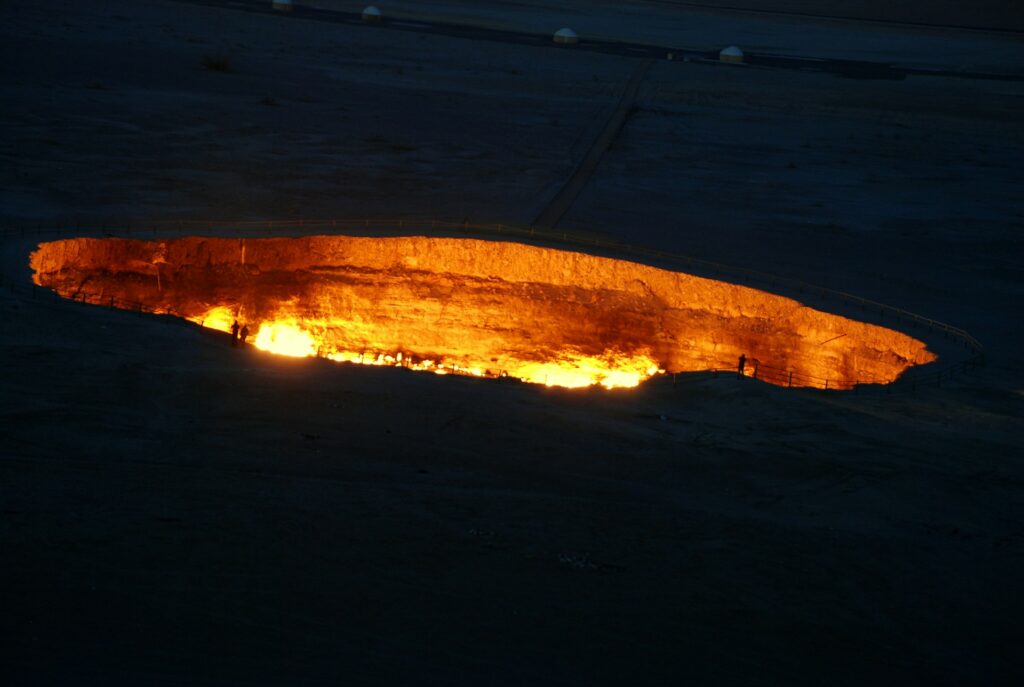
At its peak, the crater reached temperatures of around one thousand degrees Celsius. It’s roughly 70 metres wide and 30 metres deep, making it one of the most dramatic human-made formations on the planet. Even with smaller flames now, the ground still radiates heat. The air above it shimmers and cracks, and stepping too close feels like opening an oven door in the middle of the desert.
Microscopic life has survived inside it.
When scientists first descended into the crater a few years ago, they found heat-loving microbes thriving among the rocks. These tiny life forms live off chemical energy from the gas itself. Their discovery fascinated researchers because it proved that life can survive in extreme conditions. The crater became a natural experiment for understanding how organisms might exist on hostile planets like Mars.
Environmental concerns are still real.
Even as the fire fades, the site remains a major source of emissions. Burning the gas releases carbon dioxide, but if the flames go out too early, methane could escape again in large quantities. Managing that balance is crucial. Scientists need to shut it down safely without increasing greenhouse gases. It’s a delicate process that must be handled step by step rather than rushed.
The Turkmen government plans to close it.
Officials have repeatedly announced their intention to extinguish the crater completely. They argue it wastes valuable fuel and damages the environment. Plans include sealing underground gas routes and capturing the remaining methane for use. It’s a huge technical challenge, but the project is already underway. The hope is to preserve the site’s geological importance while finally ending a fire that has burned longer than most people’s lifetimes.
Its legacy will outlast the fire.
Even when the flames vanish, the “Door to Hell” will remain one of the strangest human stories on Earth. It’s a mix of science, accident and persistence, and it has fascinated generations of travellers. The crater reminds us how a single decision can create something vast and unpredictable. For more than half a century, it’s shown both the power and fragility of our relationship with nature. When the desert finally falls silent, its glow will live on in memory.