
Elephants are among the strongest and most fascinating animals on Earth, yet there’s one thing they simply can’t do: jump. While almost every other mammal manages it, elephants never leave the ground. Here’s the science behind why, and it actually makes a lot of sense if you think about it.
Their sheer size makes lifting off impossible.
Elephants can weigh up to seven tonnes, and that mass alone makes jumping unrealistic. To launch into the air, they would need far more force than their muscles could generate safely. Their huge size means their bodies are designed for stability rather than agility. Instead of bouncing off the ground, they stay firmly rooted, which suits their lifestyle and habitat.
Their leg structure limits flexibility.
Most mammals that jump have spring-like legs with bendable joints that act like catapults. Elephant legs, however, are more like sturdy columns built for bearing weight rather than propelling upwards. Because of this column-like structure, elephants can run, walk, and even climb small inclines, but they lack the spring needed for vertical leaps. Their bodies simply aren’t built for it.
All four feet stay grounded when they run.
When horses or dogs run, there is a moment when all four feet leave the ground. Elephants are unique in that they always keep at least one foot on the ground while moving quickly. This keeps their bodies balanced and prevents the risk of collapse under their own weight. It means they can reach surprising speeds but never fully take off.
Their muscles prioritise endurance over spring.

Jumping requires fast-twitch muscle fibres that provide sudden bursts of power. Elephants, however, have more slow-twitch fibres, which are suited to endurance and carrying heavy loads across long distances. Their muscle makeup makes them strong but not explosive. They can push trees over or carry logs, yet they lack the kind of energy release needed for a leap.
Their joints can’t handle the landing.
Even if an elephant managed to get off the ground, landing would be another issue entirely. The impact of thousands of kilos hitting the earth would damage their bones and joints severely.
Evolution has avoided this risk by never giving them the ability in the first place. Staying grounded protects them from injuries that could threaten survival in the wild.
Evolution favoured strength, not agility.
Elephants evolved to thrive through size, strength, and endurance, not through agility. Being able to uproot trees or defend against predators with sheer power mattered more than being able to jump. Their evolutionary path shaped everything from their muscles to their skeletons. Their grounded nature is an adaptation that fits their role as the largest land mammals alive.
Their centre of gravity is too high.
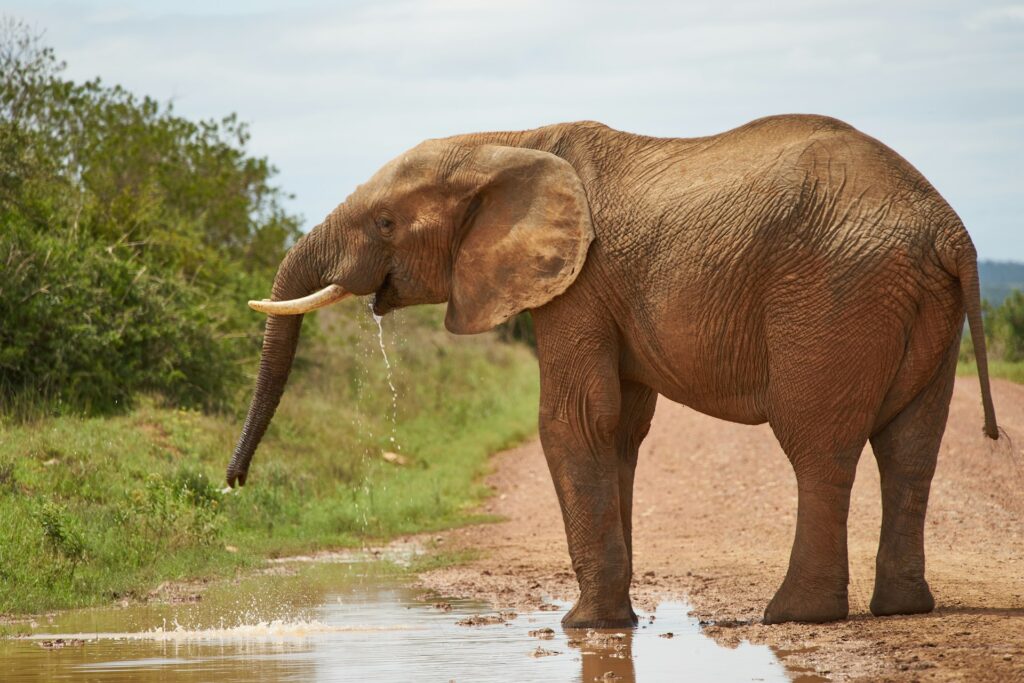
An elephant’s body shape places most of its weight high up, which makes balancing on a leap extremely difficult. With such a high centre of gravity, any attempt to jump would make them unstable. Instead, their weight distribution helps them stay solid and steady on the ground. This stability is essential when moving through uneven terrain or carrying their huge bodies over long distances.
They use other methods to assert power.
Animals often use jumping to show strength or escape threats. Elephants, on the other hand, rely on size, trumpeting, and charging to assert dominance and keep predators at bay. Frankly, it makes jumping unnecessary. Their physical presence alone is enough to intimidate or escape danger, which means their bodies never needed to develop the ability to leap.
They already move faster than expected.

Although elephants can’t jump, they can run surprisingly fast, reaching speeds of up to 25 kilometres per hour. Their unique gait keeps them grounded, but still allows them to cover ground quickly. This speed, combined with their size, is more than enough to deter predators. They may not leap, but they can still move with impressive force and momentum when needed.
Their inability highlights evolutionary diversity.
The fact that elephants are the only mammals unable to jump is a reminder of how diverse adaptations can be. Nature doesn’t always follow one rule, and survival comes in many different forms. For elephants, being grounded isn’t a weakness, but part of what makes them extraordinary. Their bodies are proof that there are many ways to thrive without copying what other animals can do.