
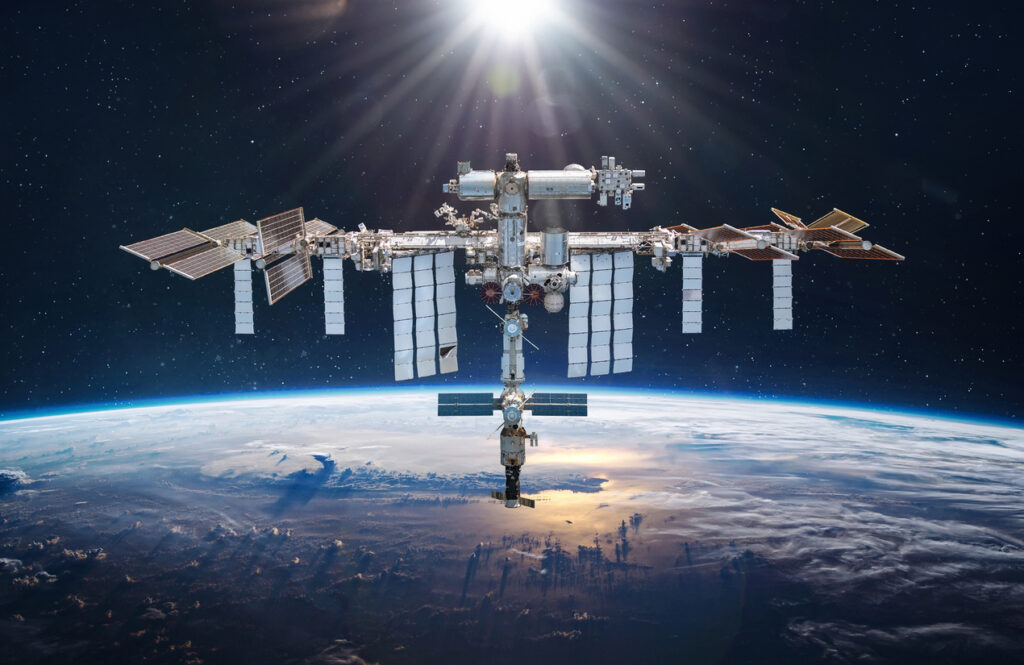
If you brought a guitar up to the International Space Station and strummed it, you’d get a pretty weird musical experience that would mess with everything you think you know about how instruments work. The guitar would make sound, but it would be completely different from what you’d hear on Earth, and some of the changes would be downright bizarre.
You’d only hear it through your body, not through the air.
Sound needs air to travel, and while the space station has breathable atmosphere inside, it’s much thinner than what we’re used to on Earth. You’d mainly hear the guitar through vibrations travelling through your body when you’re touching it, rather than hearing proper sound waves moving through the air.
It would be like listening to music through bone conduction headphones, except much weirder because you’d only get the vibrations that transfer directly from the instrument to your skeleton. Anyone not touching the guitar would barely hear anything at all.
The sound would be much quieter and flatter.
With less dense air to carry the sound waves, everything would sound muffled and quiet compared to Earth. The rich, resonant tones that make guitars sound good depend on air molecules bouncing sound waves around, and there just aren’t enough air molecules up there to do the job properly.
You’d lose a lot of the harmonic richness that makes music interesting, so even familiar songs would sound flat and lifeless. It would be like listening to music through a thick blanket, except the blanket is the vacuum of space.
The guitar strings would behave differently.
In microgravity, the strings wouldn’t hang down naturally, and this changes how they vibrate and resonate. The tension and movement patterns would be different from what the guitar was designed for, affecting both the sound quality and how the instrument feels to play.
The strings might also vibrate for longer periods since there’s less air resistance to dampen their movement, but this extended vibration wouldn’t necessarily sound better. It might just create muddy, overlapping notes that blur together.
Your playing technique would need major adjustments.
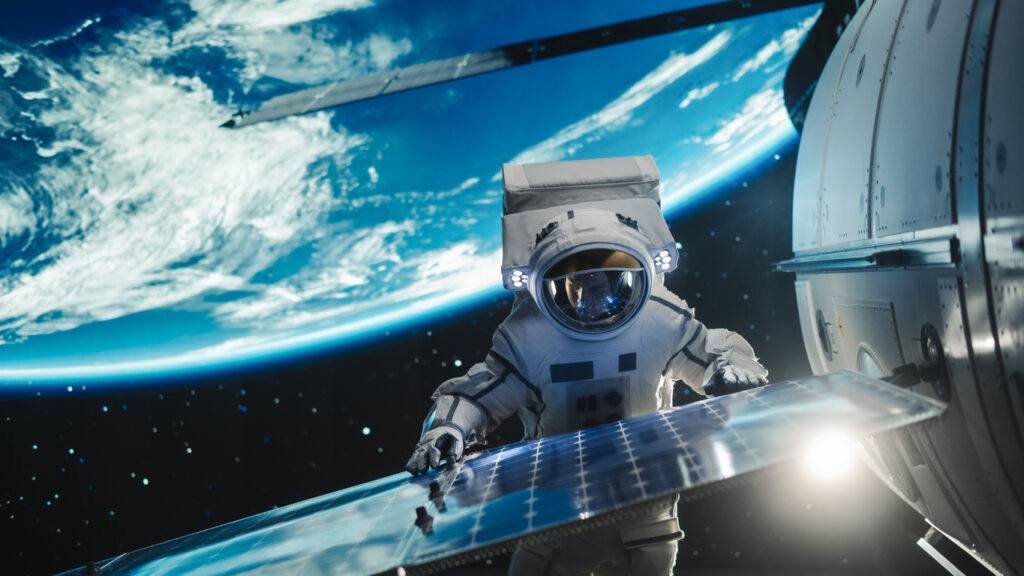
Without gravity helping to position your hands and the instrument, you’d have to completely relearn how to hold and play the guitar. Simple things like strumming and fretting would feel completely different when you’re floating around, trying not to drift away from your instrument.
You’d probably need to strap yourself and the guitar down to get any kind of stable playing position, and even then, the muscle memory you’ve built up over years of Earth-based playing would be mostly useless in space.
The guitar’s body wouldn’t resonate properly.
A big part of a guitar’s sound comes from the wooden body acting as a resonating chamber that amplifies and shapes the vibrations from the strings. With thinner air inside the guitar body, this resonance would be much weaker and produce a completely different tonal quality.
The sound hole wouldn’t work the same way either, since it’s designed to work with Earth’s atmospheric pressure. You’d end up with an instrument that looks like a guitar but sounds more like a weird electronic keyboard played through a broken speaker.
Temperature changes would mess with the tuning constantly.
The space station experiences extreme temperature swings as it orbits in and out of sunlight, and these changes would make the guitar strings expand and contract constantly. You’d be retuning every few minutes, and the wood might expand and contract enough to damage the instrument.
Metal strings are particularly sensitive to temperature changes, so maintaining consistent tuning would be nearly impossible. You’d spend more time tuning than actually playing, which would get old pretty quickly.
Other astronauts would barely hear you playing.
Since sound doesn’t travel well in the thin atmosphere, anyone more than a few feet away would struggle to hear the guitar at all. Group jam sessions would be basically impossible unless everyone was wearing headphones connected to electronic pickups.
The communal aspect of music, as in playing for other people or with them, would be largely lost because the physics just don’t support sound transmission the way they do on Earth. Music becomes a much more solitary experience in space.
You’d need electronic amplification to hear anything decent.
The only way to get proper guitar sound on the space station would be to use electric guitars with amplifiers and speakers, but even then, the speakers would sound different in the thin atmosphere. Acoustic guitars would be pretty much pointless except as expensive floating decorations.
Electronic amplification would also drain the station’s power systems much faster than acoustic instruments, and power is precious up there. You’d be trading electrical capacity for the ability to make music, which might not be the best trade-off.
The lack of gravity affects how sound behaves in enclosed spaces.
Sound waves behave differently in microgravity because there are no convection currents or natural air movements to help distribute the sound evenly. This means some areas of the station might have dead zones where sound doesn’t travel well, while others might have unexpected acoustic properties.
The usual rules about room acoustics wouldn’t apply, so even with amplification, you might find that certain frequencies disappear entirely in some locations while being amplified in others. Recording or performing music would be unpredictable and inconsistent.
Your ears would work differently in space.
Prolonged exposure to microgravity affects your inner ear and changes how you perceive sound and balance. Your hearing might become less sensitive to certain frequencies, and your brain’s processing of audio information could be altered by the space environment.
This means that even if you could get the guitar to sound normal, your perception of the music might still be off compared to how you’d experience it on Earth. The whole sensory experience of playing music would be fundamentally different, and probably not in a good way.