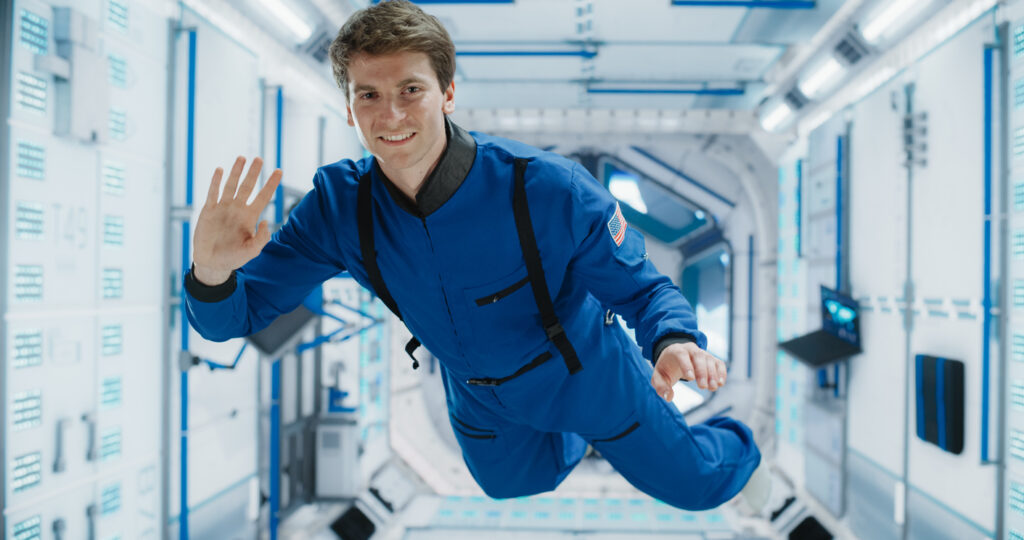
Gravity is something we take completely for granted until you imagine trying to live without it, and suddenly the simplest daily tasks become complicated or downright impossible. Here are ordinary things that work fine on Earth but can’t happen the same way in space. Be glad you’re not an astronaut!
1. Pouring a drink into a glass
Liquids don’t pour in zero gravity because there’s no force pulling them downward, so they just float away in wobbly spheres if you try to tip a container. Astronauts have to drink everything from sealed pouches with straws or specially designed containers that use surface tension to control the liquid. Even then, any liquid that escapes becomes a hazard floating around the cabin, potentially damaging electronics or getting into someone’s eyes or airways.
2. Taking a normal shower
Water doesn’t fall in space so it won’t rinse soap off your body, and it would just form floating bubbles that drift around the spacecraft creating chaos. Early space stations had shower facilities, but they were complicated, time-consuming, and used too much water to be practical. Now, astronauts use dampened towels and no-rinse soap to clean themselves, which is quicker and doesn’t waste precious water supplies that are expensive to transport from Earth.
@factellar Things Astronauts Can’t Do in Space #facts #knowledge #information #fyp #viral ♬ original sound – Factellar
3. Crying properly
You can still produce tears in space, but they don’t roll down your cheeks because gravity isn’t pulling them anywhere. Instead, tears accumulate in a ball around your eyes until surface tension makes them stick to your face in an uncomfortable blob. Astronauts have reported that crying becomes painful because the tears have nowhere to go, and they can blur your vision until you physically wipe them away.
4. Lighting a candle flame
Candles burn completely differently in microgravity because hot air doesn’t rise to draw fresh oxygen into the flame and carry away combustion products. On Earth, flames are teardrop-shaped and flicker as convection currents move air around them, but in space a candle flame becomes a small blue sphere that eventually suffocates itself. The lack of convection means the flame uses up the oxygen immediately around it and then goes out without the natural air circulation we rely on.
5. Using a regular pen
Traditional ballpoint pens rely on gravity to help ink flow down onto the ball bearing, so they don’t work reliably when you’re writing upside down or in zero gravity. Space agencies spent time developing pressurised pens that force ink onto the writing surface regardless of orientation. Pencils work fine, but they create graphite dust and wood particles that float around and can be breathed in or damage equipment, so pressurised pens became the safer solution.

6. Eating anything crumbly or powdery
Bread, crackers, salt, and pepper create tiny particles that float everywhere in zero gravity, getting into electronics, air filters, eyes, and lungs. Astronauts eat tortillas instead of bread because they don’t create crumbs, and salt and pepper come in liquid form to avoid the floating particle problem. Even something as simple as biting into a biscuit becomes complicated when the crumbs don’t fall onto a plate but instead scatter in every direction.
7. Sitting down in a chair
There’s no sensation of sitting in space because your body doesn’t press down onto a surface, so you’d just float away from a chair unless you’re strapped in. Astronauts have to anchor themselves with foot restraints or belts to stay in one place while working, which means their concept of “sitting” is really just positioning themselves near a surface. The lack of pressure on your body from sitting or standing means you don’t get the normal feedback that tells you where you are in relation to objects.
8. Using a normal toilet
Waste doesn’t fall away from your body in zero gravity so you can’t use a conventional toilet that relies on gravity and water to function. Space toilets use airflow to pull waste away from the body and into sealed containers, and astronauts have to position themselves very precisely using foot restraints and handles. It’s complicated enough that new astronauts spend significant training time learning how to use the space toilet properly before their missions.
9. Burping
On Earth, gravity separates gas from liquid in your stomach so burping releases just the gas, but in space everything floats together in your digestive system. Attempting to burp in space often results in what astronauts call a “wet burp” where liquid comes up with the gas, which is obviously unpleasant. The lack of gravity means your stomach contents don’t settle into layers, so you can’t selectively release gas the way you can on Earth.
@spacecore23 Crazy things you cannot do in space! #fyp #viral #spacethings #nasa ♬ Filter transition – Tik Tok
10. Sleeping in a bed
There’s no lying down in space because your body doesn’t press against a mattress, so sleeping in a traditional bed is pointless, and you’d just float away. Astronauts sleep in sleeping bags attached to walls or in small crew quarters, and they can position themselves in any orientation since there’s no up or down. Many report that it takes time to adjust to sleeping without the pressure and comfort of a mattress supporting their body.
11. Whistling or blowing out birthday candles
You can technically whistle in space because it’s about air moving through your mouth, but blowing air to extinguish a candle wouldn’t work the same way because the flame’s behaviour is so different. Even if you could light a candle in space, blowing on it wouldn’t necessarily put it out because the flame doesn’t respond to air currents the way it does on Earth. The whole concept of blowing something to create an effect relies on atmospheric behaviour that changes completely in microgravity.
12. Walking
There’s no such thing as walking in a spacecraft because your feet don’t press down on the floor with each step. Astronauts move by pushing off surfaces and floating to their destination, or they use handrails to pull themselves along corridors. The lack of gravity means the natural walking motion that humans evolved for simply doesn’t function, and astronauts have to completely relearn how to move through three-dimensional space.
13. Having a cup of tea or coffee
Hot beverages don’t stay in cups because the liquid floats away, and steam behaves strangely because hot air doesn’t rise to carry it away from the surface. Astronauts drink coffee and tea from sealed pouches with straws, which isn’t quite the same experience as enjoying a proper mug. The lack of convection also means hot drinks don’t cool down naturally the way they do on Earth, so temperature management becomes another complication.