When you look at most animals, their noses are pretty standard tools for breathing or sniffing out a meal, but nature has a weird way of taking a basic feature and turning it into something completely bizarre.

Some of these creatures have evolved snouts that look like they’ve been pulled straight out of a low-budget alien film, served up with functions that go way beyond just smelling. From star-shaped tentacles that can feel movement to trunks that act like a snorkel, these animals prove that a nose can be the most distinctive and slightly unsettling part of a face. You’ll have a hard time believing some of these actually exist, but each one is a perfect example of how strange evolution gets when it’s solving a specific problem.
1. Star-nosed mole

This mole’s nose looks like something from science fiction. It’s got 22 fleshy tentacles arranged in a star pattern around its nostrils, and it’s absolutely covered in touch receptors. The star-nosed mole uses this strange appendage to feel its way through underground tunnels, identifying prey in complete darkness.
It can touch and assess up to 12 objects per second, making it one of the fastest foragers in the animal kingdom. The tentacles constantly move and twitch as the mole explores its environment. It’s not pretty to look at, but it’s remarkably effective for an animal that spends its life in pitch-black tunnels eating earthworms.
2. Proboscis monkey

Male proboscis monkeys have absolutely massive noses that dangle down over their mouths. These noses can grow up to 10 centimetres long and look genuinely ridiculous. Scientists think the enlarged nose amplifies their calls, making them more attractive to females. The bigger the nose, the more successful the male tends to be at attracting mates.
When these monkeys eat, they have to physically push their noses to the side to get food into their mouths. The nose also swells and turns red when the monkey gets excited or alarmed, making it an obvious visual signal to other monkeys in the group.
3. Elephant seal
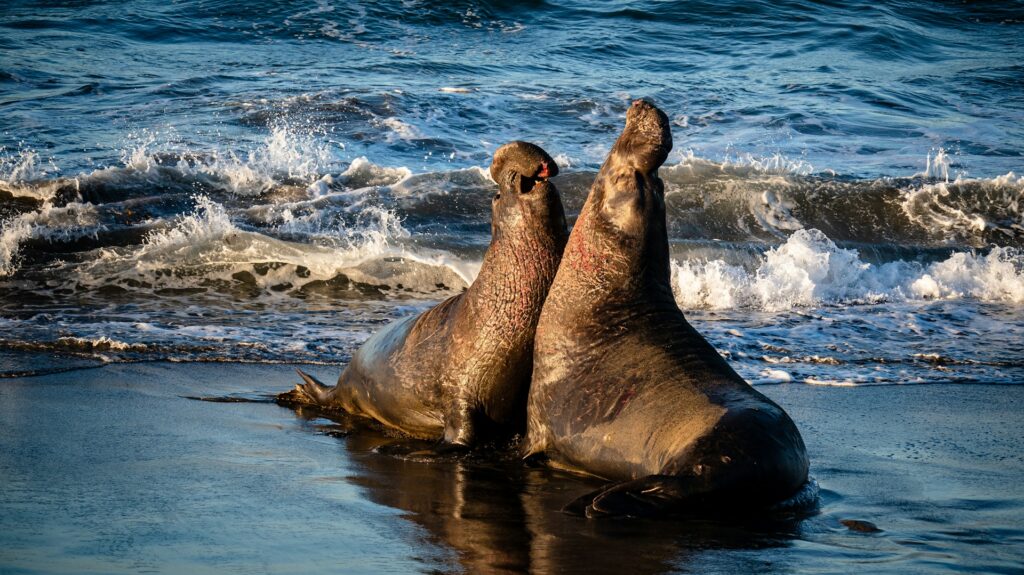
Male elephant seals develop a trunk-like proboscis that hangs down over their mouths during breeding season. This inflatable nose can be blown up like a balloon when the seal is displaying to females or threatening rival males. The sound it produces is a deep, resonating roar that carries across the beach.
The nose acts as an amplifier, making the seal sound more impressive and intimidating. After breeding season ends, the proboscis partially deflates but remains noticeably larger than a female’s nose. It’s one of the most extreme examples of sexual dimorphism in mammals—females have normal seal noses, while males look like they’re smuggling a deflated football on their faces.
4. Saiga antelope

The saiga’s nose looks swollen and bulbous, drooping downwards in a way that seems almost deformed. It’s actually a highly specialised adaptation to Central Asian steppe environments. The enlarged, flexible nose warms and moistens air before it reaches the lungs during freezing winters.
In summer, it filters out dust from the dry grasslands where saigas live. The nose contains complex internal structures, including mucus glands and a network of blood vessels. Breathing through this elaborate system means saigas can survive in environments with extreme temperature variations and heavy dust that would damage the lungs of other animals.
5. Hammerhead bat

Male hammerhead bats have grotesquely enlarged noses and lips that give their faces a genuinely unsettling appearance. The nose is bulbous and fleshy, and the entire face looks swollen and misshapen. This exaggerated facial structure creates resonating chambers that amplify the bat’s honking calls during mating displays.
Males gather in trees and compete by honking loudly through their enormous noses. Females fly past listening to the displays and choose mates based on call quality. The bigger and more resonant the nose, the more attractive the male. It’s functional but absolutely weird-looking, making these bats appear almost alien.
6. Tapir

Tapirs have a short, flexible trunk that looks like someone crossed an elephant with a pig and stopped halfway. They use this prehensile nose to grab vegetation, pull branches closer, and even pick fruit. It’s not as long or dexterous as an elephant’s trunk, but it’s remarkably functional for an animal the size of a large pig.
The trunk is also used for snorkelling—tapirs love water and will submerge themselves completely, with just the trunk tip poking above the surface to breathe. Young tapirs are born with striped camouflage patterns and these peculiar trunks, making them look like someone’s imaginative drawing rather than actual baby animals.
7. Tube-nosed fruit bat

These bats have nostrils that project outwards in obvious tubular extensions from their faces. Nobody’s entirely sure why the tubes evolved, but they’re thought to help with echolocation or possibly with detecting scents while the bat’s face is buried in fruit. The tubes make these bats look permanently surprised or confused.
Combined with their large eyes and small faces, the protruding nose tubes give them an almost comical appearance. Different species have tubes of varying lengths, with some extending a centimetre or more from the face. They’re one of the stranger adaptations in an animal group already known for unusual facial features.
8. Pig-nosed turtle

This freshwater turtle has a distinctive tubular snout that looks exactly like a tiny pig’s nose, complete with nostrils at the end. It’s the only turtle with a nose like this, and it’s perfectly adapted for the turtle’s lifestyle. The pig nose acts as a snorkel, allowing the turtle to breathe while remaining almost completely submerged.
It also has excellent sensory capabilities for detecting food in murky water. The turtle uses its nose to probe the riverbed for molluscs and plant matter. Despite spending most of its time in water, it’s got flippers instead of webbed feet, making it look like someone assembled it from different animals’ spare parts.
9. Golden snub-nosed monkey

These monkeys have virtually no nose at all—just flat nostrils set back into their blue-tinted faces. The extreme snub nose combined with golden fur and bright blue facial skin makes them look fantastical. Scientists believe the flattened nose helps prevent frostbite in the cold mountain environments where these monkeys live.
A protruding nose would lose heat quickly and be vulnerable to freezing temperatures. The reduced nose means less surface area exposed to cold air. This adaptation lets them survive in habitats where winter temperatures drop well below freezing, something most primates couldn’t tolerate.
10. Elephant shrew
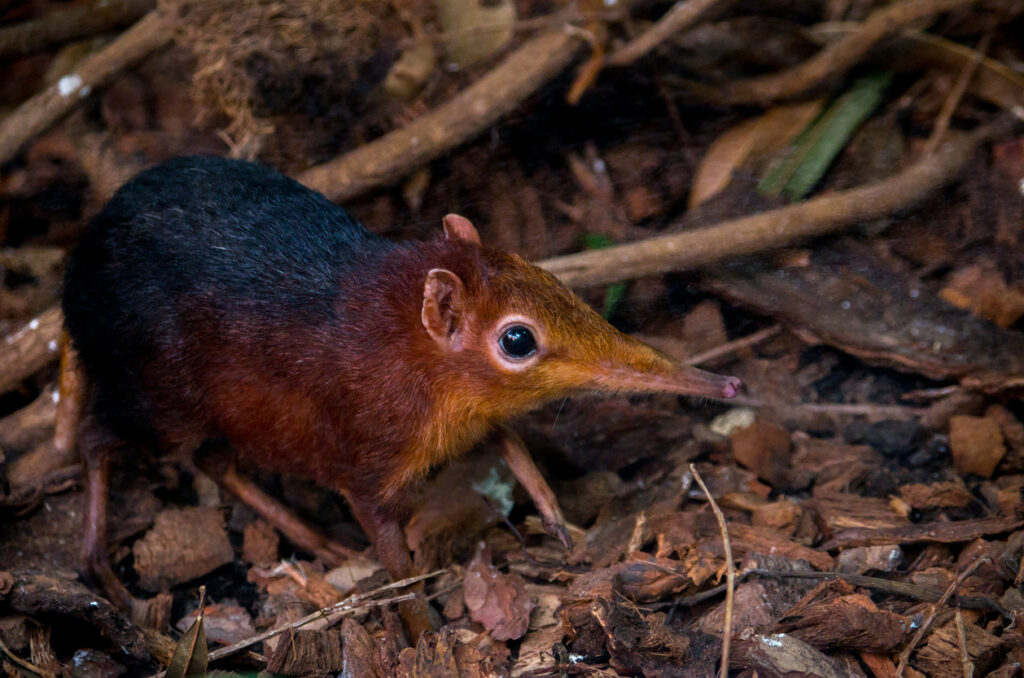
Despite the name, elephant shrews aren’t actually shrews—they’re more closely related to elephants. Their defining feature is a long, flexible, trunk-like nose that they use constantly to search for insects. The nose twitches and moves independently, probing leaf litter and soil for prey.
It’s remarkably sensitive and allows them to detect tiny invertebrates hidden in debris. Elephant shrews use this nose to vacuum up ants and termites with impressive speed. The nose is out of proportion to their small bodies, making them look like someone shrunk an elephant but forgot to scale down the trunk proportionally.
11. Mandrill

Male mandrills have brightly coloured ridges running down either side of their elongated noses. These ridges are vivid blue with red central sections, making their faces look painted. The nose itself is enlarged and prominent, with the colouration becoming more intense as the male’s rank increases.
Dominant males have the brightest noses, and this visual signal tells other mandrills exactly where they stand in the hierarchy. The nose colouration is linked to testosterone levels—healthier, more dominant males literally advertise their status through facial features. It’s one of nature’s most visually striking faces, with colours so intense they look artificial.
12. Gharial
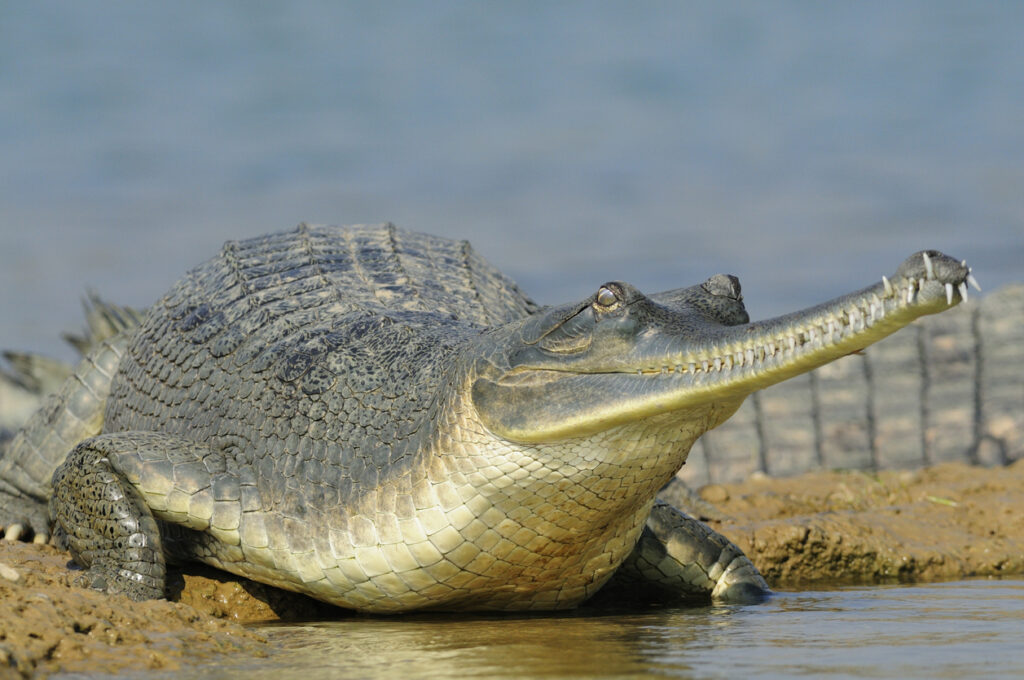
Adult male gharials develop a bulbous growth on the end of their long, narrow snouts. This growth, called a ghara, looks like someone stuck a pot on the crocodile’s nose. It’s hollow and acts as a resonating chamber when the male buzzes and hums during courtship.
The sound carries well across water and signals the male’s maturity to females. Only mature males develop this structure, making it easy to identify breeding-age gharials. The ghara also produces bubbles when the male vocalises underwater, creating visual displays alongside the acoustic signals. It’s one of the most distinctive features in the crocodilian world.