While the headlines are usually full of doom and gloom about rising sea levels and scorching summers, some parts of the UK are actually sitting in a much safer position than others.

If you’re looking at the map and wondering where to plant your roots for the long haul, you’ve got to look past the pretty scenery and start thinking about things like flood plains and average temperatures. Some towns and cities are naturally tucked away or built on higher ground, making them far more resilient to the unpredictable weather headed our way. It’s not about finding a place that’s completely immune to change, but rather finding the spots that aren’t going to be underwater or unbearable in 50 years’ time.
1. Buxton

Buxton sits high in the Peak District, which helps with two of the big UK worries. It’s well away from sea level rise, and it usually stays a bit cooler than lowland towns when we get sticky summer spells. It can still get hit by heavy rain and fast surface water, especially on steep streets, but it’s not starting from the vulnerable position that low-lying coastal places are. Higher ground doesn’t solve everything, but it does take some of the biggest long-term pressure off.
2. Harrogate

Harrogate is inland, reasonably elevated, and not sitting right on a major tidal river, which already puts it in a safer-feeling bracket compared to lots of UK towns. It tends to avoid that constant coastal flooding anxiety that hangs over some places. The main thing to watch in towns like this is intense downpours because surface water can catch anyone out. Still, if you’re looking for the kind of place that usually avoids the headline risks, Harrogate often fits the bill.
3. Skipton

Skipton has that inland, upland North Yorkshire feel, and it generally avoids the coast-driven problems that are only going one way over time. It’s also not a dense city centre, which can help with overheating risk in summer. That said, parts of Skipton are near waterways, so it’s a good example of why local geography matters street by street. As a wider area, it can be a sensible pick, but you’d still avoid low spots and anywhere that funnels rainwater.
4. Ilkley

Ilkley sits on the edge of the moors, and you can feel that higher, breezier setting in the temperature. In hot spells, places with a bit of elevation and airflow can be noticeably more bearable than flatter, built-up areas. Like most UK towns, the main modern risk is sudden heavy rain and water running downhill faster than drains can handle. The upside is that it’s not a coastal town, and it’s not a classic wide floodplain city either, which helps the overall risk picture.
5. Matlock

Matlock’s landscape is its big advantage and its big thing to respect. Being in hillier terrain can reduce some floodplain exposure and can keep temperatures a touch lower in summer compared to nearby lowland towns. The trade-off is that steep valleys can move water quickly, which is why the exact neighbourhood matters. As a general rule, the higher, more sheltered parts tend to feel less exposed than riverside stretches, especially during intense rain.
6. Ashbourne

Ashbourne has that upland Derbyshire location that often avoids the biggest coastal climate pressures. It’s also not a huge heat-trapping city, which can make a difference as summers get hotter and muggy nights become more common. It’s still Britain, so it’s not immune to flash flooding after a violent downpour, and older drainage can struggle anywhere. But as a broad location, inland and higher-leaning places like Ashbourne usually sit on the lower-risk end of the scale.
7. Bakewell

Bakewell is another Peak District option where the general setting helps. It’s inland, it’s not low-lying in the coastal sense, and it tends to avoid the worst of sea-driven risk that’s going to keep rising over time. Parts of Bakewell sit close to the River Wye, which is exactly why you always treat these lists as a starting point, not a property report. The safer angle is focusing on higher ground within the town and avoiding spots where water naturally collects.
8. Hexham

Hexham has a lot going for it on paper. It’s inland, it’s not right on the coast, and it’s surrounded by higher land, which can help with temperature moderation compared to flatter, more sealed-over places. It’s also a reminder that rivers matter. Even inland towns can have flood risk if they sit close to a significant river, so the lower-risk approach is always about choosing the right parts of the place, not assuming the whole postcode is safe.
9. Wolverhampton
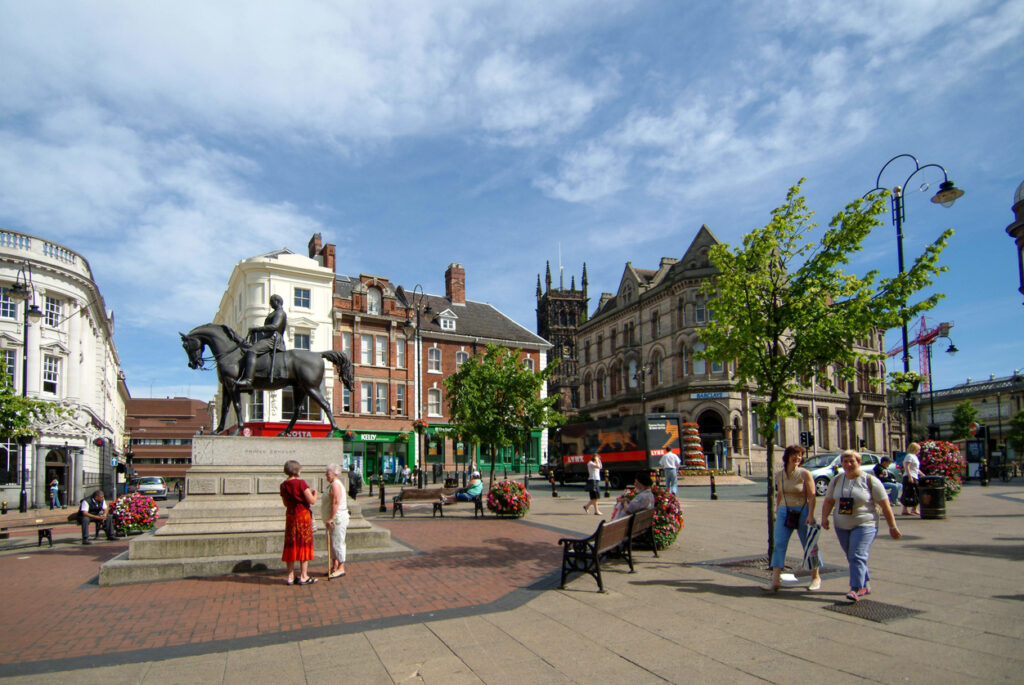
Wolverhampton is inland and generally higher than some nearby areas, which can help a little with flood exposure compared to places built right on major river floodplains. It also avoids the coast entirely, which is a big tick for long-term risk. With any city or large town, the bigger modern issues can be heat and sudden surface water flooding because hard surfaces don’t soak rain up. The upside is that these risks can be managed better with green space, shade, and drainage upgrades, while sea level rise is a much tougher beast to outrun.
10. Coventry

Coventry is another inland city that avoids the obvious coastal threats, and it isn’t defined by a single huge river running straight through the centre in the way some cities are. That alone can reduce the chance of the classic river flood headlines.
The flip side is that cities can get hot, and heavy rain can overwhelm drains quickly, so the lower-risk parts tend to be greener, slightly higher, and less boxed in by hard paving. If you’re thinking in climate terms, it’s the sort of place where the big risks are more about planning and infrastructure than geography trapping you.