
Shooting stars look like they’re falling toward us, diving across the sky in a straight-down streak. But if they’re actually space rocks hitting our atmosphere from all sorts of angles, why do they always seem to fall down instead of fly upward or sideways? The answer is part science, part perspective, and part illusion. Here’s a breakdown of why your brain always sees them as falling.
You’re standing on a sphere.
We tend to think of “up” as above our heads and “down” as toward the ground, but Earth is a sphere. That means people in Australia see a totally different “up” than people in the UK. When you see a shooting star heading downwards, it’s really just following a path through the atmosphere that looks downward from your angle on the planet.
Because your personal version of the sky dome is curved, anything entering it can look like it’s streaking downward, even if it came in sideways or at a weird angle. So when you see a shooting star drop toward the horizon, it’s more about your viewpoint than the meteor’s direction.
Gravity adds to the illusion.
While gravity does tug on meteors once they enter Earth’s atmosphere, most of the downward motion we see isn’t from falling. It’s from the meteor already speeding in that direction. These rocks are travelling at 25,000 to 160,000 kilometres per hour. They’re not drifting gently; they’re plummeting fast.
That speed combined with gravity’s pull gives us the impression of a steep fall. But the truth is, meteors aren’t “aiming” for Earth. They’re just crossing our atmosphere on their way to burning up completely, or in rare cases, hitting the ground.
You’re seeing the brightest part of the trail.
The glowing tail of a meteor—the part that makes it look like a shooting star—only becomes visible once the rock hits the denser part of the atmosphere. That usually happens 60–100 km above the ground. Because it only lights up once it gets close, the streak tends to point downward toward the horizon.
We never see the full arc of a meteor’s journey. We only catch the bit that’s brightly burning. That cropped version often looks like it’s dropping from above, even if it actually entered at a shallow or sideways angle.
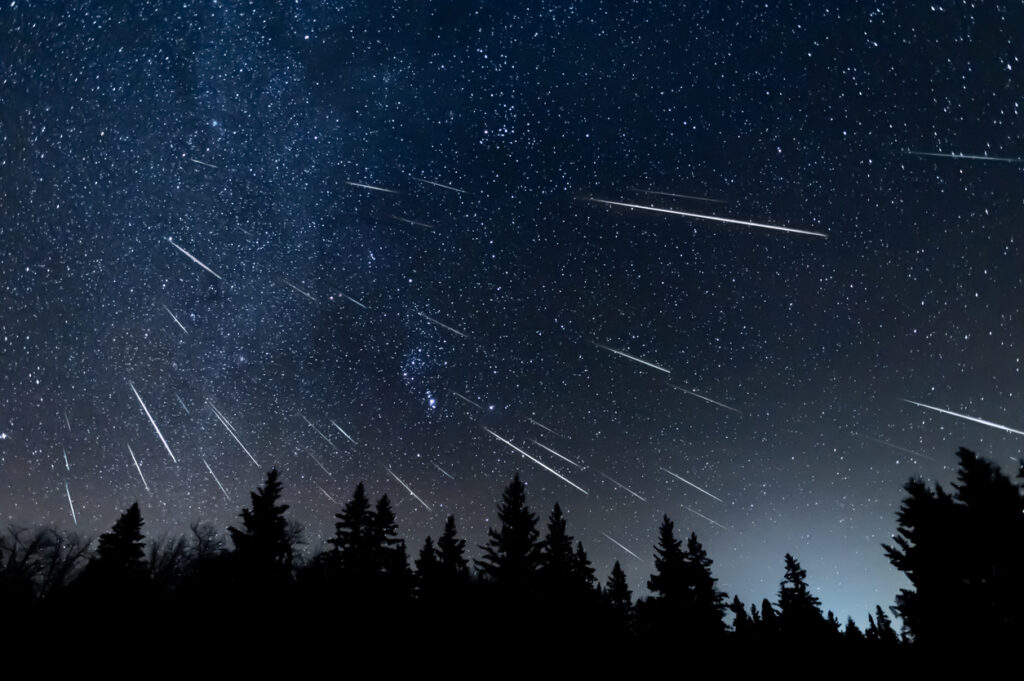
Most meteors come from meteor showers.
Many of the shooting stars we see are part of regular meteor showers, which happen when Earth passes through a trail of debris left behind by comets. These bits of rock and dust enter the atmosphere on very predictable paths.
Those paths usually intersect Earth’s atmosphere at an angle that makes the meteors appear to fall downward in the sky. They all seem to come from one point (called the radiant), and depending on where you’re standing, that will nearly always give a downward-looking trajectory.
The horizon plays tricks on your brain.
When a shooting star appears close to the horizon, your brain interprets it as falling more steeply. That’s because we associate the horizon with the ground, even if the meteor is actually skimming across the upper atmosphere at a shallow angle.
This perception trick is similar to how the moon looks bigger when it’s low in the sky. Our brains exaggerate the steepness of anything heading toward that horizon line, which makes meteors seem like they’re falling faster and more vertically than they really are.
Meteors are entering from space, not rising from Earth.
This might sound obvious, but it’s worth saying: meteors aren’t shooting up from the ground. They’re coming from space, so by default, their motion is going to be downward relative to where we’re standing. We don’t see meteors “flying up” because they’re not leaving Earth—they’re entering. And since they’re hitting the atmosphere from above, they naturally take on that downward appearance, even if their actual angle is more horizontal than we realise.
The streak is short-lived and sudden.
Shooting stars don’t hang around. The entire show usually lasts less than a second or two. That flash of motion tricks your brain into assuming a simple path—straight down—because it doesn’t have time to analyse the trajectory. It’s the same reason lightning looks like it comes straight down, even when it snakes sideways or forks in multiple directions. Your brain just goes with the simplest explanation in the moment: that thing fell from the sky.
Earth’s rotation influences the angle.
Because Earth is rotating, meteors often appear to streak in from the direction we’re moving. This means they hit the atmosphere almost head-on, which can make their path look steeper and more dramatic from the ground. This effect is more noticeable after midnight, when your part of the planet is facing forward in Earth’s orbit. You’ll see more meteors then, and they’ll look like they’re dropping in faster and from higher above, even if the angle is actually shallow.
You’re only seeing one piece of the path.
The part of the meteor’s journey that you can actually see is just a thin slice of a much longer path. Many meteors travel hundreds or thousands of kilometres through the atmosphere before burning up completely. However, from your specific position on Earth, you only see the part where the meteor lights up in your section of sky. That cropped visual makes the streak appear shorter and steeper than it really is, reinforcing the idea that it’s “falling.”
It’s all filtered through human perception.
In the end, our sense of what’s “up” and “down” is completely tied to gravity and our place on Earth. We look up and expect things in the sky to come down because that’s what rain, snow, and birds do. Meteors are no different in our minds.
Even if a meteor entered sideways or nearly horizontal to the atmosphere, we’d still interpret that flash as falling, because that’s how our brains make sense of movement across the sky. It’s less about the meteor’s actual direction, and more about how we’re wired to see it.