
If you’ve ever heard (or witnessed yourself!) that hurricanes spin clockwise in one part of the world and counterclockwise in another, you’re not imagining things. It’s a real phenomenon, and it all comes down to how Earth spins. The direction a hurricane turns isn’t random or based on temperature or sea levels. It’s influenced by something called the Coriolis effect, which plays a subtle but powerful role in steering the world’s biggest storms. Here’s what’s really going on, and why your hemisphere decides how a storm spins.
The Earth spins—fast.
Let’s start with the basics: Earth is constantly spinning on its axis. It does a full rotation every 24 hours, moving fastest at the equator and slower toward the poles. This spin affects pretty much everything in the atmosphere, including how wind and water move across the surface.
Because Earth is round and rotating, different parts of the planet are moving at different speeds. That difference creates a kind of sideways tug on anything moving long distances, like wind or ocean currents. That’s where the Coriolis effect comes in.
The Coriolis effect explains it all.
The Coriolis effect is the force that makes moving objects curve instead of going straight when they’re on a rotating planet. In our case, that planet is Earth. This effect doesn’t create wind, but it changes the path of wind that’s already blowing.
In the Northern Hemisphere, it causes air to veer to the right. In the Southern Hemisphere, it veers to the left. That tiny directional nudge might not sound like much, but when it acts on something as massive as a hurricane, it determines how the entire storm rotates.
Storms spin one way in each hemisphere.
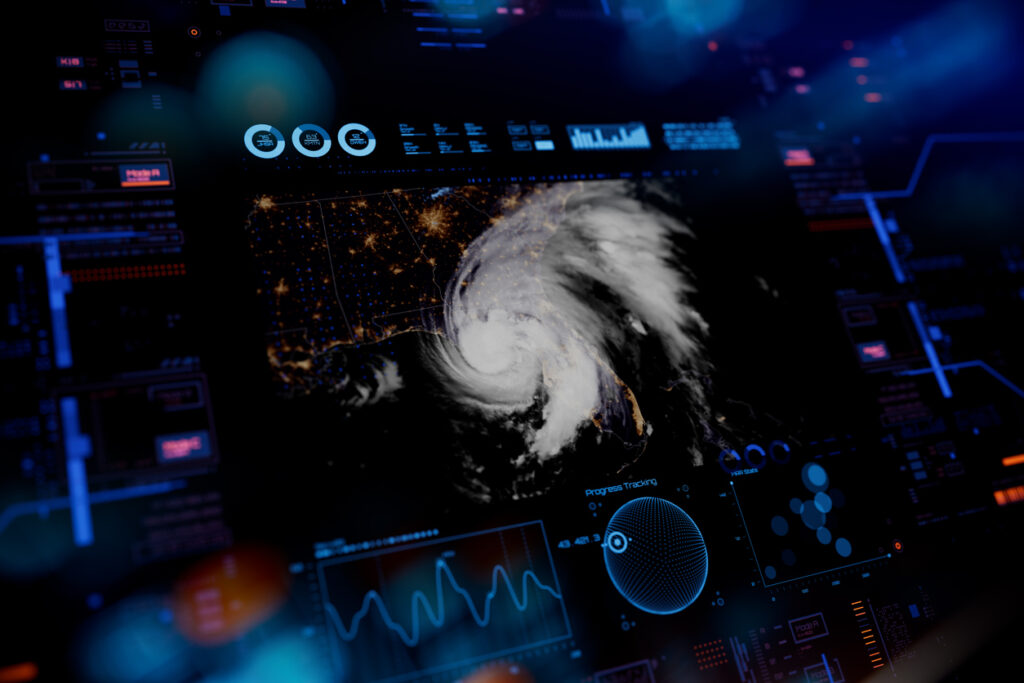
Because of the Coriolis effect, hurricanes spin counterclockwise in the Northern Hemisphere and clockwise in the Southern Hemisphere. This isn’t just theory—it’s been confirmed in satellite images and weather data again and again.
Basically, if you ever see a storm spinning clockwise, you’re most likely looking at one forming south of the equator. Flip that, and you’ve got a Northern Hemisphere storm swirling counterclockwise, like most hurricanes that hit the Atlantic coast or the Gulf of Mexico.
The spin starts early in the storm.
Even in its early stages, a developing storm already feels the Coriolis pull. As warm, moist air rises in a tropical low-pressure zone, the Earth’s spin starts tugging on the movement of air around it. This causes the system to begin rotating—and the direction depends on which side of the equator it forms.
That early twist gets reinforced as the storm grows. Eventually, it becomes strong enough to create the giant spiral shape we see in satellite photos. Without that initial nudge from the Coriolis effect, storms wouldn’t develop the familiar swirling pattern we associate with hurricanes and cyclones.
There’s a reason hurricanes never cross the equator.
Hurricanes almost never form right at the equator, and they definitely don’t cross it. That’s because the Coriolis effect is weakest near the equator and essentially disappears at zero latitude. Without it, there’s not enough rotational energy to get a storm spinning in the first place.
If a storm does drift toward the equator, it tends to fall apart. The balance that keeps it organised breaks down, and the storm loses its structure. So storms tend to stay firmly in their own hemisphere, spinning according to the rules of the region they started in.
Wind direction reinforces the spin.
As the storm strengthens, the direction of wind flow feeds into the rotation. In the Northern Hemisphere, winds spiral inward counterclockwise toward the storm’s centre. In the Southern Hemisphere, they spiral in clockwise. This inward spiralling motion keeps reinforcing the spin direction set by the Coriolis effect.
The tighter and stronger that spiral gets, the more powerful the storm becomes. It’s a self-feeding loop driven by warm ocean water, moisture, and the Earth’s rotation—all working together to lock in the storm’s direction of spin.
Hurricanes and cyclones are basically the same thing.
Whether it’s called a hurricane, cyclone, or typhoon, the science behind the storm is the same. It’s a massive low-pressure system spinning due to the Coriolis effect. The different names just depend on where the storm is happening geographically.
But the direction of the spin stays true to the hemisphere. A typhoon in the Western Pacific will still spin counterclockwise if it’s in the north, and a cyclone in the Indian Ocean will spin clockwise if it’s in the south. The name changes, but the physics doesn’t.
Tornadoes don’t always follow the same rule.
Unlike hurricanes, tornadoes can spin in either direction, though most still follow the Coriolis rule. That’s because tornadoes are much smaller and influenced more by local wind patterns and storm conditions than by Earth’s overall rotation. So while the majority of tornadoes in the Northern Hemisphere spin counterclockwise, exceptions do happen. The Coriolis effect still plays a role, but it’s not as dominant as it is in huge, wide-reaching systems like hurricanes.
Jet streams play a supporting role.
The planet’s major wind belts, like the jet streams, are shaped by the Coriolis effect too. These high-altitude winds steer hurricanes and often determine how long they last, where they go, or whether they curve out to sea or hit land.
The jet streams themselves don’t cause the storm to spin, but they help shape its journey, often pushing it along familiar paths. Their direction and intensity also differ by hemisphere, reinforcing the way large weather systems behave differently north and south of the equator.

Ocean currents follow similar rules.
Just like air, ocean currents are affected by the Coriolis effect. They don’t spin into storms, but their curved flow helps explain why water moves clockwise in one hemisphere and counterclockwise in the other. This movement helps warm or cool regional climates, and supports the kind of conditions hurricanes need to form.
Warm ocean currents like the Gulf Stream in the Northern Hemisphere and the East Australian Current in the Southern Hemisphere help fuel tropical storms by keeping sea surface temperatures high. The spinning of those currents also helps drive surface winds that feed into a storm’s energy.
It’s not about magnetic poles or gravity.
A common misconception is that the direction of a hurricane’s spin has something to do with magnetism or gravity. It doesn’t. The Coriolis effect isn’t caused by magnetism, and while gravity pulls everything downward, it doesn’t affect spin direction in this context.
Everything about the spin comes down to motion across a rotating sphere. The Earth’s shape, speed, and tilt all contribute to how the Coriolis effect bends airflow. It’s subtle, but over thousands of miles, it adds up to giant spinning storms.
The equator is like a spin-neutral zone.
At the equator, the Coriolis effect essentially cancels itself out. Air moving straight up or down isn’t deflected left or right with enough strength to trigger a rotation. That’s why even the warmest waters near the equator rarely host storms—there’s just no spin to work with.
This makes the equator a kind of barrier between spinning systems. Northern and southern storms don’t cross it because they’d lose the very force that holds them together. It’s not a physical wall, but for storms, it might as well be.
It’s all about location, location, location.
At the end of the day, the direction a hurricane spins is entirely based on where it starts. Northern Hemisphere? Counterclockwise. Southern Hemisphere? Clockwise. No exceptions, unless the storm somehow hops the equator, which it won’t.
So next time you’re watching satellite footage of a storm, you’ll know instantly what part of the world it’s forming in—just from the way it spins. All thanks to the invisible but unstoppable hand of the Coriolis effect, shaping storms on a spinning planet.