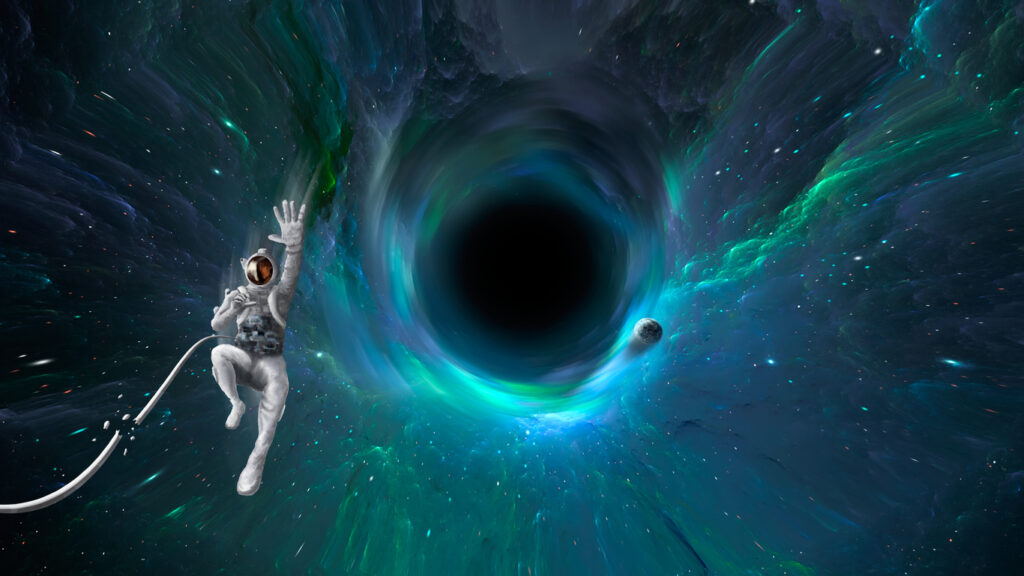
Black holes are weird. They’re one of the few things in the universe that manage to be terrifying, fascinating, and invisible all at the same time. But here’s the real head-scratcher: if no light can escape a black hole, how can we even see it, or rather, how do we know where it is, and why does it look like a black blob instead of, say, just blank space? Here’s what’s really going on when you “see” a black hole.
They don’t emit light, but the stuff around them does.
Black holes themselves don’t glow. Light can’t escape past the event horizon, or the boundary where gravity becomes so intense that nothing gets out. However, matter falling toward a black hole heats up dramatically and emits huge amounts of light, especially X-rays.
So what we see isn’t the black hole, but the chaos around it. It’s like seeing a fire whirl around a drain: you can’t see the drain, but the blaze gives away exactly where it is. The glowing ring that often shows up in black hole images is this high-energy material swirling just outside the event horizon.
Their gravity warps the light nearby.
Black holes bend space itself, which means they also bend the path of light. This is called gravitational lensing, and it lets us detect the presence of a black hole by how it distorts the light from stars or galaxies behind it. Sometimes, this effect creates eerie halos or warped shapes around the black hole, which helps us map its location. It’s like looking at a funhouse mirror in space, except the mirror is bending starlight, not your face.
The darkness is actually a shadow.
The black “disc” we often see isn’t the black hole itself; it’s the shadow it casts against the backdrop of glowing matter. It’s what happens when light from behind or around the black hole gets swallowed, leaving a distinct void in the middle.
This shadow gives astronomers a way to measure the size and shape of a black hole, even if they can’t see the object directly. So yes, the black hole looks black, but technically, it’s the absence of visible light being framed by everything it’s devouring.
Nothing escapes past the event horizon.
The event horizon is the outer boundary of a black hole. Cross it, and escape becomes impossible. Not even light, the fastest thing in the universe, can get out. That’s why it appears so utterly black: light hits the horizon and vanishes from view. This makes the black hole’s surface, if you can even call it that, the ultimate point of no return. Any information or particles crossing that line are effectively erased from our universe as far as observation goes.
They’re visible in other ways, just not directly.
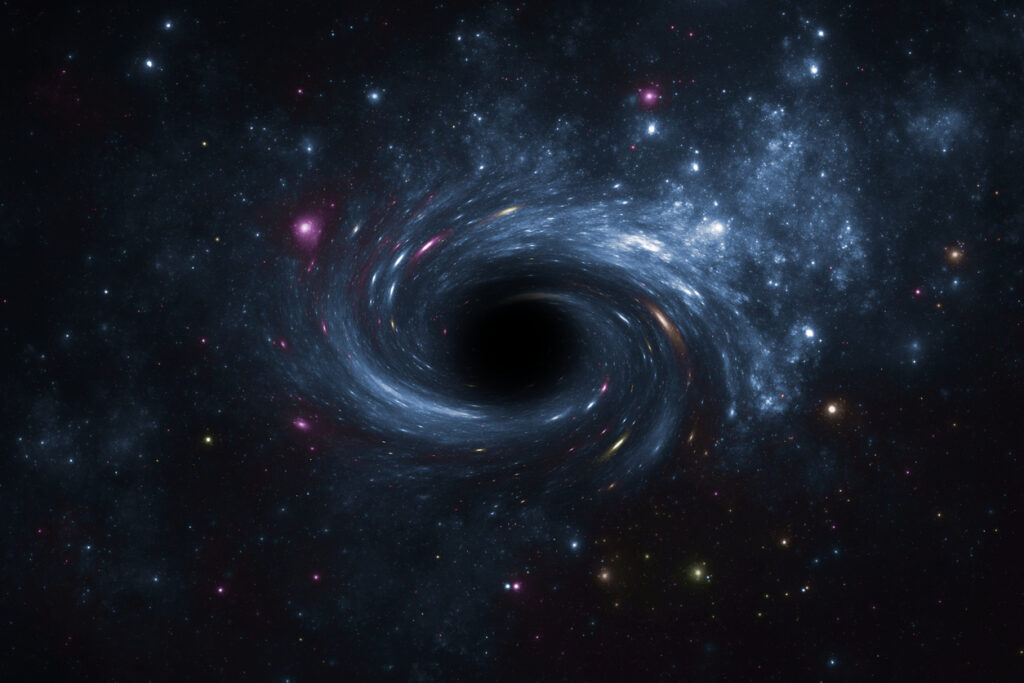
We “see” black holes through indirect evidence. This might be stars orbiting something invisible, jets of radiation shooting out from the centre of galaxies, or the way gas clouds move near a strong gravitational pull. So even though you can’t see the black hole itself, you can spot all the wild activity it causes. It’s a bit like knowing there’s a powerful fan in the room based on the papers flying everywhere, even if the fan itself is hidden behind a curtain.
They don’t reflect light, either.
Unlike a shiny object like the moon, black holes don’t reflect any light. They absorb everything. So even if you shine a beam of light directly at one (hypothetically), nothing bounces back. It just disappears. This makes them invisible against the blackness of space unless there’s a glowing mess nearby. Without something to illuminate or distort, they’d be as undetectable as a drop of ink in the middle of the ocean at night.
Some are surrounded by glowing discs.
When a black hole is actively feeding, pulling in gas, dust, and stars, it creates an accretion disc. This disc spins rapidly and glows extremely brightly due to the friction and heat generated as particles spiral inwards. This is often what we capture in telescope images: a glowing swirl with a black centre. The black hole is right at the middle, hidden behind the light show it’s created by being gravitationally greedy.
They’re only “black” in visible light.
Black holes may be invisible to the naked eye, but they’re active in other parts of the electromagnetic spectrum. Radio waves, X-rays, and gamma rays can all point to a black hole’s presence through emissions from nearby matter. Many of the best black hole discoveries have come from telescopes that don’t use visible light at all. So the “blackness” is just how they appear to us, not necessarily the whole picture.
The first actual photo was all about silhouette.
The famous 2019 image of a black hole, captured by the Event Horizon Telescope, didn’t show the black hole directly. It showed the shadow of its event horizon surrounded by a glowing, orange-red ring of hot gas and light being pulled in. This was the first visual proof that these cosmic monsters look exactly as predicted. It’s not a fake rendering, just the best view we could get of a truly unseeable object, outlined by its own destruction.
They can be completely invisible if inactive.
If a black hole isn’t actively feeding on anything, it’s practically impossible to spot. No glowing disc, no radiation jets, just a gravitational hole sitting silently in space. You’d only know it’s there if something drifted too close and got ripped apart. This makes dormant black holes some of the creepiest things out there. They’re like cosmic landmines: completely invisible until something sets them off.
Light circles them before falling in.
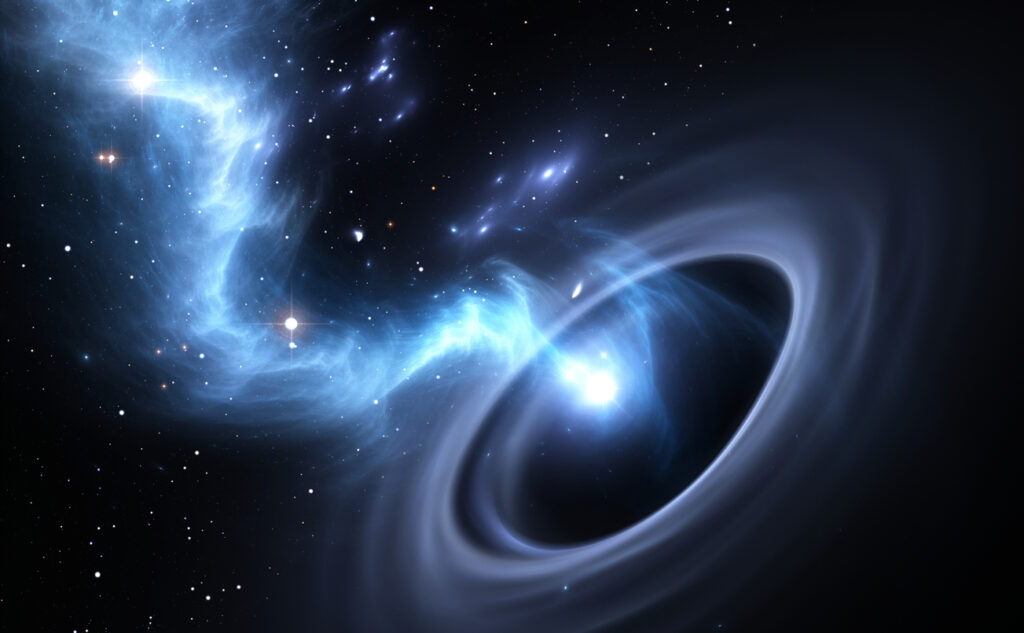
At just the right distance from the event horizon, there’s a point where light can actually orbit the black hole in what’s called the “photon sphere.” It’s like a racetrack where light loops around just before giving up and falling in. This effect bends the light into rings, adding to the illusion of a glowing halo. It’s not that the black hole shines. It’s that it warps and traps light long enough to give us something to spot.
They’re black because they erase information.
One of the most mind-bending reasons black holes appear black is that they represent the end of information. Once something crosses the event horizon, its data is gone, at least as far as we can tell right now. This isn’t just about light. It’s about reality disappearing behind a one-way curtain. And that curtain is what gives a black hole its iconic look: not just black, but blank. It’s where the universe stops letting us peek behind the scenes.