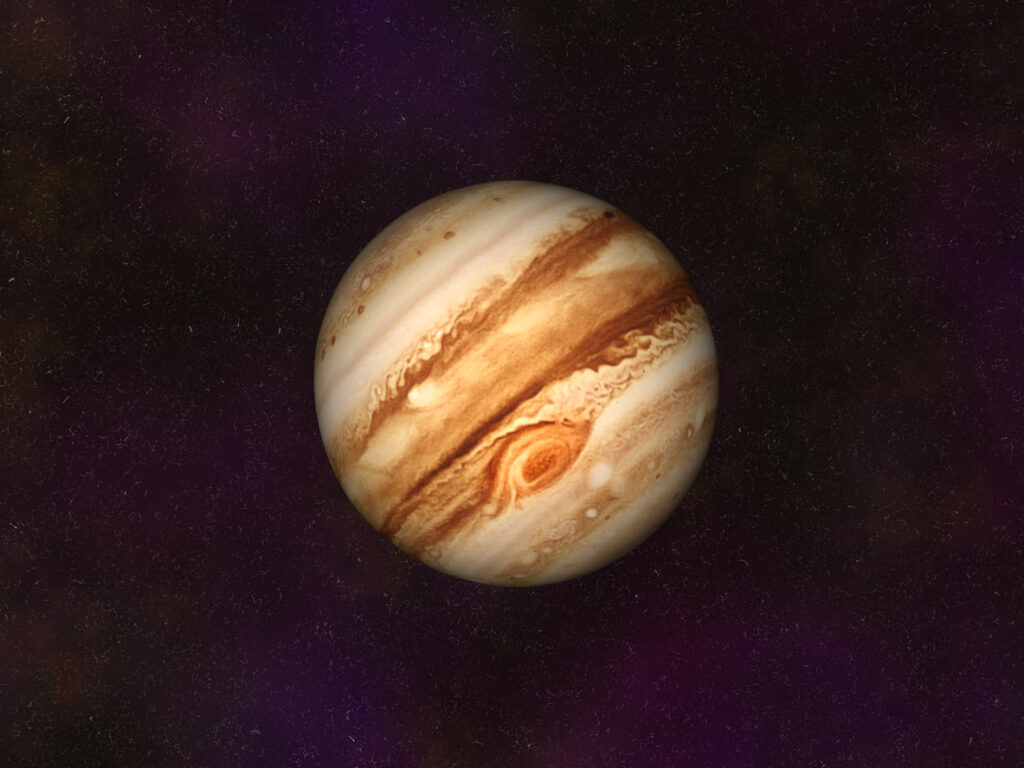
Jupiter reaches opposition once a year, when Earth passes directly between it and the Sun, creating the best possible viewing conditions for the giant planet. This astronomical alignment makes Jupiter appear brighter, larger, and more detailed than at any other time, and it’s visible all night long from sunset to sunrise.
Opposition happens roughly every 13 months.
Jupiter takes about 12 Earth years to orbit the Sun, but opposition occurs more frequently because Earth is also moving in its orbit. Every 13 months or so, Earth catches up to Jupiter and passes between it and the Sun, creating the opposition alignment. The exact timing shifts slightly each year because planetary orbits aren’t perfectly circular. This regular cycle means you get annual opportunities to see Jupiter at its absolute best without waiting years between good viewing periods.
Jupiter appears brightest and largest during opposition.
At opposition, Jupiter is at its closest point to Earth for that particular orbit, making it appear significantly larger and brighter than usual. The planet can shine at magnitude -2.9 or brighter, making it one of the brightest objects in the night sky after the Moon and Venus. Even small telescopes show impressive detail during opposition because the planet’s disk is at its maximum apparent size. The difference between opposition and other times is dramatic enough that casual observers notice Jupiter looks particularly impressive.
The planet is visible all night long.
Because Jupiter sits opposite the Sun in our sky during opposition, it rises around sunset and sets around sunrise, giving you all night to observe it. This is completely different from other times, when Jupiter might only be visible for a few hours before or after sunset. The all-night visibility means you can observe at your convenience, rather than rushing to catch it during a narrow window. Jupiter reaches its highest point in the sky around midnight, when atmospheric distortion is typically minimal and viewing conditions are best.
Jupiter’s moons are easier to spot and track.
The four Galilean moons—Io, Europa, Ganymede, and Callisto—are visible through binoculars or small telescopes year-round, but opposition makes them easier to observe. The improved brightness and size of Jupiter means the moons stand out more clearly against the darkness of space. You can watch them change position over hours as they orbit Jupiter, sometimes disappearing behind the planet or casting shadows on its surface. Their movements are fast enough that you’ll see different configurations each night, and opposition gives you the whole night to track these changes.
Surface details become much more visible.
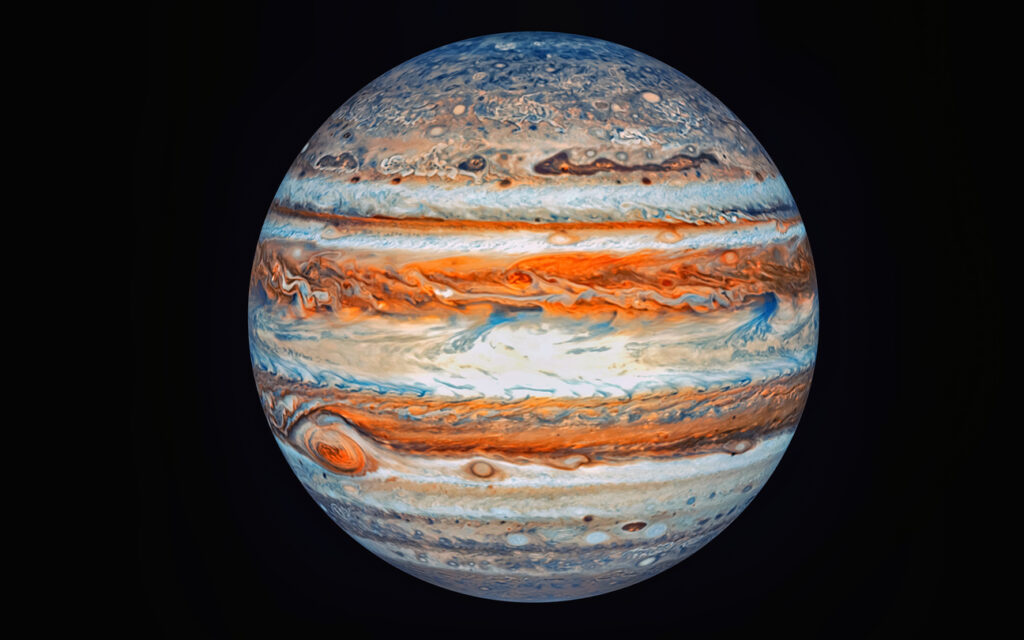
Jupiter’s cloud bands, the Great Red Spot, and other atmospheric features show much more detail during opposition when the planet’s disk is largest. Even modest telescopes reveal the distinct dark belts and bright zones that stripe Jupiter’s atmosphere. The Great Red Spot, a storm larger than Earth, becomes clearly visible when it rotates into view, appearing as an oval feature in the southern hemisphere. Opposition is when amateur astronomers take their best Jupiter photos because the increased apparent size captures more atmospheric detail.
@spacecentre Happy New Year! here’s what’s in the night sky January 2026 Jupiter at opposition Gemini constellation Saturn near the Moon #stargazing #nightsky #constellation #Saturn ♬ original sound – National Space Centre
Opposition dates shift through the calendar over years.
Because the opposition cycle is roughly 13 months, the date slides forward through the year over time. An opposition in January one year will be in February the next year, March the year after, and so on. This means opposition eventually moves through all seasons, affecting how high Jupiter appears in the sky from different latitudes. The seasonal position matters because summer oppositions place Jupiter low in the sky for northern hemisphere observers, while winter oppositions put it higher up where viewing is better.
Not all oppositions are equally good.
Jupiter’s orbit is slightly elliptical, so its distance from Earth at opposition varies depending on where both planets are in their orbits. Some oppositions happen when Jupiter is near perihelion (closest to the Sun), making it genuinely closer to Earth and appearing even larger. Other oppositions occur when Jupiter is near aphelion (farthest from the Sun), and while still excellent viewing, the planet appears slightly smaller. The difference in distance can be about 75 million kilometres, which noticeably affects how large Jupiter looks through a telescope.
Ancient astronomers tracked Jupiter’s opposition cycle.
Babylonian astronomers recorded Jupiter’s movements and opposition cycle thousands of years ago, using it to develop early planetary theories. The predictable 13-month cycle helped ancient cultures develop calendars and understand planetary motion. Greek astronomers noticed that Jupiter appeared to move backwards (retrograde motion) around opposition time, which eventually led to understanding that Earth and Jupiter orbit the Sun rather than everything orbiting Earth. Opposition observations were crucial evidence in developing our modern understanding of the solar system’s structure.
You don’t need special equipment to enjoy opposition.

Jupiter is bright enough that you can easily spot it with the naked eye during opposition, appearing as a brilliant white “star” that doesn’t twinkle like actual stars do. Binoculars reveal it as a disk rather than a point of light and show the four Galilean moons as tiny dots lined up on either side. Even a small telescope transforms the view, showing cloud bands and the planet’s obvious flattened shape caused by its rapid rotation. Opposition makes Jupiter so prominent that finding it is easy even for complete beginners without star charts or apps.
Opposition marks the best time for serious observation projects.
Amateur astronomers plan Jupiter observation campaigns around opposition because the extended visibility and optimal viewing conditions allow systematic study. You can track cloud band changes, monitor the Great Red Spot’s behaviour, time moon transits, and document atmospheric storms over weeks. The all-night visibility means observers in different time zones can coordinate observations, creating continuous coverage of Jupiter’s rapidly changing atmosphere. Many astronomical organizations run Jupiter observation programs during opposition, collecting data from amateur telescopes worldwide to track changes professional astronomers might miss.