
People often feel tiny when they think about space, yet working out your cosmic address can make everything feel more familiar. It is simply the layered version of asking where you live, starting with Earth and zooming out step by step until you reach the biggest structures we know.
Earth is the first line of your cosmic address.
Your story begins with the planet under your feet because everything else builds on top of it. Earth anchors you in a place you recognise before you move into the wider universe. It is the world that shaped your entire life and every moment you remember. Starting here helps you see the cosmic journey as something personal rather than distant. Earth gives you the foundation for every layer that follows, making the bigger steps easier to picture and far less overwhelming.
The Solar System forms your neighbourhood.
Your next step sits inside the Solar System, which is the small region shaped by the Sun and everything that orbits it. Earth, the other planets and countless smaller objects all move together in this shared space. Seeing the Solar System as your neighbourhood shows that you live in a community of worlds. You are part of a group that travels around the Sun in a steady rhythm that keeps your planet stable.
You live inside the Milky Way.
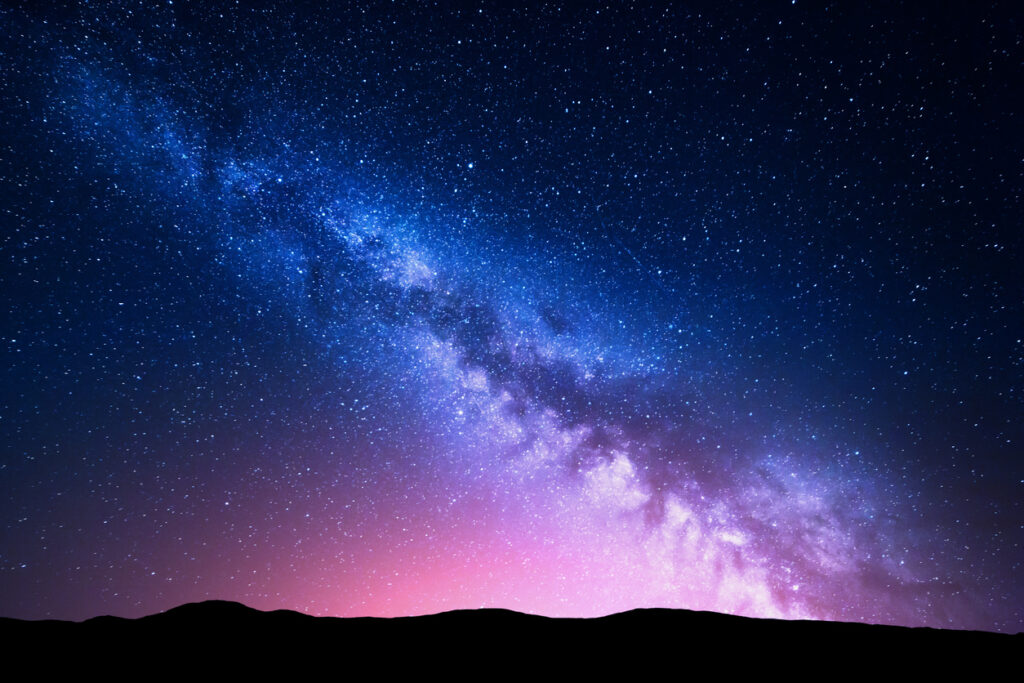
Your Solar System sits inside a huge spiral galaxy packed with billions of stars. The Milky Way is your cosmic city and stretches across an area so enormous that light needs one hundred thousand years to cross it. Knowing this helps you see that your life belongs to a massive structure rather than floating alone. Every star you see at night is part of the same galaxy that holds your home.
You sit in a calmer region called the Orion Arm.
Your position inside the Milky Way sits in the Orion Arm, which is one of the quieter parts of the galaxy. It is less chaotic than the major arms where stars form rapidly, which gives your Solar System steady conditions. Thinking of the Orion Arm as your district makes your position inside the galaxy easier to understand. You occupy a peaceful patch that helped life grow without constant disruption.
The Local Bubble surrounds your part of the galaxy.
Your region sits in a cavity called the Local Bubble, formed millions of years ago by ancient stellar explosions. These events cleared out much of the gas and dust around your Solar System. This layer shows that your address carries the history of what happened long before humans appeared. The bubble changes how your area of space behaves and adds another small detail to your place in the galaxy.
The Local Neighbourhood includes the closest stars to the Sun.
This small region contains the stars nearest to you, including well-known systems like Alpha Centauri. These stars sit in the same stretch of space that the Sun moves through during its slow orbit around the Milky Way. Seeing this as part of your address adds another layer between the Solar System and the wider galaxy. You live among a handful of nearby stars that travel through space alongside you.
The Local Interstellar Cloud wraps around your Solar System.
Your system currently moves through a thin cloud of gas and dust that scientists call the Local Interstellar Cloud. You can’t see it, yet it surrounds you across many light years. Including this layer shows that even the empty looking parts of space contain structures that shape your environment. Your address sits inside a cloud that changes slowly as your system drifts onward.
The Local Group gives you a cluster of galaxies to belong to.
Zoom out far enough and your galaxy becomes one of roughly eighty in the Local Group. The Milky Way shares this region with Andromeda and many smaller galaxies that move together under shared gravity. This cluster becomes a major step in your cosmic address because it links your galaxy to others in a wider family. Your place expands from a single galaxy to a connected group that travels through space together.
The Local Group sits inside the Virgo Cluster.

The Virgo Cluster is a much larger region containing thousands of galaxies. Your Local Group is one small part of this enormous collection, which stretches across vast distances. Adding this layer shows how your cosmic address keeps expanding into structures too large to grasp fully. You belong to a cluster that forms part of an even greater network.
The Virgo Supercluster holds many clusters together.
The Virgo Cluster sits inside the Virgo Supercluster, which stretches across hundreds of millions of light years. This region gathers multiple galaxy clusters into one enormous structure. Seeing yourself inside the Virgo Supercluster gives your address an even larger context. It reveals how countless galaxies sit inside a single pattern that pulls everything together through gravity.
The Laniakea Supercluster is your true cosmic region.
This is the largest clearly mapped structure you belong to. Laniakea contains around one hundred thousand galaxies and spans half a billion light years across, forming your wider cosmic region. Scientists discovered that galaxies flow through Laniakea like slow rivers guided by gravity. Knowing you live inside this structure gives you the top level of your address before reaching the universe itself.
The observable universe holds everything you can possibly see.
The final layer is the observable universe, which contains every galaxy whose light has reached us so far. It’s not the entire universe, only the part visible to us right now. This layer is unimaginably vast, yet it forms the outer boundary of your current address. Everything you have ever seen in space sits inside this one enormous region.
Each layer links your life to a much bigger structure.
Your cosmic address shows how every level fits inside the next, creating a chain from your daily life to the largest structures ever mapped. It helps you understand your place in a clear and layered way, rather than as a vague idea. These layers connect your ordinary experiences with the shape of the universe. You begin to see that your life sits within patterns shaped by stars, galaxies, and ancient forces spread across billions of years.
Your full cosmic address reveals your exact place in the universe.
When you place all the layers together, you can write your full cosmic address from smallest to largest. It begins with Earth and moves steadily outward through each structure that holds you. Your final address reads as Earth, Solar System, Local Interstellar Cloud, Local Neighbourhood, Orion Arm, Milky Way, Local Group, Virgo Cluster, Virgo Supercluster, Laniakea Supercluster and the observable universe. This gives you the clearest picture of where you live in the cosmos.