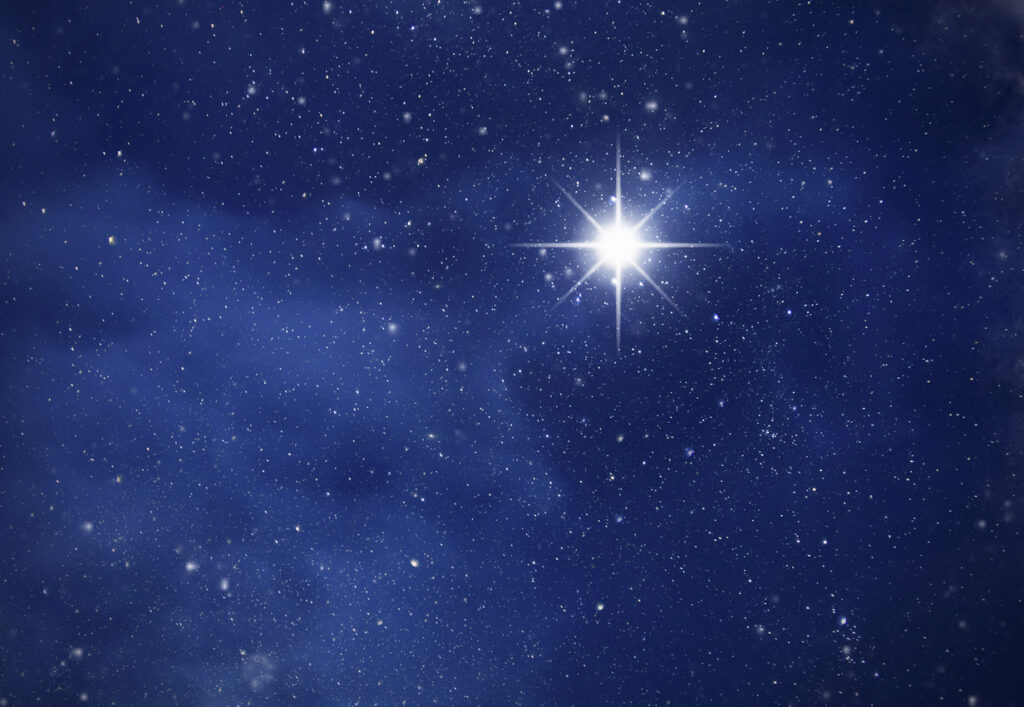
The North Star seems to be glued to the same spot in the northern sky every night, while all the other stars wheel around it. It’s been the ultimate celestial landmark for centuries, but what’s actually keeping it pinned there like a cosmic drawing pin?
It’s not actually stuck—it just looks that way from here.
Polaris, our current North Star, isn’t magically fixed in place by some cosmic force. It just happens to sit almost directly above Earth’s North Pole, so when our planet spins, it appears to stay put while everything else rotates around it.
Think of it like standing on a spinning playground roundabout and looking up at a lamppost that’s positioned right above the centre. The lamppost stays in the same spot relative to you, but everything else on the horizon spins past as you rotate.
Earth’s axis points almost straight at it.
Our planet tilts at about 23.5 degrees and spins like a slightly wonky top. The invisible line that runs through Earth’s North and South poles, extended out into space, passes very close to where Polaris sits in the sky.
Because Polaris sits almost exactly on this extended axis line, it barely moves as Earth rotates. It’s positioned at the celestial equivalent of the eye of a hurricane: the calm centre while everything else swirls around it.
The “North Star” job is actually temporary.
Polaris hasn’t always been the North Star, and it won’t be forever either. Earth’s axis wobbles very slowly over thousands of years, like a spinning top that’s starting to lose momentum, which means different stars take turns being the “pole star.”
About 12,000 years ago, a star called Vega was the North Star, and it’ll get the job again in about 13,727 AD. Polaris just happens to have the role right now during this particular slice of human history.
It’s perfectly positioned by cosmic coincidence.
The fact that we have such a bright, easily visible star sitting almost exactly on our celestial north pole is pure astronomical luck. Most planets don’t have pole stars at all, or if they do, they’re too dim to be useful for navigation.
This cosmic coincidence has been incredibly helpful for human navigation and astronomy. Without Polaris being so conveniently placed, figuring out directions and understanding celestial mechanics would have been much harder for our ancestors.
Earth’s wobble means it’s slowly drifting away.
Right now, Polaris is about 0.7 degrees away from the true celestial north pole, which is just close enough to appear stationary to the naked eye. However, Earth’s axial wobble means this distance is gradually changing over time.
The star will actually get closer to true north over the next few decades, reaching its minimum distance around 2100, before slowly starting to drift away again. It’s like a very slow celestial dance that takes thousands of years to complete.
Ancient civilizations had different pole stars.
The ancient Egyptians used different stars for navigation because Polaris wasn’t in the right position yet. They oriented their pyramids using stars that were closer to the celestial pole during their time period.
This is why some ancient monuments and navigation techniques seem to use different reference points—they were built when different stars held the pole star position. Each civilization had to work with whatever star happened to be closest to north during their era.
The whole sky appears to rotate around it every night.
If you set up a camera for a long exposure photo pointing at Polaris, you’d capture beautiful star trails: circular streaks showing the paths of all the other stars as they appear to orbit around the North Star throughout the night.
This apparent rotation is actually just our perspective from Earth’s surface as our planet spins. Polaris sits at the centre of this cosmic carousel, barely moving while everything else traces perfect circles around it in the sky.
It’s much farther away than most people realise.
Polaris is roughly 430 light-years away from us, which means the light we see from it tonight left the star around the time Shakespeare was writing his plays. Despite this enormous distance, it appears bright enough to be easily visible.
This distance also means that if Polaris suddenly disappeared or changed, we wouldn’t know about it for over 400 years. We’re always seeing the North Star as it was centuries ago, not as it exists right now.
Other planets don’t have convenient pole stars.
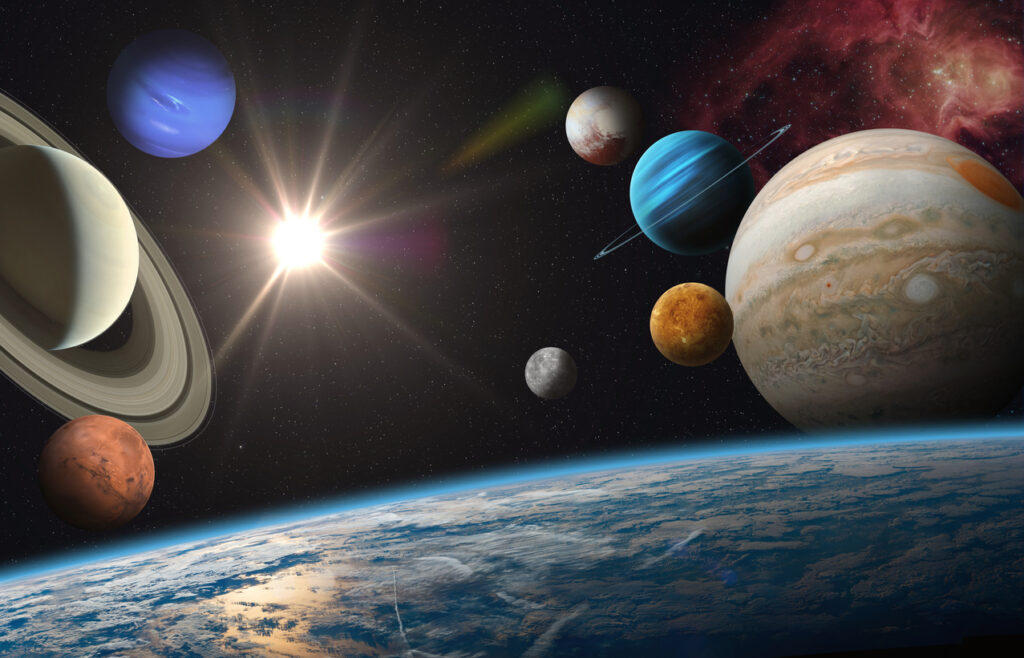
Mars, Jupiter, Saturn and the other planets in our solar system don’t have bright stars positioned near their poles. Their axes point toward relatively empty patches of sky, making celestial navigation much more complicated.
This makes Earth’s situation quite special in our solar system. Having such a bright, obvious reference point has been crucial for human exploration and understanding of astronomy throughout history.
The star itself is actually quite remarkable.
Polaris isn’t just conveniently positioned. It’s also an interesting star in its own right. It’s what astronomers call a Cepheid variable star, which means its brightness changes in a regular pattern over about four days.
It’s also much bigger and more luminous than our Sun, roughly 2,000 times brighter and about 37 times larger. If Polaris replaced our Sun, it would extend well beyond the orbit of Mars and obviously fry everything in the solar system.
Navigation becomes tricky as you move toward the equator.
The farther south you go, the lower Polaris appears in the sky until it eventually disappears below the horizon completely. People navigating near the equator can’t rely on the North Star because it’s barely visible or not visible at all.
This is why different navigation techniques developed in different parts of the world. Southern hemisphere sailors had to use completely different methods, since they couldn’t see Polaris and don’t have an equivalent bright southern pole star.
Future generations will need to find new navigation stars.
In a few thousand years, when Earth’s wobble has moved our axis to point elsewhere, people will need different reference stars for navigation. They’ll have to update star charts, navigation equipment, and teaching methods to account for the new pole star.
By around 3000 AD, the star Gamma Cephei will become the new pole star, though it won’t be quite as bright or as perfectly positioned as Polaris is for us today. Future navigators might look back at our era as the golden age of easy celestial navigation.