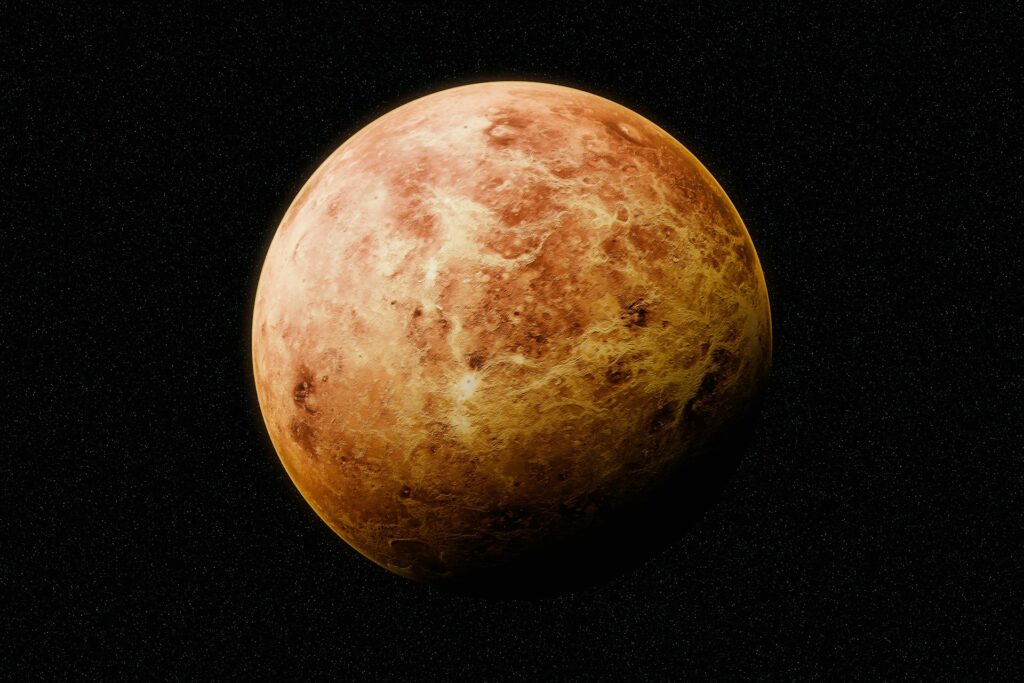
Venus gets called Earth’s twin because of how similar the two planets are in size and structure, but that’s where the resemblance ends. Step foot on Venus, and you’d be crushed, incinerated, and dissolved in acid within seconds. Here’s why our nearest planetary neighbour is one of the most hostile places in the solar system.
Venus is almost identical to Earth in size.
Venus has a diameter of about 12,100 kilometres, making it roughly 95% the size of Earth. The mass is similar too, about 80% of Earth’s mass, which means gravity there would feel nearly the same as what we’re used to. This is why scientists initially thought Venus might actually be habitable, maybe even covered in tropical forests or oceans. Both planets formed from the same cosmic material in roughly the same part of the solar system, so their basic makeup is remarkably alike. That’s about where the twin thing ends, though.
The surface temperature is hot enough to melt lead.
Venus sits at around 465 degrees Celsius constantly, everywhere on the planet, day and night. That makes it the hottest planet in the solar system, even hotter than Mercury, despite being much further from the Sun. Lead melts at 327 degrees, so you’re looking at temperatures that would liquify metal. Any spacecraft landing there has to somehow survive that inferno. The heat never lets up, and it’s uniform across the entire surface because the thick atmosphere distributes it evenly. There’s literally nowhere on Venus that offers any relief.
@modernday_eratosthenes Replying to @user8083441165747 Habitable doesn’t mean inhabited, just that the right conditions existed for life as we know it to exist #stem ♬ Sci-fi / space / science / documentary(1106126) – Lyrebirds music
The atmospheric pressure would crush you instantly.
Standing on Venus’s surface means dealing with atmospheric pressure 92 times greater than Earth’s. To put that in perspective, it’s like being 900 metres underwater. This pressure would crumple spacecraft like tin cans and would crush a human instantly. The atmosphere is so dense it practically behaves like a fluid, and moving through it would feel more like swimming than walking. Soviet probes that managed to land there in the 1970s and 80s only lasted a couple of hours at most before the combination of heat and pressure destroyed them. The atmosphere is suffocatingly heavy in the most literal way possible.
Clouds of sulphuric acid completely blanket the planet.
Venus’s thick cloud layer is made of concentrated sulphuric acid droplets, which sounds exactly as pleasant as it is. These clouds reflect sunlight brilliantly, making Venus the brightest thing in our night sky after the Moon. They extend from about 50 to 70 kilometres above the surface and whip around the planet ridiculously fast, circling the entire thing in just four Earth days. Acid rain does form, but it never actually reaches the ground because it evaporates in the brutal heat of the lower atmosphere. The clouds are so dense and reflective that we can’t see the surface at all with normal telescopes. We can only peek underneath using radar. The entire planet is wrapped in a corrosive, opaque blanket.
The greenhouse effect has gone completely out of control.
Venus’s atmosphere is 96% carbon dioxide, creating a runaway greenhouse effect that traps heat with devastating efficiency. Sunlight gets through the atmosphere and warms the surface, but the heat can’t escape back into space because that thick CO2 layer acts like an insulating blanket. This process just keeps building on itself, making things hotter and hotter over time. Venus is basically a cautionary tale about what happens when greenhouse gases completely dominate an atmosphere. Scientists study it to understand climate feedback loops and what could theoretically happen to Earth if things went catastrophically wrong with our own climate.
@modernday_eratosthenes My vote is for Dante’s Inferno #stem ♬ Suspense, horror, piano and music box – takaya
A day on Venus lasts longer than a year.
Venus rotates on its axis incredibly slowly, taking 243 Earth days to complete one spin. But it only takes 225 Earth days to orbit the Sun, which means a day on Venus is actually longer than its year. Let that sink in for a second. Even weirder, Venus rotates backwards compared to most planets in the solar system, so the Sun rises in the west and sets in the east. This retrograde rotation probably happened because of a massive collision early in the planet’s history that knocked it spinning the wrong way. The slow rotation also means there’s no real day-night temperature difference, since the heat has plenty of time to distribute evenly.
It likely had oceans billions of years ago.
Scientists reckon Venus once had liquid water on its surface, possibly for up to two billion years after the planet formed. Something went catastrophically wrong, probably a runaway greenhouse effect kicked off by volcanic activity pumping out massive amounts of CO2. The water eventually boiled away, and the hydrogen escaped into space, leaving behind the hellscape we see today. This transformation from potentially habitable world to toxic oven happened relatively early in Venus’s history. The fact that Venus and Earth started out so similarly but ended up so different is both fascinating and slightly terrifying when you think about it.
Soviet probes are the only spacecraft to successfully land there.
The Soviet Venera programme managed to land several probes on Venus between 1970 and 1982, and they captured the only photographs we have from the surface. These missions were absolute engineering marvels because the spacecraft had to be built like deep-sea submarines to handle the pressure and heat. The longest any probe survived was about 127 minutes before the environment destroyed it. The images they sent back show a rocky, barren landscape shrouded in orange haze from the thick atmosphere. Those few precious photographs represent humanity’s only direct glimpse of what standing on Venus actually looks like, and they show a world that’s as alien as it gets.